
Il Poggione: Tasting four decades of Brunello
Aldo Fiordelli tastes vintages back to 1988 from this popular estate, including the famed Vigna Paganelli Riserva...


Il Poggione’s Brunellos have proven to be elegant, accessible and excellent value. The estate was one of the first wineries to take Brunello di Montalcino wines to market, as early as the first decades of the 20th century, and it’s one of the founding members of the Brunello di Montalcino consortium.
Il Poggione is the third-largest Montalcino winery after Banfi and Castelgiocondo, with 143ha of vineyards – of which 63ha are dedicated to Brunello production. The vineyards lie around the winery in Sant’Angelo in Colle, on the southwest slopes of the appellation, where the Brunello di Montalcino produced here differs from that of the village itself.
‘We usually have 1g of acidity less than in the highest part of the appellation,’ says Bindocci, which creates a more approachable style of Brunello with ripe, often silky tannins, concentrated raspberry fruit and exciting depth and finesse without the austerity of the northern and higher part of the appellation.

I Paganelli
Il Poggione’s most prestigious and oldest vineyard is the idyllic alluvial plateau of I Paganelli. Planted in 1964, it retains its original vines to this day and provides clones for new vineyard plantings on the estate.
In the past it has also provided clones for some of Brunello’s most appreciated winegrowers, including Baricci, Pacenti and Zannoni, while vines have even been transplanted to Atlas Peak in Napa Valley. It was in this vineyard that the recently retired Piero Palmucci, the talented producer of Poggio di Sotto, took his first steps in the wine world.
The old vines here produce loose bunches of small, thick-skinned grapes, which are destined for the single-vineyard Vigna Paganelli Riserva in the best years.
The estate’s other vineyards have never been wholly replanted either, apart from Capannucce, which was replanted in 1976 due to insufficient drainage. Throughout the estate, 100 different clones of Sangiovese assure the complexity of Il Poggione’s Brunellos, while the use of vigorous rootstocks such as Kober 5BB ‘allow us to embroider the vineyards’, notes managing director Fabrizio Bindocci.
In the winery
While work in the vineyards remains quite traditional, the winery aims to maintain as much purity as possible in the fruit.
Fermentation takes place in stainless steel tanks at a controlled temperature of 25-28°C with a submerged cap. This technique, widely used for Nebbiolo and Sangiovese in order to preserve their delicate colour, is employed here without oak staves ‘to avoid any possible volatile acidity granted by the oak,’ according to Bindocci.
Malolactic fermentation takes place immediately afterwards, with 5% of press wines blended in and higher temperatures maintained in the tanks. Maturation takes place in big 33-52hl oak vessels of which, for this latest vintage, 18 out of 100 were new. The standard Brunello spends 36 months in oak, while the Riserva matures in wood for 48 months, then both are aged in bottle for an additional period of time before release.
Tasting four decades of Il Poggione Brunello:
You may also like:
A taste of Bolgheri: Ornellaia 1990-2016
Chianti Classico 2010 Riserva & Gran Selezione: Panel tasting results
Best Piedmont wines: Latest-release Barolo & Barbaresco
Il Poggione, Brunello di Montalcino, Tuscany, Italy, 2014
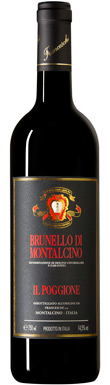

2014 was one of the rainiest vintages of the past few decades in Montalcino, and the southwest portion of the appellation was no exception despite...
2014
Il PoggioneBrunello di Montalcino

Il Poggione, Brunello di Montalcino, Tuscany, Italy, 2013
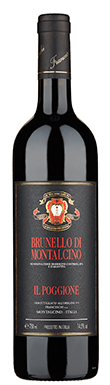
The harvest date returned once more to that of tradition, commencing on 23 September – whereas these days it usually begins around 3 September. This...
2013
Il PoggioneBrunello di Montalcino
Il Poggione, Vigna Paganelli Riserva, Brunello di Montalcino, Tuscany, Italy, 2012
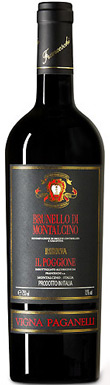
The 2012 vintage was extremely dry in Montalcino, mostly on the southern side. Despite several clean, sound examples of the vintage, the finished product is...
2012
Il PoggioneBrunello di Montalcino
Il Poggione, Vigna Paganelli Riserva, Brunello di Montalcino, Tuscany, Italy, 2010
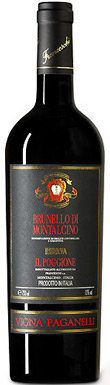
Harvested on 22 September, approximately 10 days before Montalcino proper but within the traditional average dates for Il Poggione, this very elegant 2010 is a...
2010
Il PoggioneBrunello di Montalcino
Il Poggione, Vigna Paganelli Riserva, Brunello di Montalcino, Tuscany, Italy, 2006
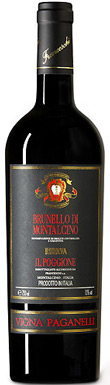
A new winery was built in 2004, and this 2006 is the first vintage in the context of this tasting to have been produced in...
2006
Il PoggioneBrunello di Montalcino
Il Poggione, Vigna Paganelli Riserva, Brunello di Montalcino, Tuscany, Italy, 1997
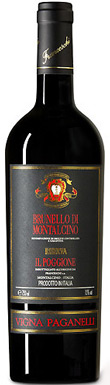
A warm year in Montalcino, the over-celebrated 1997 vintage saw an early harvest at ll Poggione, as suggested by its slightly green finish. Concrete fermentation...
1997
Il PoggioneBrunello di Montalcino
Il Poggione, Brunello di Montalcino, Tuscany, Italy, 1990
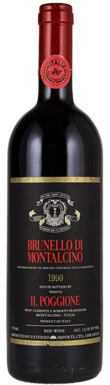
Though admittedly one of the outstanding vintages of Montalcino, this was probably not one of the top bottles of Il Poggione 1990. The year was...
1990
Il PoggioneBrunello di Montalcino
Il Poggione, Brunello di Montalcino, Tuscany, Italy, 1988
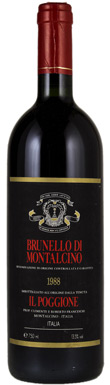
Another celebrated vintage in Montalcino, with the signature of Sant’Angelo still in the glass. Evolved notes of leather, prune, and cigar emerge, then rhubarb and...
1988
Il PoggioneBrunello di Montalcino
