
Marvellous Morgon: A guide to this star Beaujolais cru
The rehabilitation of Beaujolais and Gamay has been one of the great turnaround stories in the world of wine. At the top end, the wines from the 10 central crus offer superb value and drinkability. Charles Curtis MW suggests Morgon as a good place to start.

Beaujolais has long been misunderstood. The root cause was the introduction of Beaujolais Nouveau in the 1950s, which has been both a blessing and a curse for the region as a whole.
In recent years, however, there has been a quality revolution in Beaujolais, and serious wine lovers owe it to themselves to taste some of the top examples.
The crus are standout single villages and are endowed with a great terroir and a long tradition of quality. Whether you are a long-time fan or a recent convert, you will find top quality and superb value in this village, with styles ranging from approachable and easy-drinking to concentrated and surprisingly age-worthy.
Scroll down for tasting notes and scores for 20 top Morgon wines to try

The taste and style of Morgon wines
With a few exceptions, Beaujolais means Gamay, a grape that accounts for 97% of the plantings in the region. This unjustly maligned variety gained notoriety in the 14th century when Philip the Bold, Duke of Burgundy, tried (unsuccessfully) to ban its cultivation in his lands, calling it, in his decree of 1395, a ‘very bad and very disloyal vine [that] produces a great abundance of bitter wine’. If only he knew!
While it is true that in some circumstances the vine can over-produce, when yields are limited and the grape is grown on its preferred soil (granite or schist), the results can be delicious.
Overproduction can lead to dilute, insipid wines and the popularity of Beaujolais Nouveau enhanced this tendency. The rush to turn grapes into wine in a couple of weeks also prompted producers to cut corners by using techniques such as heating the must to speed extraction (thermovinification).
The results were fruity, light and innocuous, and although the wine sold well for a time, sales have dropped by half since its heyday in the 1990s, according to French magazine Les Echos.
Fortunately, Nouveau is not the only style either the region or Gamay has to offer. The best wines can be deeply coloured and fragrant, with plummy fruit and complexity from floral notes, a hint of saline minerality and an edge of brambly wild herbs from the use of whole bunches.
Often the alcohol is moderate, acidity is low and the tannins are silky and soft: eminently drinkable wines.
Morgon’s best wines share these virtues yet age well, too. The idea that they must be consumed within the year is a misconception. Several years ago, I enjoyed a bottle from 1934 that had gracefully stood the test of time for more than 80 years.
History
Beaujolais once enjoyed great prestige. Burgundian winemaker (and Beaujolais native) Philippe Pacalet says the Mommessin family bought the Burgundy grand cru Clos de Tart in 1932 because ‘they couldn’t afford land in Moulin-à-Vent’.
The Great Depression and World War II ended that prestige, however, and the post-war years saw the rise of Beaujolais Nouveau.
Among those pushing against this trend was the Beaujolais négociant, chemist and author Jules Chauvet (1907–1989). Chauvet’s scientific research into the action of yeast and the carbonic maceration technique earned him the title ‘the father of natural wine’.
Chauvet soon gathered several winemaker disciples, including Marcel Lapierre, Jean Foillard, Jean-Paul Thévenet and Guy Breton. This quartet of winemakers were based in and around the appellation of Morgon, and their savvy American importer Kermit Lynch took to calling them the ‘Gang of Four’.
Terroir and climats

Morgon is one of the 10 Beaujolais crus, a series of village-level appellations clustered in the north of the Beaujolais region, centred on granite and schist soils, that sit at the top of the quality pyramid.
Morgon was one of the first crus to be recognised with an appellation in 1936, along with Chénas, Chiroubles, Fleurie and Moulin-à-Vent. It was also among the first to acknowledge sub-divisions, called climats, within the appellation.
Unlike Burgundy, where a climat is most often composed of a single lieu-dit (named place), the climats in Morgon group together several lieux-dits with similar characteristics. Morgon is the only Beaujolais cru to use this climat system.
The use of these climats, however, has complicated the growers’ quest for broader recognition. Beaujolais crus such as Fleurie have applied to the INAO for premier cru status for some of their vineyards.
While plans appear to be moving forward slowly, the authorities have told Morgon vignerons that their climats must be simplified before the same can be done for them.

The climats of Morgon
Les Charmes along the western edge of the appellation includes some of the highest elevation sites and sandy granite soils that produce a perfumed, lighter style.
Corcelette, north of Les Charmes, has lighter granite soils but less sand; the wines can be very aromatic and deeply coloured.
Côte du Py is a dome-shaped hill that rises to 350m, with volcanic subsoils covered with schist, which gives the wines a unique flavour, full body and density. The intertwining of blue schist with iron oxide from the volcanic strata underneath provides a friable soil called ‘roche pourrie’ that is perfect for Gamay.
Douby is to the northeast of the village, on granite soils that border Fleurie.
Grand Cras, at the southern edge of the appellation, has another outcropping of schist surrounded by granitic sand and scree.
Les Micouds, east of the village of Villié-Morgon, is on well-drained, east-facing slopes that ripen easily and produce a lighter style of wine.

Winemaking
The Gang of Four all shared a devotion to Chauvet’s natural precepts, such as fermenting without sulphur and the use of his technique of carbonic maceration. In this method, grapes are placed as whole clusters in a sealed tank and covered with carbon dioxide to produce an oxygen-free environment.
They are left to macerate and begin to ‘ferment’ from the inside out. However, this process is not a fermentation as such, since yeast is not yet involved. After several weeks of maceration, the grapes are crushed, and the juice is fermented customarily. The results deliver lush wines with forward fruit and supple structure that delight the hedonist.
Winemaking in Morgon is not limited to carbonic maceration, however. Some winemakers use whole clusters without sealing the tank (semi-carbonic maceration), and the Burgundian influence has led some, such as Fabien Duperray of Domaine Jules Desjourneys, to adopt the Burgundian method of destemming some or all of the harvest.
Several Burgundy producers also produce Beaujolais this way, such as Louis Jadot at Château des Jacques. With such a variety of styles and the presence of such quality-driven producers, there is something for every wine lover in Morgon.
Eight names to know
Domaine Marcel Lapierre
Domaine Marcel Lapierre was founded in 1909 by Michel Lapierre, whose son Camille joined him at the winery in 1925. Camille’s son Marcel was born in 1950, and took over the domaine in 1973. Under the influence of Jules Chauvet he decided to vinify without sulphur, and he farmed using organic principles from the 1980s.
Marcel’s son Mathieu joined the domaine in 2004 and oversaw official organic certification; he was joined by his sister Camille in 2013. The wines are made using classic carbonic maceration of nine to 35 days, according to the cuvée.
Domaine Jules Desjourneys
Fabien Duperray is a breath of fresh air who is among France’s foremost fine wine agents. In 2006, he purchased a Beaujolais estate in the village of La Chapelle de Guinchay. Duperray began organic conversion immediately, and was certified in 2009.
Although the domaine is certified organic and follows biodynamic principles, he does not subscribe whole-heartedly to the Chauvet system or the ‘Gang of Four’ precepts, since he customarily uses a maximum of 30% whole clusters in the fermentation. His blended Morgon and single-climat bottlings from Micouds and Grand Cras are definitely worth seeking out.
Domaine Laurent Gauthier
The Gauthier family has been growing grapes since 1834, and today the domaine is run by Laurent Gauthier and his two sons, Jason and Elie. The family farms 23ha, mainly in Morgon, and obtained organic certification in 2023.
The fermentation is done in a semi-carbonic style, and no sulphur is added until bottling. The most serious wines at this domaine are the single-vineyard Morgons, which ferment for 10-14 days before ageing until the next harvest in large, older oak upright casks.
Domaine Jean-Marc Burgaud
Burgaud created his property in 1989, and farms 17.5ha in total today, including 12.5ha in Morgon and another 5ha of Beaujolais Villages in Lantignié. Most of his vineyards are planted with old vines (50-70 years old). The fermentation is done as whole clusters using a semi-carbonic process.
The single-climat bottlings from Cras, Charmes, Corcelette, and Côte du Py have slightly extended maceration. The maturation is done exclusively in tank, save the Javernières and the cuvée he calls James (after James Bond), both aged in used casks for a year.
Château des Jacques
Château des Jacques was originally the property of the Sornay family, who used it principally as a residence. Their successor, Amédée Rousseau, established the property (located in Moulin-à-Vent) as a wine estate along Burgundian production models. The domaine was purchased in 1996 by Burgundian négociant Louis Jadot.
Jadot added to its acquisition in 2001 by purchasing 27ha of land in Morgon in the climats of Corcelette and Côte du Py. It has continued the winemaking traditions of the estate, destemming the grapes, fermenting slowly, and ageing in cask (25% new) until the next harvest.
Domaine Mee Godard
After training as an oenologist and making wine in several French wine regions, Korean-born vintner Mee Godard visited Beaujolais almost by chance and fell in love with the region. In 2013, she acquired a few hectares in and around Morgon, which she has since grown to 7.8ha.
Godard uses organic techniques, and the domaine is in conversion. She picks fairly early and sorts rigorously to achieve very modest yields for the appellation. Godard vinifies the grapes almost completely as whole clusters, punching down and pumping over in concrete tanks for 3-12 days to deliver her solid, complex wines.
Domaine Jean Foillard
Jean Foillard began to work his family’s vineyards in 1981 and soon adopted the methods of Jules Chauvet. The grapes are macerated at low temperatures over several weeks before crushing and finishing the alcoholic fermentation.
The pride of the domaine is 8.6ha in Côte du Py, where the oldest vines are over a century old. The wine from there is bottled as Cuvée 𛑠(Pi), also known as Cuvée 3.14. This very rare bottling can top £400 per magnum and is one of the few Beaujolais wines that trade regularly at auction.
Domaine Guy Breton
At just under 7ha, Domaine Guy Breton is modest in size but not reputation. Breton took over from his grandfather in 1986. He is based in Morgon, where the wine from a hectare of the oldest vines is bottled as P’tit Max, including some more than a century old.
The range is completed by the Morgon Vieilles Vignes (made with ‘only’ 80-year-old vines) and several cuvées produced from grapes outside the village. The grapes are fermented as whole clusters with a fairly short maceration in order to produce a lighter, fresher, easier-to-drink style.
20 top Morgon wines to try:
Related articles
- Regional profile: Moulin-à-Vent celebrates its centenary
- Discovering white Beaujolais: 10 wines to try
- Beaujolais: Fleurie premier cru plan backed by winemakers
Jean-Marc Burgaud, Côte du Py, Beaujolais, Morgon, Burgundy, France, 2022
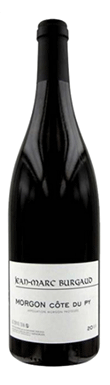

<p>This delightful wine has a ripe blueberry and blackberry fruit character with pronounced floral notes on the initial attack. It has an impressively dense and...
2022
Jean-Marc BurgaudBeaujolais

Domaine Laurent Gauthier, Charmes, Beaujolais, Morgon, Burgundy, France, 2020
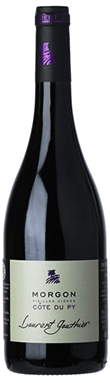
This Javernières is among the most concentrated wines I tasted on this visit, with a spectacular depth of black fig, plum and blackberry fruit coloured...
2020
Domaine Laurent GauthierBeaujolais
Jean-Marc Burgaud, Côte du Py, Beaujolais, Morgon, Burgundy, France, 2009
The final wine in a compelling vertical of Côte du Py from Burgaud showed ripe, lush plum and fig fruit with notes of chocolate and...
2009
Jean-Marc BurgaudBeaujolais
Domaine Marcel Lapierre, Cuvee Marcel Lapierre MMXXII, Beaujolais, Morgon, Burgundy, France, 2022
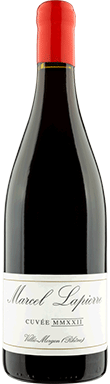
The aromas here are dense with plum, fig, ripe mulberry and hints of earth, menthol, spice and smoke. Impressive density and weight on the palate...
2022
Domaine Marcel LapierreBeaujolais
Domaine Mee Godard, Passerelle 577 Côte du Py, Beaujolais, Morgon, Burgundy, France, 2022
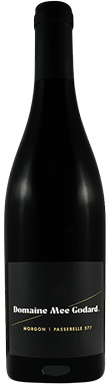
This is the top wine at Domaine Mee Godard, produced from what she calls her best parcel in the lieu-dit Côte de Py. The 2022...
2022
Domaine Mee GodardBeaujolais
Château des Jacques, Côte du Py, Beaujolais, Morgon, Burgundy, France, 2003
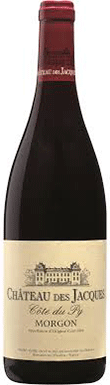
At more than 20 years of age, the Côte du Py from the Château des Jacques is holding its own. There is a rich, black...
2003
Château des JacquesBeaujolais
Domaine Jules Desjourneys, Côte du Py, Beaujolais, Morgon, Burgundy, France, 2020
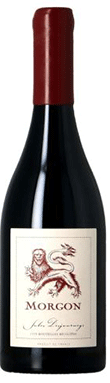
The Morgon village is a wine on the edge of youthfulness, with a ripe, expressive plum fruit character touched now with hints of exotic Asian...
2020
Domaine Jules DesjourneysBeaujolais
Domaine Jules Desjourneys, Grand Cras, Beaujolais, Morgon, Burgundy, France, 2023
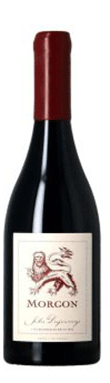
An extraordinary terroir,' according to Fabien Duperray, the grapes come from the plateau of Morgon at the base of the Côte de Py, where the...
2023
Domaine Jules DesjourneysBeaujolais
Domaine Marcel Lapierre, Camille Roche du Py, Beaujolais, Morgon, Burgundy, France, 2023
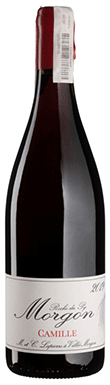
Ripe aromas of plum and blackberry scented with a saline mineral note and hints of black tea and spice lead into a pleasantly hefty texture...
2023
Domaine Marcel LapierreBeaujolais
Jean Foillard, Côte du Py, Beaujolais, Morgon, Burgundy, France, 2021
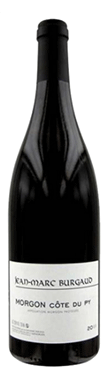
Several recent bottles of Foillard's 2021 Côte du Py convincingly show this among the top wines in the appellation, even in a challenging vintage. There...
2021
Jean FoillardBeaujolais
Louis Claude Desvignes, La Voûte Saint Vincent, Beaujolais, Morgon, Burgundy, France, 2022
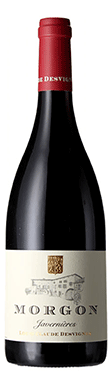
The Voute Saint-Vincent bottling from Domaine Louis-Claude Desvignes was a revelation. When I pulled the cork, the wine seemed to lack fruit aroma and the...
2022
Louis Claude DesvignesBeaujolais
Domaine Laurent Gauthier, Javernières, Beaujolais, Morgon, Burgundy, France, 2022
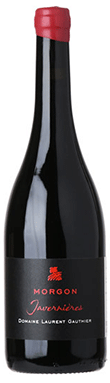
Dense and tannic, the Côte du Py from Laurent Gauthier offers a lush, dark, plummy fruit with accents of star anise and tarragon, underpinned by...
2022
Domaine Laurent GauthierBeaujolais
Domaine Mee Godard, Corcelette, Beaujolais, Morgon, Burgundy, France, 2022
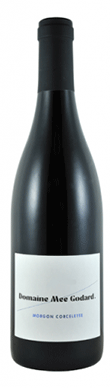
This enchanting wine boasts a lovely perfumed nose with hints of plummy fruit and floral notes on the initial attack, while the palate features an...
2022
Domaine Mee GodardBeaujolais
Domaine Mee Godard, Grand Cras, Beaujolais, Morgon, Burgundy, France, 2022
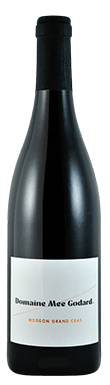
This approachable wine features a delicate raspberry fruit, a mineral undertone and a hint of violets. The texture is silky and light in body, with...
2022
Domaine Mee GodardBeaujolais
Guy Breton, P'Tit Max, Beaujolais, Morgon, Burgundy, France, 2021
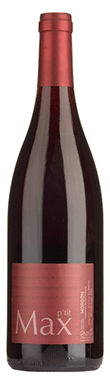
P'Tit Max is anything but small in stature. The colour, however, is very light, and the fruit aromas are high-toned pomegranate and Bing cherry with...
2021
Guy BretonBeaujolais
Jean-Marc Burgaud, James, Beaujolais, Morgon, Burgundy, France, 2022
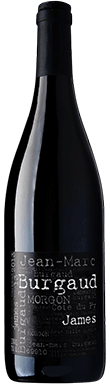
<p>Named for James Bond, this is the top cuvée from Burgaud. The aromas are spicy with hints of liquorice and anise (but not barrel spice),...
2022
Jean-Marc BurgaudBeaujolais
Château des Jacques, Beaujolais, Morgon, Burgundy, France, 2022
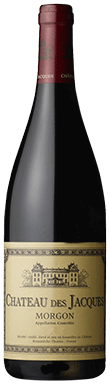
The blended 'village' Morgon from Château des Jacques is delicious, with a fairly deep colour, dark plummy fruit, and hints of black tea, anise and...
2022
Château des JacquesBeaujolais
Domaine Jules Desjourneys, Micout, Beaujolais, Morgon, Burgundy, France, 2022
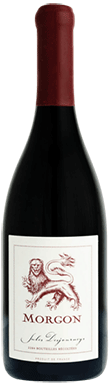
This powerful yet elegant wine with a deep violet-coloured hue flaunts a spicy nose with hints of flowers, ripe blackberry and fig. The texture is...
2022
Domaine Jules DesjourneysBeaujolais
Jean-Paul & Charly Thévenet, Beaujolais, Morgon, Burgundy, France, 2022
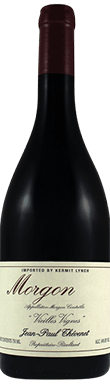
This is the classic cuvée from Jean-Paul and Charly Thévenet (as opposed to the Vieilles Vignes bottling). Nonetheless, the wine is deeply coloured with bright,...
2022
Jean-Paul & Charly ThévenetBeaujolais
Domaine Marcel Lapierre, Raisins Gaulois, Vin de France, Burgundy, France, 2023
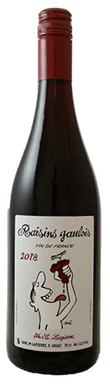
This entry point to the Marcel Lapierre range will please fans of natural wine looking for value. The colour is light, and the wine presents...
2023
Domaine Marcel LapierreVin de France