
Monteraponi’s Trebbiano Toscano: Burgundian-style Tuscan benchmark
Monteraponi's owner, Michele Braganti, has a weak-spot for the often derided Trebbiano Toscano. In 2023, he celebrates 10 years of his benchmark Burgundian-styled expression with the first complete vertical. Asa Johansson reports.


‘I feel more similar to Trebbiano Toscano than to Sangiovese because it is an underdog, like me,’ said Monteraponi owner, Michele Braganti during the first vertical tasting of his Trebbiano Toscano.
‘I am the youngest of three siblings, and when I continued to fail exams at law school, my parents let me take over Monteraponi instead of entering the successful family business. It was a sort of punishment,’ Braganti recalled.
Scroll down to see tasting notes and scores for a 10-vintage vertical of Monteraponi Trebbiano Toscano
Monteraponi is an acclaimed winery but the road to get here was not easy.
In 1974, Braganti’s father purchased Monteraponi, a medieval hamlet dating back to the 10th century in Radda in Chianti – now welcoming many visitors every year, but then a low-key rural spot off the beaten track – surrounded by 200 hectares of land. For many years, the family rented out the vineyards surrounding the picturesque village and let local farmers take care of the wine production.
Since Michele and his wife Alessandra took over, they have – with the insight of consultant oenologist Maurizio Castelli – turned the situation at Monteraponi around. Today, the estate makes award-winning wines including the Il Campitello Chianti Classico Riserva and the Baron’Ugo Toscana IGT – both made with Sangiovese from the estate’s 12 hectares of organic vineyards.
Braganti’s first vintage at the estate was 2003, and over the next few years he began to believe in the project. ‘I wanted to show that I could create something important, and since I adore Burgundy, I saw similar characteristics between Sangiovese and Pinot Noir, and Trebbiano and Aligoté.’ He noted that the latter pair are very often misunderstood and taken for granted in their respective regions.
Trebbiano: Making a comeback?
Few grape varieties have a worse reputation than Trebbiano Toscano. One of the most commonly planted in Italy, it represents 36,000 hectares of vineyard (Source: Agea data, 2015). In France, the grape is known as Ugni Blanc, and due to its neutral character it is used to produce Cognac and Armagnac.
There are around 15 different varieties under the Trebbiano umbrella grown in Italy but most of them, rather confusingly, are not related to one another.
Trebbiano Toscano was for a long time allowed in the blend for Chianti and Chianti Classico, but in 2005 white grapes were completely banned from the recipe of the latter (10% of white varieties is still allowed in Chianti).
‘In 2005, we got the advice from the Chianti Classico consortium to rip out the Trebbiano vines – but I never listen to stupid advice,’ Braganti said, well-known for not being afraid to speak his own mind.
Following the ban, some of the bigger wineries in the region started to make a wine called Galestro, an easy-drinking white wine comprising Trebbiano and a little Chardonnay. In this way, they absorbed the abundance of Trebbiano Toscano, providing a lifeline to small growers while they converted their vineyards to other varieties. However, this practice did nothing to help Trebbiano Toscano’s reputation.
Braganti, as always, went his own way. He started to invest and experiment with his Trebbiano Toscano from 40-year-old vines growing at an altitude of 420 to 570 metres. ‘It has a skin rich in polyphenols and it maintains high acidity but needs careful winemaking and the right timing for harvest,’ he said.
A rich, complex and full-bodied white wine, it’s made in a Burgundian style and is completely different from what you expect from the so-often neutral Trebbiano Toscano grape.
The grape variety is today gaining new interest among a number of producers in Tuscany, especially in Chianti Classico. It’s a region that currently lacks a significant white wine, and maybe Trebbiano Toscano could be the answer. Surely, Monteraponi´s Burgundian style of Trebbiano is a benchmark for the comeback of this so long underestimated grape variety.
Monteraponi’s Trebbiano
‘In 2010, I made my first Trebbiano Toscano and started to vinify it like a regular white. I destemmed everything. Fermentation took place in steel vats and so on, but the result was so bad I threw everything away,’ Braganti explained.
The following year, he decided to pick the Trebbiano Toscano later than the red varieties. He also started experimenting with whole-bunch fermentation and changed from steel to concrete tanks.
‘In 2012, we used indigenous yeast for the first time and we have never gone back – but it is from the 2014 vintage that I understood the formula that I have tried to fine-tune since then.’
Today, Braganti uses 30% whole-bunch fruit during fermentation, with no temperature control. ‘After 48 hours of skin contact we put the juice into used barriques, where it completes the alcoholic fermentation.’ He often blocks the malolactic fermentation to keep freshness in the wine and, at the end of October, 50% of the wine is transferred for six months into new barriques from Burgundy and Austria, while the rest stay in the used wood.
Twice-weekly bâtonnage helps to give the wine body, structure and aromas, and following a light clarification, the wine returns to concrete tanks for natural decantation. It is bottled without filtration during a waning moon, using gravity.
See tasting notes and scores for a 10-vintage vertical of Monteraponi Trebbiano Toscano
Related articles
- Italy’s finest white wines: 20 top bottles, region by region
- New Chianti Classico releases 2023: Top recommendations & best-value picks
- Ornellaia Bianco: A link to the past
Monteraponi, Trebbiano, Colli della Toscana Centrale, Tuscany, Italy, 2012
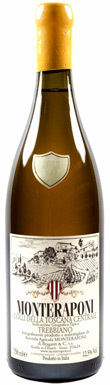

2012 is Monteraponi´s first bottled vintage of Trebbiano Toscano. It was a warm vintage with a hot and dry summer and some welcome rain in...
2012
MonteraponiColli della Toscana Centrale

Monteraponi, Trebbiano, Colli della Toscana Centrale, Tuscany, Italy, 2013
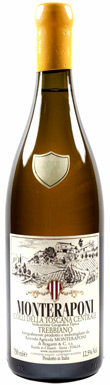
The cool 2013 vintage was the first (and last) time Michele Braganti used 100% new barriques for ageing. This wine shows a developed character, beginning...
2013
MonteraponiColli della Toscana Centrale
Monteraponi, Trebbiano, Colli della Toscana Centrale, Tuscany, Italy, 2014
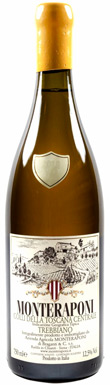
2014 was a cool and rainy vintage that will be remembered as one of the most difficult in Tuscany in the last century. Monteraponi’s Trebbiano,...
2014
MonteraponiColli della Toscana Centrale
Monteraponi, Trebbiano, Colli della Toscana Centrale, Tuscany, Italy, 2015
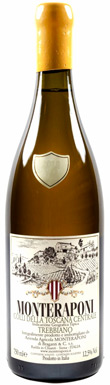
A warm vintage that is considered one of the best for the reds in Tuscany, in 2015 Monteraponi stopped using toasted barriques and went for...
2015
MonteraponiColli della Toscana Centrale
Monteraponi, Trebbiano, Colli della Toscana Centrale, Tuscany, Italy, 2016
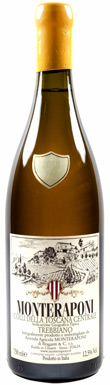
2016 was an excellent vintage in Tuscany, slightly cooler than 2015, giving wines with balance and tension. The summer saw low rainfalls and high temperatures...
2016
MonteraponiColli della Toscana Centrale
Monteraponi, Trebbiano, Colli della Toscana Centrale, Tuscany, Italy, 2017
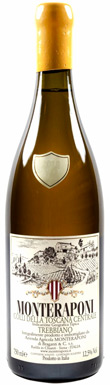
2017 will be remembered as one of the hottest vintages in Tuscany, with a dry summer and autumn, but Monteraponi´s Trebbiano surprises with its energy...
2017
MonteraponiColli della Toscana Centrale
Monteraponi, Trebbiano, Colli della Toscana Centrale, Tuscany, Italy, 2018
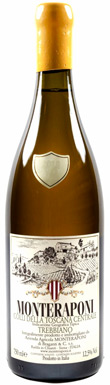
A challenging year with rain in spring and in August which created humid conditions and demanded intense vineyard management. Luckily, Monteraponi´s Trebbiano grows at high...
2018
MonteraponiColli della Toscana Centrale
Monteraponi, Trebbiano, Colli della Toscana Centrale, Tuscany, Italy, 2019
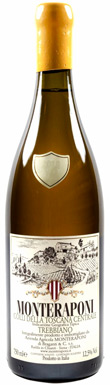
2019 was an excellent vintage, even though there were some worries in May given the endless rain and below-average temperatures. Luckily this was followed by...
2019
MonteraponiColli della Toscana Centrale
Monteraponi, Trebbiano, Colli della Toscana Centrale, Tuscany, Italy, 2020
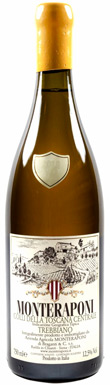
The pandemic year of 2020 at least gave wine producers in Chianti Classico an excellent vintage. The rain came in June and September, which topped...
2020
MonteraponiColli della Toscana Centrale
Monteraponi, Trebbiano, Colli della Toscana Centrale, Tuscany, Italy, 2021
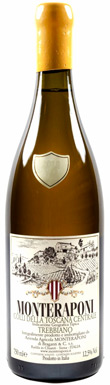
2021 was a hot vintage, but the season began with late-spring frosts striking vineyards at lower altitudes. Monteraponi´s latest vintage of Trebbiano shows great character,...
2021
MonteraponiColli della Toscana Centrale
