
A taste of Bolgheri: Ornellaia wine 1990-2016
Aldo Fiordelli visited the famed estate in Bolgheri for a taste back to its early days...


A single long road called the Viale dei Cipressi, named after the cypress trees which flank it on either side, signals your arrival in Bolgheri. The region’s vineyards grow just three miles from the Tyrrhenian Sea and are sheltered by a large forrested hillside area called the ‘Magona’. The refreshing influence of sea breezes, allied with night and day temperature variations provided by the forest, allow Bordeaux varieties to ripen over a long growing season here, achieving depth and complexity.
Everything at Tenuta dell’Ornellaia seems to be done with the aim of creating wines for the long-haul. A history of passion and intuition at this estate has turned out two of the most important Italian labels: Ornellaia and Masseto.The latter has today become a single estate of 7ha, with a new winery set to be inaugurated this coming April, while the former – along with Sassicaia – maintains a sturdy reputation as a super-premium Bordeaux blend produced from over 115ha in Bolgheri, Tuscany.
A brief history
When, in 1981, Lodovico Antinori founded the Ornellaia winery, the Bolgheri appellation didn’t exist – the DOC would not be approved until three years later. After a brief joint-venture with Mondavi, the estate is today under the control of Frescobaldi, one of the world’s oldest Italian winemaking families.
The first vineyards were planted in 1982 above the Bolgherese road, followed by the planting of vineyards on the recently acquired Bellaria property in the early ‘90s, on the northern side of the Viale dei Cipressi.
Ornellaia: Producer profile
Making Ornellaia
Ornellaia is a Margaux-style blend, even more so since 1999 with the addition of Petit Verdot. It traditionally has a dominant proportion of Cabernet Sauvignon (50-55%), with 25-30% of Merlot, 10-15% of Cabernet Franc and the rest Petit Verdot. In cool vintages, such as 2010, the Merlot component has been known to reach up to 40%, ‘the meat over the bones’ of the blend, as director Axel Heinz describes it.
The vineyard selections that make up the wine today include grapes from up to 100 different plots. The average vine density on the estate is around 6,500 vines per hectare. This average is exceeded in the Ginestraio plot, which produces Merlot rich in black fruit flavours and is harvested in the middle of September in warm vintages such as 2015. Vine density is lower in some plots, such as the Cabernet Sauvignon in Bellaria Alta, ‘the backbone of Ornellaia,’ according to Heinz.
In the cellar, each of the 100 or so plots are vinified separately with selected yeasts, a practice that dates back to 2005-2006. Fermentation takes place in stainless steel tanks, although the use of the concrete is increasing. In fact, the new Masseto winery will be equipped only with concrete tanks.
All of the grapes are fermented below 25°C. Pumping over and délestage are carried out, avoiding punch downs in order to achieve as delicate a physical extraction as possible. Temperatures are raised up to 28°C during two weeks of maceration in order to polymerise the tannins, yet only 3-5% of press wines are used.
Malolactic fermentation is carried out on half of the wine in oak, and then the wine is matured for up to 20 months in French barriques, of which two-thirds are new.
Long-lived
The wine’s only limitation could be expressed as having too heavy an impression of tannin and oak when young. But Heinz counters, ‘We don’t regard this wine when it is young. We are constantly thinking about its potential to age, we want precise wines with a long shelf-life.’ He admits that some wines, particularly from the early 2000s, are on the verge of over-extraction, stating that, ‘From 2010, we became aware of excessive power in previous wines and worked hard to return to a greater balance.’ It perhaps explains why these were not represented at this tasting.
Without a doubt, Ornellaia is one of the greatest Italian wines, with an impressive ability to age. The latest 2016 vintage has an outstanding classic style that honours its past, while the 1998 vintage is definitely the best vintage of Ornellaia you can buy, exemplifying the potential of Bolgheri’s terroir.
Tasting Ornellaia:
You may also like:
Top restaurants in Bolgheri to visit
Top Bolgheri wineries to visit
Sassicaia wines tasted: 1968 – 2015
Brunello’s new generation: six top producers and their wines
Ornellaia, Bolgheri, Superiore, Tuscany, Italy, 2015
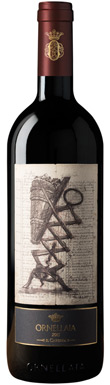

2015 is a celebrated vintage due to its powerful character. Considerable warmth produced extremely thick-skinned grapes, and the harvest for Ornellaia started in the middle...
2015
OrnellaiaBolgheri

Ornellaia, Bolgheri, Superiore, Tuscany, Italy, 2014
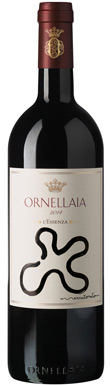
This was one of the most challenging vintages ever in Tuscany, with no exception in Bolgheri. The wine doesn’t lack its characteristic cassis fruit but...
2014
OrnellaiaBolgheri
Ornellaia, Bolgheri, Superiore, Tuscany, Italy, 2013
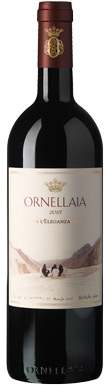
What a difference 10 years makes! There are plenty of bottle age characteristics on both nose and palate (cigar, tobacco and leather), while the oak...
2013
OrnellaiaBolgheri
Ornellaia, Bolgheri, Superiore, Tuscany, Italy, 2012
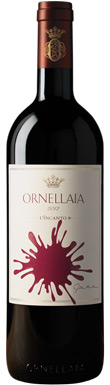
2012 was an extremely dry yet sound vintage where the awareness of making less extracted and more balanced wines was employed. If the style is...
2012
OrnellaiaBolgheri
Ornellaia, Bolgheri, Superiore, Tuscany, Italy, 2011
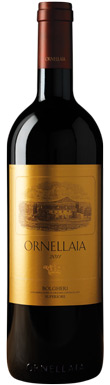
Oak notes of smoke and baking spices dominate the nose. There are black fruit characteristics in the mouth, along with a rich, textured body. The...
2011
OrnellaiaBolgheri
Ornellaia, Bolgheri, Superiore, Tuscany, Italy, 2010
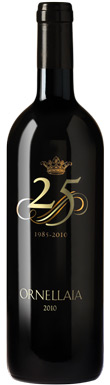
If they had not increased the Merlot to 40% of the blend in this moderate to cool vintage, they wouldn't have found the balance between...
2010
OrnellaiaBolgheri
Ornellaia, Bolgheri, Superiore, Tuscany, Italy, 1998
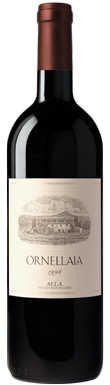
The wine of the flight, this 1998 is a wonderful wine, and it's hard to believe this is 25 years old. It has aromatic notes...
1998
OrnellaiaBolgheri
Ornellaia, Bolgheri, Superiore, Tuscany, Italy, 1996
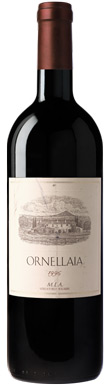
1996 should be considered a classic vintage, as it is in Bordeaux. This wine is not rich and is in fact quite austere, yet...
1996
OrnellaiaBolgheri
Ornellaia, Bolgheri, Superiore, Tuscany, Italy, 1994
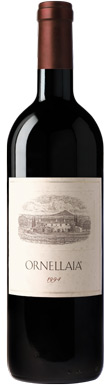
The 1994 was, with 1991 and 1992, one of the most challenging vintages of the ‘90s due to a cool and rainy season. This was...
1994
OrnellaiaBolgheri
Ornellaia, Bolgheri, Superiore, Tuscany, Italy, 1993
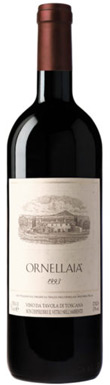
Axel Heinz said this was a really good, very classic vintage but overshadowed by 1995 and 1997. It has an iodine minerality on the nose...
1993
OrnellaiaBolgheri
Ornellaia, Bolgheri, Superiore, Tuscany, Italy, 1990
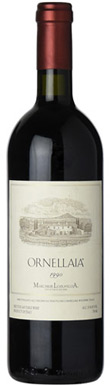
A great vintage all over Europe, this is most likely, after the scarce 1988, Ornellaia’s vintage of consecration after only five years of winemaking. Michel...
1990
OrnellaiaBolgheri
