
Patagonia: South America’s new frontier
With climate change pushing them into cooler territory, intrepid South American winemakers are overcoming extreme conditions to produce fresh and delicate wines at the continent’s southernmost point.

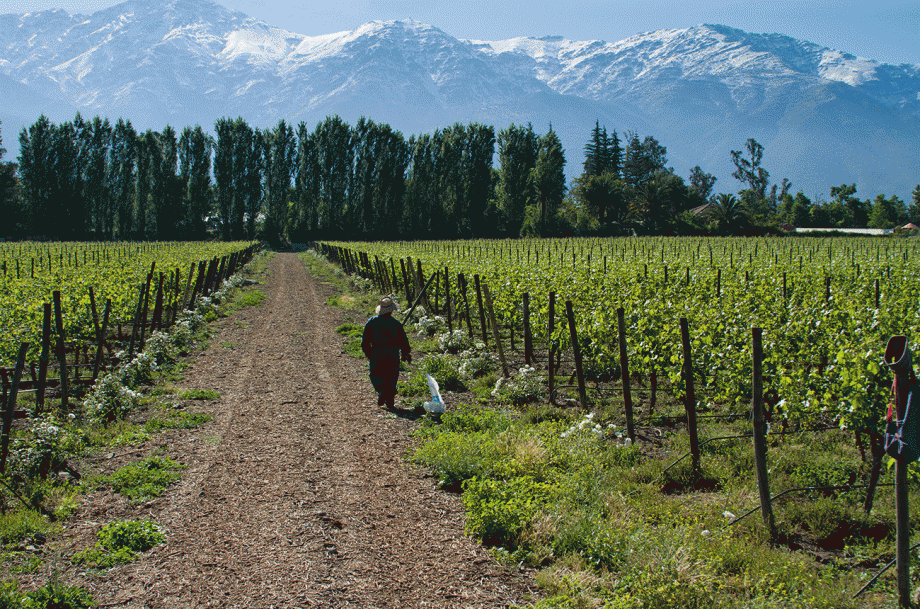
In the past decade, winemakers in Chile and Argentina have moved beyond what was seen as the final frontier for South American viticulture and into the cool climates and wild terrains of Patagonia. Growing confidence and expertise; a quest for lower temperatures and greater water availability in the face of climate change; and a thirst for adventure – all of these factors are leading the current generation of winemakers further south.
The sparsely populated wilderness of Patagonia, at the tail end of the continent, has enraptured voyagers for centuries. When the famed 16th-century explorer Ferdinand Magellan sailed around these southern archipelagoes, he described it as the land of giants – the land of the patagón.Patagonia is indeed nothing short of gigantic: 1 million km2 of land surrounded by three oceans. Awe-inspiring landscapes range from hanging glaciers, mountain peaks and dense forests to snow-capped volcanoes, wind-whipped deserts and crystal-clear lakes.In Argentina, Patagonia begins at the Huincul Fault or the Neuquén Basin, where the Río Negro runs eastwards, providing fertile lands that have been planted with vines for over a century. No one, however, dared plant further south, where temperatures dropped, winds picked up and conditions grew harsher. The feasible viticultural limit was seen as 39°S.
Virgin terrain
What Patagonia did offer, though, was excellent fly-fishing. And it was on one such fishing trip that Mendoza vine-grower Bernardo Weinert pondered how the conditions looked remarkably similar to those of another favourite fishing spot of his: Oregon in the US – where he’d tasted decent local wine.
So in 1991, Weinert took his winemaker’s son, Roberto de la Mota, on the 1,500km drive south from Mendoza, with a truck filled with 800 vines to plant in this virgin terrain. The local agriculture institute laughed the pair out of the office, and instead they went door to door, asking local residents to plant vines in their gardens.
‘My mission was to trial the vines in different sites, and then buy the grapes from the owners to make wine,’ says Weinert. Within three years the vines had their first fruit and it was enough to convince him to buy land and plant 27ha in El Hoyo, at 42°S.
He planted cool-climate varieties he’d known in Oregon – Pinot Noir, Chardonnay, Riesling, Gewürztraminer – and also Merlot, ‘because I love nothing more than Merlot!’
That first vintage of Merlot is remarkably good today, resplendent with evolved berry and truffle aromas but retaining acidity and tension more than a decade later. The greatest fruit of that first adventure, though, is the intellectual seed sown, and the dissemination of vines to families in Chubut who continue making wine with these varieties today.
Scroll down for Barnes’ top Patagonia picks
Unique profile
Small, passion-driven wine projects are leading the expansion of Chubut’s 100ha wine region. Most estates are tucked into the Andean foothills, where valleys offer some respite from the wind.
‘Frost is a really big challenge, but we are somewhat protected from the wind here,’ says Sofia Elena, winemaker at Contra Corriente, another vineyard that was started by keen anglers who also have a fishing lodge. ‘This extreme limit of cool-climate viticulture is what gives the wines here a unique profile – I’d never tried anything like it in Argentina before, which is why I came here to make wine,’ she adds.
This intellectual stimulation and distinctive wine profile is attracting many Argentinian winemakers to the region and its fresh and filigree wines, which are a world away from plush Mendozan Malbec. But Patagonia’s potential is only beginning to be explored, as several producers move beyond the mountain corridor and towards the coast.
Risk-taking winemaker Matías Michelini has planted in Chubut’s seaweed-farming district in Bahía Bustamante, at a latitude of 45.1°S, just metres from the sea. It is the latest in a growing number of coastal plantations in Argentina, which include the sizeable projects of Tapiz (45ha in Viedma, 40.8°S) and Trapiche (30ha in Chapadmalal, 38.1°S).
The biggest investment down here, however, is in the Patagonian Steppes, where Argentinian billionaire and wine magnate Alejandro Bulgheroni has planted the world’s southernmost commercial vineyard, at 45.33°S. On purchasing a cherry farm in Sarmiento, near Lago Musters, Bulgheroni asked his dream team of consultants (soil expert Pedro Parra and flying winemaker Alberto Antonini) about the feasibility of making wine there. In 2011 they concurred and planted a 50ha vineyard, which is now coming to fruition with the first commercial release of Otronia 2017.
Site selection is enormously important in such an extreme environment. Although winemakers are rejoicing at the better water supplies in the south, humidity is a new challenge for those used to arid wine regions. But it is frost and the southern winds (up to 100km per hour!) that are fatal perils of Patagonian viticulture. But this is a feat that producers are increasingly willing to face, and not only in Argentina.
The Austral region
Vines traversed their way through most of Chile during four centuries of immigration, but commercial wine production stopped at Bío Bío. Not only was the cooler, wetter climate seen as inhospitable for vines, but southern Chile (known locally as the Austral region, rather than Patagonia) was also a stronghold of the native Mapuche population, who weren’t amenable to outsiders or their business endeavours. Despite Chile’s extensive viticultural spread elsewhere, anywhere below the Bío Bío River was effectively off the grid.
In the early 1990s, at the same time as other winemakers began exploring the coastline of Casablanca for cooler climates, one producer looked south. ‘Everyone said I was out of my mind, but I’d tasted New Zealand’s wines and believed it would be possible in southern Chile too,’ explains Aquitania winemaker Felipe de Solminihac, who planted 5ha of Chardonnay in Malleco in 1993.
Although Malleco is at a similar latitude to Río Negro in Argentina, it receives more than 1,000mm of rain annually compared to Río Negro’s 200mm. It was the first vineyard in Chile to be planted within Zone I of the Winkler Index, comparable to Champagne. ‘I knew it had great potential for sparkling wine,’ says de Solminihac, ‘but the slow maturation was great for developing complex aromas and retaining acidity in still wines too.’
The wines quickly started to speak for themselves, and by 2002 a denomination of origin was created for the unique wines of Malleco – at the time Chile’s smallest DO, of just 5ha. Today, there are more than 120ha and 24 producers seeking Malleco’s unique profile of wines.
‘There are few wines in the world from young volcanic soils such as this, and we were excited to try it,’ explains Clos des Fous winemaker François Massoc. ‘The scarcity of water and the warmer temperatures are an undeniable fact of climate change, and here in the south we still get this opportunity for cooler-climate expressions of varieties such as Riesling, Chardonnay and Pinot Noir.’
It’s these three varieties (as still wines and traditional-method sparklings) that are defining Austral Chile. And this cooler-climate profile has attracted many other terroir hunters to Malleco, taking vineyards to even more extreme locations, such as the De Martino brothers’ vineyard on the slopes of the Villarrica volcano, at 700m altitude.
Osorno and beyond
Although the action is concentrated in Malleco, the new frontier of Chilean wine is much further south – 350km away in Osorno.
Since 2006, a handful of small producers, including Cruchon and Ribera Pellín, have put the Bueno Valley in central Osorno on the map with, respectively, their fresh Pinot Noirs and characterful sparkling wines.
Another emerging star in Osorno is Trapi, with 8ha in the coastal hills. ‘We started looking for a vineyard site in 2005,’ says agronomist Luis Moller. ‘It took years to find the right northern exposure to get all the extra sunlight, and even then we lost the first three years of production to frost!’
Daytime temperatures reach 30°C but evenings can drop to -5°C, even in summer. But with ample water supply: Trapi now uses sprinkler systems to protect its vines from frost. It’s also expanding its vineyard to meet demand from another producer making Osorno wines – Miguel Torres.
‘We’re very concerned about climate change,’ explains Torres winemaker Eduardo Jordan. ‘Chile’s Central Valleys have seen a significant impact since 2007, with half as much rain and maximum temperatures reaching 2°C higher. This is why we are investing in the south.’ Torres has purchased a further 5,700ha even further south, in which it has already planted experimental vineyards – a likely precursor of the general migration of big companies in this direction.
The most prolific producer in Osorno for now, though, is Casa Silva – one of the original Osorno pioneers, which planted in Lago Ranco in 2007. Now with 14ha, the vineyard’s lakeside position (on sunny slopes just 600m from the 410km2 Ranco Lake) puts it in a narrow frost-free zone.
‘The biggest challenge for us has been logistics rather than climate,’ says agronomist René Vásquez. ‘Training a viticultural team in a cattle-breeding region isn’t easy!’ Despite the associated high costs, it’s a rewarding challenge, says commercial director Arnaud Frennet: ‘Osorno is a challenge, from viticulture and winemaking to the commercial standpoint, but these wines fill us with adrenaline.’
Exhilarating
Adrenaline-seeking is perhaps what led avid sailor Aurelio Montes to plant a vineyard on the island of Chiloé (at 42.6°S) last year, and Undurraga to plant on the side of General Carrera Lake in 2008, at 45.33°S. But Patagonia is still a land for the brave, as Undurraga winemaker Rafael Urrejola can attest after the winery had to abandon its project in 2016. ‘Even though the climatic data made sense, the vines couldn’t survive the extreme climate and winds,’ he explains.
Urrejola did, however, manage to get one vintage from his Patagonian vines – in 2012. That taste of the forbidden fruit, which he describes as ‘unlike any Pinot I ever imagined in Chile’, has made him adamant that he will return. ‘Despite all the challenges, I’ll make wine there again in the future,’ he asserts. ‘The feeling of making wine in the remoteness of Patagonia is exhilarating.’
These Patagonian wine adventures are also exhilarating for consumers. In a very short space of time, and despite being from very young vines, the wines of both Argentinian and Chilean Patagonia are becoming some of the most distinctive on the continent. They have brought an exciting new dimension to South American wine: one with freshness, delicacy and acidity to the fore.
In my opinion, it is not only the climate and grape varieties that give these wines a common style stamp, but also the evolving tastes, expertise and adventurous nature of this new wave of producers. These wines are certainly worthy of their own cross-nation denomination – perhaps of Austral Sparkling or Patagonian Pinot. The artisanal nature of the winemaking, and the effort required from the challenging terroir, put Patagonian wines in a league of their own.
Amanda Barnes is a wine and travel writer who has been based in South America since 2009.
Patagonia wines: Top bottles to try
You may also like
Old vines in Latin America: The gift of timeTop South American Cabernet Franc wines: Panel tasting results30 best affordable Chilean wines to tryFive great Malbec wines from Patagonia
Trapi del Bueno, Brut Nature Traditional Method, Osorno Valley, Austral, Chile, 2016

This boutique production in Osorno shows the great potential for characterful wines and top-notch traditional-method bubbly here. Wild notes of cider apples and honey combine...
2016
Trapi del BuenoOsorno Valley

Bodegas Aquitania, Sol de Sol Chardonnay, Malleco Valley, Chile, 2015
The taut acidity on the palate balances this rich, barrel-fermented Chardonnay, which sings with seductive notes of Meyer lemon, hazelnut and lavender. For me this...
2015
Bodegas Aquitania
Casa Silva, Lago Ranco Riesling, Osorno Valley, Austral, Chile, 2016
The proximity of these vineyards to the enormous Ranco lake helps to moderate the most extreme of the temperatures, and the result is a well-balanced...
2016
Casa SilvaOsorno Valley
Clos des Fous, Felicea Riesling, Malleco Valley, Chile, 2017
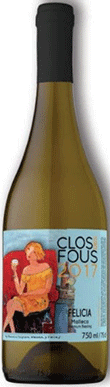
Winemaker François Massoc is a master of the barrel and you’d never know that this thrilling Riesling spends 20 months in oak. Bone-dry with electric...
2017
Clos des Fous
Otronia, Block 3 & 6 Chardonnay, Chubut, Patagonia, Argentina, 2017
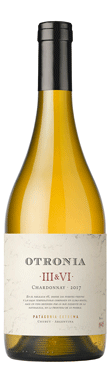
Made in the wind-beaten steppes of Chubut, at parallel 45.33°S, this winery claims to be the southernmost commercial production in the world. This austere Chardonnay...
2017
OtroniaChubut
Miguel Torres, Cordillera Sauvignon Blanc, Osorno Valley, Austral, Chile, 2018
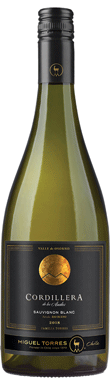
From Sauvignon Blanc grapes planted on terraced vineyards in La Union, in the coastal hills of Osorno, where the cool climate preserves a razor-sharp acidity...
2018
Miguel TorresOsorno Valley
Bodega Volcanes de Chile, Tectonia Chardonnay, Malleco Valley, Chile, 2017
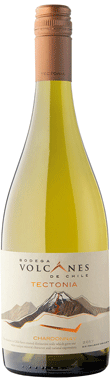
Malleco is a quality hotspot for Chilean Chardonnay, the cool southerly region giving naturally vibrant acidity and age-worthy styles. This is a full-throttle style within...
2017
Bodega Volcanes de Chile
Casa Silva, Lago Ranco Pinot Noir, Osorno Valley, Austral, Chile, 2017
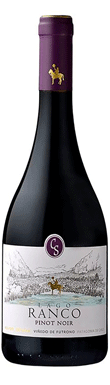
Fresh strawberry and cranberry aromas are becoming a trademark of cool-climate Osorno Pinot Noir. Forest herb and graphite aromas add complexity to an otherwise ultimately...
2017
Casa SilvaOsorno Valley
Undurraga, TH Pinot Noir, Malleco Valley, Chile, 2017
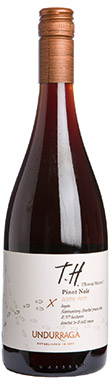
If you want to understand the different profile of Austral Pinot, try this alongside the coastal Leyda Pinot from the same Terroir Hunter series. Cooler...
2017
Undurraga
Contra Corriente, Pinot Noir, Chubut, Patagonia, Argentina, 2018
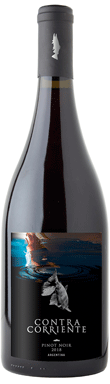
When fly-fishermen Rance and Travis planted a vineyard in Trevelin, they got more than they anticipated, including a wine club in the US on the...
2018
Contra CorrienteChubut
