Le Pergole Torte: One of Italy’s most consistent wines
Get our daily fine wine reviews, latest wine ratings, news and travel guides delivered straight to your inbox.
You are now subscribed
Your newsletter sign-up was successful
A voyage through nearly 40 years of vintages at Montervertine’s estate in April provided confirmation of Le Pergole Torte’s unwavering success, reports as Aldo Fiordelli, who profiles the winemaking methods and picks out his top wines...
Sergio Manetti founded Montevertine in 1967 when Radda, one of the highest and rockiest sites of Chianti Classico, was considered one of the trickiest places to ripen grapes. Today, it offers one of the longest growing seasons of the region.
Manetti bypassed the traditional Chianti recipe, however, which at the time demanded the use of white grapes in the blend.
Leaving the Consorzio in 1981, he had the freedom to use a cépage of 100% Sangiovese for his new project, Le Pergole Torte – which lays claim to being one of the first Super Tuscans.
It was originally labelled simply as Vino da Tavola, but became Toscana IGT in 1998 once the category was approved.
Scroll down to see Aldo’s tasting notes & scores
An experienced wine collector with a clear idea for his wines, Manetti was helped in the winery by consultant Giulio Gambelli, a key proponent of Sangiovese who also consulted for the likes of Soldera.
Upon his death, enologist Paolo Salvi took over winemaking duties, but has been careful to preserve his predecessor’s methods.
Get our daily fine wine reviews, latest wine ratings, news and travel guides delivered straight to your inbox.
In the vineyard, soil expert and local, Bruno Bini, was succeeded by Ruggero Mazzilli. Manetti himself passed away in 2000, and his son, Martino, took over.
Despite changes in the leadership, this tasting demonstrated remarkable stylistic consistency across nearly 40 years, even as the estate outgrew its original vineyards and cellars.
Each wine in the lineup could be attributed to Montevertine for its precise cherry fruits underpinned by privet aromas and bergamot depth.
Its firm yet ripe structure showed extraordinary balance in the best samples, such as 1999 and 2013, always on the edge between elegance and power.
‘To be honest,’ says Martino, ‘we changed from an artisanal outfit to a professional winery during the 1980s and ‘90s, growing from 7-8,000 bottles to 20,000.’
Today, Montevertine produces a maximum of 30,000 bottles of Le Pergole Torte, yet each year there are unanswered requests to increase production, which is sold entirely on pre-allocation.
Winemaking
The grapes are fermented in temperature controlled concrete vats at up to 32°C and aged in both small French barriques ‘bonde à coté’ and old Slavonian oak casks for 24 months. The barriques are tilted to prevent oxygen ingress around the bung and a small proportion are new.
This is the same regimen that has been followed since the beginning.
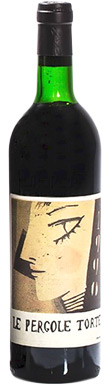
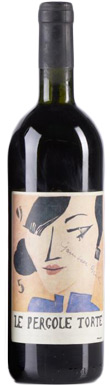
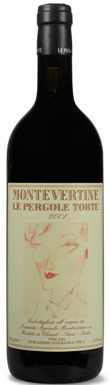
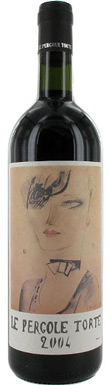
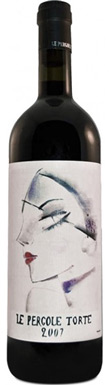
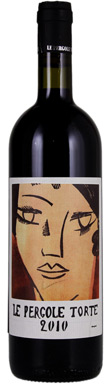
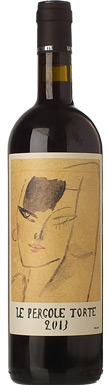
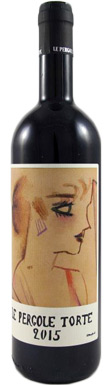
The bottle label is striking for its portrait of a woman, changing with every vintage. Each year it is painted by Alberto Manfredi, an Italian artist who sways between expressionism and cubism.
In her analysis of Tuscany’s leading crus for Wine Lister last March, Ella Lister identified the region as ‘underexposed’ and named Le Pergole Torte as a ‘buzz brand’ with the highest long-term price performance, which Wine Lister now reports is around +25% (three-year compound annual growth rate), dependent upon vintage.
One of the most consistent wines in all of Italy, it’s fair to say that Le Pergole Torte is one of the top Sangiovese-based Super Tuscans alongside Soldera and Flaccianello.
Le Pergole Torte: Top vintages
You might also like:
Super Tuscan evolution: Comparing Tignanello and Solaia
Chianti Classico new releases – Full report & top wines
Tua Rita: Redigaffi vertical & new release Keir
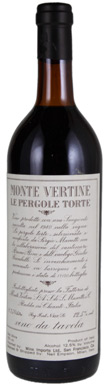
Montevertine, Le Pergole Torte, Vino da Tavola, Tuscany, Italy, 1980

1980 was a particularly cold vintage in Radda, 'immediately forgotten by critics, upstaged by 1979, 1981 and 1982' says Martino Manetti. The harvest started on the 6 October, almost a week earlier than average at Montevertine. The wine has a vivid pale ruby core with a brick-toned rim, full of aromas of eau de vie de framboise, underbrush and appealing whiffs of dried plums. This is balanced in the mouth by fresh pomegranate and rhubarb candy flavours, showing an almost lean body and dusty tannins which complete the finish.
1980
TuscanyItaly
MontevertineVino da Tavola
Montevertine, Le Pergole Torte, Vino da Tavola, Tuscany, Italy, 1990

Pergole Torte 1990 Riserva was produced in small quantities of just 2,500 bottles, 1,000 magnums, plus around 400 in larger formats. The product of a great vintage, the 100% Sangiovese aged for 24 months in both barriques and botti grandi. The wine is still incredibly youthful, with a slightly garnet colour. Austere and dark on the nose, with an intoxicating violet aroma combined with cherry kernel and hematic, earthy notes. The attack is powerful, with almost zesty acidity, then long freshness and a mass of tannins which are silky at first and then chalky. A great wine, full of structure and energy, this deserves time to enjoy its evolution in the glass. An Italian jewel.
1990
TuscanyItaly
MontevertineVino da Tavola
Montevertine, Le Pergole Torte, Vino da Tavola, Tuscany, Italy, 1995

The picking date was crucial in 1995, when Tuscany experienced a cool, rainy summer followed by a dry and hot October. The producers who were able to wait obtained very classic wines, often superior to 1997. Le Pergole Torte was harvested very late, on 17 October, giving a jammy, cherry fruit profile to the wine with some rose and violet complexity. It's medium-bodied with chalky tannins, although it's drying on the finish.
1995
TuscanyItaly
MontevertineVino da Tavola
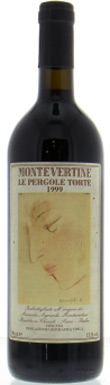
Montevertine, Le Pergole Torte, Toscana, Tuscany, Italy, 1999

1999 was the final vintage of Sergio Manetti, who died in 2000. Today this bottle seems to be proof of his will to produce outstanding wines. Harvested on 11 October – perfectly average for Montevertine – it's considered a classic yet austere vintage in Tuscany compared to the riper 1997 and 1998. It's a bright ruby colour, with a restrained nose of rhubarb candy, privet and Earl Grey tea. The palate flows freely and fully, showing velvety tannins, vibrant freshness and an amazing finish.
1999
TuscanyItaly
MontevertineToscana
Montevertine, Le Pergole Torte, Toscana, Tuscany, Italy, 2001

In 2001 Martino Manetti, who had worked alongside his father Sergio for 10 years, stepped up for his first solo vintage. A freezing spring - with a recorded temperature of -8°C on 16 April - provoked drastically lower yields than normal. The wine today is full of scents of privet, red cherry, bergamot, leather and oxidative notes, with an appealing hint of nutmeg. In the mouth it's full and powerful, and is one of the most extracted and ripe examples of Pergole. A truly gourmet wine.
2001
TuscanyItaly
MontevertineToscana
Montevertine, Le Pergole Torte, Toscana, Tuscany, Italy, 2004

Harvested on 13 October from an abundant vintage following the heat of 2003, the 2004 vintage marks the first year of collaboration between Martino and his wife, Liviana. In the glass it still shows an incredible youthfulness of colour without any rim variation. The nose opens with an intense meaty, bloody character followed by a core of dark cherry fruit. The palate brings in rhubarb notes and a vivid acidity which balances the full body and chalky yet ripe tannins.
2004
TuscanyItaly
MontevertineToscana
Montevertine, Le Pergole Torte, Toscana, Tuscany, Italy, 2007

In 2007, widely considered a hot vintage, the harvest started early on 1 October. Nevertheless, Le Pergole Torte boasts precise red cherry fruit with a whiff of privet, followed by a smoky woodland depth. The palate is savoury and full, more powerful than elegant, with firm acidity and tannins leading to a slightly thick, dry finish.
2007
TuscanyItaly
MontevertineToscana
Montevertine, Le Pergole Torte, Toscana, Tuscany, Italy, 2010

The 2010 vintage was considered a very good vintage in Tuscany due to an even growing season, and Montevertine began the harvest on 7 October. The colour is vividly ruby, with a fragrant bouquet of rose, violet, raspberry and a hint of rust. The medium to full palate flows with bright cherry fruit and youthful, grainy tannins - a chewy, crisp drinking style. The youngest vineyard (after a series of replanting) was 10 years old at the time.
2010
TuscanyItaly
MontevertineToscana
Montevertine, Le Pergole Torte, Toscana, Tuscany, Italy, 2013

If 1999 was a testament to Sergio Manetti, 2013 is the 'heritage vintage' of his son Martino. Again, harvest commenced on the 7 October in a vintage that's considered very classic for Tuscany. This was the second vintage with Paolo Salvi as winemaker, and it's the best expression of Le Pergole Torte of the decade. It's youthful and almost crimson at its core, showing signature aromas of privet and matcha tea over a savoury cherry and boiled beetroot core. It has a hearty character with large, velvety tannins and melting acidity.
2013
TuscanyItaly
MontevertineToscana
Montevertine, Le Pergole Torte, Toscana, Tuscany, Italy, 2015

The hot 2015 vintage resulted in the most alcoholic Pergole Torte, coming in at 14%, regardless of the fact that it was harvested not long after 28 September. It has a generous fruit profile of ripe cherry and raspberry, and although it's estery on the nose it still has an underlying depth of liquorice and flowers. Refined, grainy and crunchy tannins balance the powerful fat fruit, as does the typical chewy acidity that Sangiovese rarely lacks.
2015
TuscanyItaly
MontevertineToscana

Aldo Fiordelli is an Italian wine critic, journalist and wine writer. He has published four books about food, wine and art and is a regular Decanter contributor.
In Italy he is an editorial board member of L’Espresso restaurant and wine guide (one of Italy’s most prominent) since 2004. He also writes for Corriere della sera in Florence, as well as Civiltà del Bere (Italy’s oldest Italian wine magazine).
A certified sommelier since 2003, he is currently a 2nd stage student at the Institute of the Masters of Wine.
In 2017 he was named Chevalier de l’Ordre des Coteaux de Champagne.
Aldo joined DWWA for the first time as a judge in 2019.