
Six decades of Biondi-Santi masterclass: DFWE New York 2025
Lucky attendees who secured a ticket to this oversubscribed masterclass were treated to a tasting of eight wines, including rare library vintages of Brunello di Montalcino Riservas back to 1975. Decanter's content director joined Biondi-Santi's head winemaker Federico Radi on stage and reports from the event.


The hottest ticket to be had at this year’s Decanter’s New York Fine Wine Encounter on Saturday 7 June was a seat at the Biondi-Santi masterclass.
Not only did the masterclass sell out in record time, but it had a lengthy waiting list – thanks to the quality of wines on offer and the fact that Biondi-Santi’s director of winemaking and viticulture, Federico Radi, was hosting.
Scroll down for notes and scores of the eight Biondi-Santi masterclass wines

Radi captivated attendees from the start, outlining the rich 160-year-old history of the Biondi-Santi family and its Tenuta Greppo estate in Montalcino, and how tradition and terroir are expressed in the wines.
Biondi-Santi produces three wines, and the masterclass line up took guests through each, from the new-release 2022 Rosso di Montalcino, to a comparison of the 2019 and 2015 vintages of Brunello di Montalcino, and then five vintages of Brunello di Montalcino Riserva: 2018, 2004, 1997, 1988 and 1975.
Tradition, innovation, longevity
Few Italian wineries are as revered as Biondi-Santi, not only for the ageability of the wines themselves, but for the founding family’s role in the creation and continued development of this Tuscan denomination.
Radi took guests on a potted history of the estate, starting in 1888, when Ferruccio Biondi-Santi made the first wine labelled Brunello di Montalcino (named for the brown colour of the specific Grosso clone of Sangiovese he identified) and continuing through 1967, when his son Tancredi created the production rules under which the denomination was formed.
Tancredi’s son Franco, whose first vintage as winemaker was 1971, was also an innovator and behind the creation of a proprietary clone of Sangiovese Grosso, called BBS11 (Brunello Biondi-Santi 11), registered in 1978 and arguably key to the estate’s signature style.
The Biondi-Santi style, Radi explained, is conceived with longevity in mind through firm tannic structure and acidity, but also marked by great elegance thanks to a notable freshness combined with fruit sweetness which means they can retain great balance and vibrancy for decades.

Did you know?
In 1994, Franco Biondi-Santi held an epic vertical tasting, opening bottles from 1888 to 1988 to celebrate the 100th anniversary of Brunello di Montalcino and show the longevity of the estate’s wines.
Italian wine expert Nicolas Belfrage MW, writing for Decanter, gave a perfect score to the 1891 Riserva – the second Brunello in history after the 1888 Riserva, and then a mere 103 years old. Franco said, for him, 1891 was the vintage against which all later vintages should be measured.
Today there are only two bottles left of the 1891 in La Storica, Biondi-Santi’s wine library, where all historic vintages of its Brunello di Montalcino Riserva are kept.
Wines released from La Storica are dressed with the original label from its vintage, including ‘la lunetta’ – the neck label which carries the number of each bottle – and a handwritten date of its departure from the cellar on the back label.
The three wines
Radi explained that while many people think of Rosso di Montalcino as an entry-level Brunello di Montalcino, it is a complex style in its own right. At Biondi-Santi, the Rossos are made using grapes from the youngest vines and aged in Slavonian oak barrels for 12 months.
The annata Brunellos are only made in the best years from hand-selected grapes from vines up to 25 years of age and (since Radi’s first full vintage in 2019) are fermented in a mix of oak barrels, concrete and stainless steel using indigenous yeasts, before ageing in Slavonian oak barrels for 36 months.
Only made in exceptional vintages, just 42 Brunello Riservas have been produced at Biondi-Santi since 1888. Hand-selected grapes come from estate vines 25 years and older and vinified with indigenous yeasts in Slavonian oak before ageing further for 36 months.

Changes and future strategies
In 2017 Biondi-Santi and Tenuta Greppo were bought by French luxury group EPI, which also owns Champagne houses Charles Heidsieck, Piper Heidsieck and Rare as well as Chianti Classico estate Isole e Olena. Radi was appointed the same year.
Since the first Brunello was made in 1888, only Slavonian oak casks had been used at Il Greppo. Now, with no Biondi-Santi family member at the helm for the first time in its history, the latest Riserva release, the 2018, was vinified in barrel, as well as concrete. Barrels again replaced casks for the maturation.
Radi explained that he and the new team aim to honour the legacy of the Biondi-Santi family by following the ethos of ‘Evolution not Revolution’.
‘It is very important for us to preserve this style that is so classic yet always current – a “new classic”,’ he said.

In addition to the introduction of smaller oak vessels as well as concrete, Radi detailed the team’s ‘four pillars’ strategy for the future:
• Regenerative viticulture – to restore health to the soils
• Parcellisation – prime plots on specific soils identified, enabling micro vinifications
• Old-vine massal selection – 40 different clones identified to improve wine complexity.
• New trellising – to manage global warming
Responding to a question from the floor regarding how climate change might affect the Biondi-Santi style, Radi replied: ‘I see our style as a tightrope walker walking on a wire. It can be disturbed by the climate – rain, winds, very cold or extremely hot – but it wants to hold on.
‘We are its balancing pole,’ Radi said of himself and the other ’sensitive professionals’ in the vineyard and cellar negotiating the vagaries of vintage. ‘We help the style not to fall.’
Radi’s recap

A memorable part of this Decanter masterclass – and one that sparked good discussion – was Federico Radi sharing a few personal descriptors for each of the wines he presented to give attendees a grasp of their structure and nature.
Biondi-Santi, Rosso di Montalcino 2022 ‘Crisp and tenacious’
Biondi-Santi, Brunello di Montalcino 2019 ‘Dynamic, balsamic, enticing, floral’
Biondi-Santi, Brunello di Montalcino 2015 ‘Generous, lush, intense’
Biondi-Santi, Riserva, Brunello di Montalcino 2018 ‘The lithe dancer’
Biondi-Santi, Riserva La Storica, Brunello di Montalcino 2004 ‘Solid and trustworthy’
Biondi-Santi, Riserva La Storica, Brunello di Montalcino 1997 ‘Sumptuous’
Biondi-Santi, Riserva La Storica, Brunello di Montalcino 1988 ‘Pure elegance’
Biondi-Santi, Riserva La Storica, Brunello di Montalcino 1975 ‘Welcome to the multiverse!’
Biondi-Santi masterclass: Exploring six decades, back to 1975
Related articles
- Tuscany’s top tier: New vintage releases
- Brunello di Montalcino 2020: Vintage report and 20 top picks
- Biondi Santi: producer profile & Riserva vertical
- Wine Legend: Biondi-Santi, Riserva, Brunello di Montalcino 1975
Biondi-Santi, Rosso di Montalcino, Tuscany, Italy, 2022


<p>The earliest harvest ever at Biondi-Santi (starting 31 August) followed a warm spring and hot summer with some rain, giving optimal growing conditions. Viticulture and...
2022
Biondi-SantiRosso di Montalcino

Biondi-Santi, Brunello di Montalcino, Tuscany, Italy, 2019
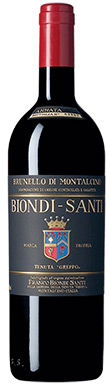
<p>After cold, wet spring delayed flowering, northern winds and some rain tempered the summer heat, ahead of harvest starting on 14 September. A great vintage...
2019
Biondi-SantiBrunello di Montalcino
Biondi-Santi, Brunello di Montalcino, Tuscany, Italy, 2015
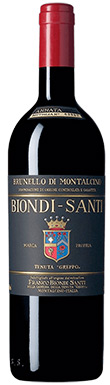
<p>A hot, dry year which coincided with the estate deciding to harvest later (starting on 21 September), resulting in this 2015 hitting 14.5% abv –...
2015
Biondi-SantiBrunello di Montalcino
Biondi-Santi, Riserva, Brunello di Montalcino, Tuscany, Italy, 2018
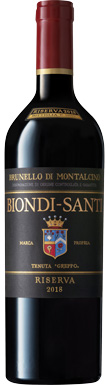
<p>Below-average temperatures and abundant rain characterised this vintage, which saw northerly winds dry out the grapes just before harvest began on 16 September. Viticulture and...
2018
Biondi-SantiBrunello di Montalcino
Biondi-Santi, Riserva La Storica, Brunello di Montalcino, Tuscany, Italy, 2004

<p>A cold, wet spring preceded a mainly warm, dry summer punctuated by temperature fluctuations and rainy spells, before a cold, dry harvest began on 20...
2004
Biondi-SantiBrunello di Montalcino
Biondi-Santi, Riserva La Storica, Brunello di Montalcino, Tuscany, Italy, 1997
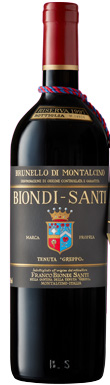
<p>Ideal weather this growing season: a cold, rainy winter led to a temperate spring with moderate rain, then a warm and dry summer with three...
1997
Biondi-SantiBrunello di Montalcino
Biondi-Santi, Riserva La Storica, Brunello di Montalcino, Tuscany, Italy, 1988
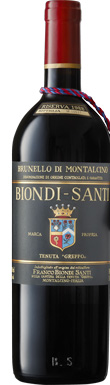
<p>The Riserva release that marks the centenary (1888-1988) of Biondi-Santi was appropriately born of an exceptional growing season: a very rainy spring; warm, dry summer;...
1988
Biondi-SantiBrunello di Montalcino
Biondi-Santi, Riserva La Storica, Brunello di Montalcino, Tuscany, Italy, 1975
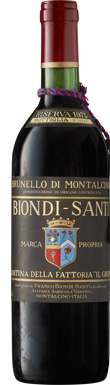
<p>An exceptional vintage, where a dry harvest followed a wet spring and dry summer. This vintage precedes the registration and formal recognition in 1978 of...
1975
Biondi-SantiBrunello di Montalcino
