
Producer Profile: Weingut Willi Schaefer
The Schaefers are a true Mosel Riesling winemaking dynasty – local documents date the family’s involvement in vineyards back at least as far as 1590. Today it’s Christoph Schaefer running the show.


Blink and you could miss it. The village of Graach, or Graach an der Mosel, was first mentioned in historical texts in 975. Home to just over 600 inhabitants, it is a tiny town lying alongside the B53 road as it traces the meanders of the Mittelmosel while you’re making your way north from picturesque Bernkastel town towards the charming hamlet of Zeltingen.
That such a small place could be home to some of the world’s greatest wines and, in fact, one of the finest producers of Riesling on the planet, might be a little surprising. However, if you know anything about these steep Devonian slate slopes and the reputation of Weingut Willi Schaefer, you’ll understand that Graach indeed sits on hallowed ground.
Scroll down to see notes and scores for a selection of Willi Schaefer Rieslings
Christoph Schaefer, along with his wife Andrea, has been at the helm of Willi Schaefer since 2015, taking over from his father Willi. Christoph’s grandparents, Martha and Willibrord Schaefer, founded the winery in its current state after World War II. The family’s viticultural roots, however, go back nearly as far as the town of Graach itself.
There is mention in a document referring to a vineyard changing hands from 1121 of one of the Schaefer family ancestors. Local and historical documents from the region around Graach show evidence of the Schaefer family’s involvement in vineyard work as early as 1590.
When I ask Christoph how long his family has owned and tended their vineyards above the village of Graach, he chuckles. ‘Actually, more or less always,’ he says with a wry smile. And he means it literally.
Those centuries-old beginnings laid the foundation for Christoph’s father Willi, who would take the wines and the global reputation of Weingut Willi Schaefer to the pinnacle of Riesling producers, staking the label’s renown on its kabinett, spätlese and auslese wines – bottled poetry from the steep slate slopes of the Mosel.
A style is born
Willibrord Schaefer (Christoph’s grandfather) had been producing bone-dry Riesling for years when he stumbled onto the style that would become the calling card for his eponymous brand.
Europe experienced a series of extremely cold winters throughout the 1940s. Fermentations of the 1943 vintage Rieslings were not complete, owing to the very cold weather, leaving Schaefer with a cellar full of wines boasting a delicate sweetness. This style became his focus, with the aim being to find a balance between the bright and lively acidity of this region’s terroir and the graceful sweetness of the Riesling planted here when the fruit attains perfect ripeness.
Schaefer’s great growths
The holdings for Weingut Willi Schaefer are tiny. With just 4.5ha, the family is not nearly able to meet the unceasing demands of a world of Riesling lovers enchanted with its wines. Though it does make an effort: Schaefer bottles are available in about 30 countries, in cities from London to Seoul. The Schaefer vines are spread over a number of parcels in three of Mosel’s designated Grosse Lagen – Germany’s equivalent of grand cru vineyard land. ‘Since we’re from Graach, we’re really focused on the vineyards here, mainly the Domprobst and Himmelreich crus,’ says Christoph. ‘So, we’re talking about nearly 4.5ha, but it’s over 40 different parcels.
‘We like to have so many different characteristics over those many sites. We choose to keep those different site expressions in different bottlings of Riesling we’ll produce, which will vary vintage to vintage,’ Christoph explains. ‘In 2022, we made only six “regular” Rieslings, but we can make as many as 16 if the vintage calls for it.’
Schaefer’s Grosse Lagen
Graacher Domprobst
Soil: Devonian blue slate
Slope: 45%-75%
Elevation: 110m-260m
The rich clay soils that underlie the weathered Devonian slate supply this finest of the Graacher crus with more groundwater and tend to create wines of greater power and intensity. The Domprobst wines have tremendous ageability and a distinctive minerality.
Graacher Himmelreich
Soil: Devonian blue slate
Slope: 45%-75%
Elevation: 110m-325m
Based on the soil composition over millions of years of alluvial deposits, the Graach slope has a richer soil bed with greater water retention, which tends to produce wines with more concentration and complexity.
Wehlener Sonnenuhr
Soil: Devonian blue slate
Slope: 65%-70%
Elevation: 110m-320m
Located in the village of Wehlen, the vineyard is named for a sundial built in the 1840s by Joducus Prüm. The site is known for producing wines of freshness, bright fruit and minerality.
Graacher Himmelreich is one of the two Grosse Lage sites associated with the village of Graach. Himmelreich means literally ‘Kingdom of Heaven’ and was so named because much of the vineyard land was owned back in the Middle Ages by the Catholic church. Weingut Willi Schaefer has 2ha of vines within this larger Grosse Lage cru.
Half of the estate holdings are located within the Graacher Domprobst Grosse Lage, where the most sought-after Schaefer wines are produced. Domprobst sits in the centre of the Himmelreich cru. Imagine a sort of bullseye. The term Domprobst means ‘Dean of the Cathedral’ (of Trier) – since it was of higher quality, 10% of the fruit from this most prestigious of sites went to the local religious leader.
Wehlener Sonnenuhr is located just downstream from the village of Graach on the Mosel river (in the direction of Zeltingen). The Willi Schaefer estate holdings in Wehlener Sonnenuhr are only 0.25ha.
Elegance & tradition
While a world of wine drinkers has fallen in love with the pinpoint acidities of the fashionable Grosses Gewächs [dry Rieslings from vineyard sites rated as top-quality by Germany’s VDP organisation], the Schaefers continue doing what they always have; making some of the Mosel’s best classic Rieslings. The tradition that Christoph carries on in the cellar is founded on one defining principle: ‘a pursuit of elegance’ is how he puts it.
This has become a challenge in a warming climate. The picking windows have become smaller and the margin for error has increased. ‘In the 1970s, just like the old days, it was simply a matter of waiting for the grapes to ripen. Now you must be ready to go, because if you are even just a few days behind, the grapes won’t give us the wines we intend to make.’

That approach is also a commitment to low-tech winemaking. In the face of global technological advances, the ethic at Weingut Willi Schaefer remains the same as it was in the days of Christoph’s grandfather and of those before him. ‘We don’t measure any data,’ Christoph tells me. ‘We just taste the grapes. You have to trust your tongue. I gauge the ripeness and aromatics through tasting in the vineyard. I taste the grapes again during the pressing and again at fermentation. When the wines taste as though they’re ready, and I like where they are, then I stop the fermentation.’
So the house style at Willi Schaefer is to do as close to nothing to the wine as they possibly can. Every barrel is stopped, Christoph says, ‘when the feeling is that we have a perfect balance of all the components’. And: ‘It’s the purity that allows us to see the terroir with clarity in these wines’. The wines are then racked into stainless steel tanks until bottling, with just a slight filtration beforehand.
‘In general we don’t use many techniques,’ says Christoph. ‘We focus on harvest strategy and we follow that closely. If we make the right selections and decisions in the vineyard, then we don’t have to worry about what happens in the cellar.’
Let the terroir talk
The Schaefer approach is refreshing in its simplicity. The cellar sits below Christoph and Andrea’s family home, built by his grandfather in the 1950s. They use only the gentlest pressing of the grapes and all fermentations are spontaneous and very slow. The wines ferment in old, 1,000-litre German fuders, some of them dating back to the 1950s.
They are driven by an obsessive respect for the terroir that has supported this family for centuries. They take what the vintage gives them. ‘If we don’t have the grapes for a particular wine, we simply don’t make that wine in a given vintage,’ Christoph tells me.
Their commitment has won them a cult-like following among Riesling devotees, driven by their purity of approach and strong commitment to tradition, one that feels so fleeting in our rapidly changing world.
Willi Schaefer: Top-flight Rieslings in high demand
Related articles
- German dry Riesling: Panel tasting results
- German Grosses Gewächs 2023 releases: the top wines
- Weingut Keller: Producer profile
Willi Schaefer, Graacher Riesling Trocken, Mosel, Germany, 2022
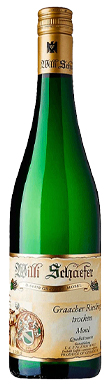

A rare dry Schaefer Riesling, ‘the only one’, Christoph tells me. Crystalline and focused. Brilliant stony aromatics mingle with hints of ginger and beeswax. The...
2022
Willi Schaefer

Willi Schaefer, Graacher Domprobst Riesling Spätlese, Mosel, Germany, 2018
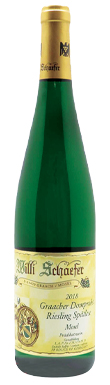
This spätlese, with seven years of bottle age, is a thing to behold. A beautiful intensity of aromas that offer grilled pineapple and salinity. The...
2018
Willi Schaefer
Willi Schaefer, Graacher Domprobst Riesling Kabinett, Mosel, Germany, 2022
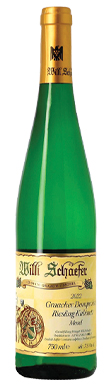
Balances perfectly the richness of the slate terroir with fresh, zesty fruit. Aromatics show slightly reduced notes of flint, pencil lead and streaks of graphite....
2022
Willi Schaefer
Willi Schaefer, Graacher Domprobst Riesling Spätlese, Mosel, Germany, 2021
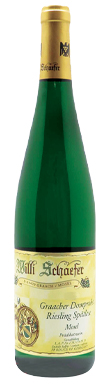
Christoph and Andrea call 2021 a ‘small but beautiful’ vintage. Yields were down and few spätleses were produced. A tour de force of intense, racy...
2021
Willi Schaefer
Willi Schaefer, Graacher Himmelriech Riesling Kabinett, Mosel, Germany, 2022
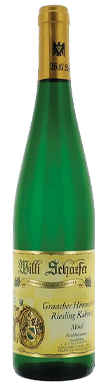
Great elegance and focus. The aromatics of lime zest and pronounced notes of spiced pear intermingle with notes of freshly cut nectarine. The Himmelreich is...
2022
Willi Schaefer
Willi Schaefer, Graacher Domprobst Riesling Auslese, Mosel, Germany, 2013
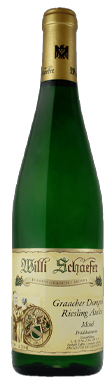
The 2013 vintage was a trying one in the Mosel but, 10 years later, this wine is stunning. Gorgeous petrol aromas, with notes of cardamom...
2013
Willi Schaefer
Willi Schaefer, Graacher Domprobst Riesling Auslese, Mosel, Germany, 1975
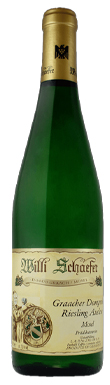
At 48 years this auslese shows an unbelievable depth of colour, a deep golden nectar. There is great richness of fruit, balanced with verve and...
1975
Willi Schaefer
