
Susana Balbo Torrontes: Taking Argentina to new heights
Known as the ‘Queen of Torrontes’, Susana Balbo has pioneered distinctive styles of this aromatic variety in Argentina. Andy Howard MW reports from a recent tasting and recommends seven top wines to try.


Susana Balbo is a winemaking force of nature. This was confirmed by a recent tasting in London of her premium barrel-fermented Torrontes wines.
Torrontes is one of those grapes which, along with South Africa’s Pinotage, many wine consumers shy away from. Yet Balbo is passionate in her belief that great Torrontes can be made to compete with fine Chardonnay from Burgundy, as well as Gruner Veltliner and Germany’s finest dry Riesling.
Up until now, I would admit to being in the group of wine-drinkers who found Torrontes initially ‘interesting’ and different on the nose; but I would rarely, if ever, go back for a second glass. As a result of Balbo’s groundbreaking work, I am now having to review that stance.
Scroll down to see tasting notes and scores for seven top Susana Balbo Torrontes wines worth seeking out
The Susana Balbo Barrel Fermented Signature Torrontes is a refined, graceful and intriguing wine, with a hint of the vivid florality found in the variety but in a restrained style. The wine is 100% fermented in barrel, but the oak influence manifests itself purely in terms of a creamy, silken texture without adding any of the smoky, orange zest characters often imparted by time in wood. Acidity is precise and focused, with surprising concentration on the palate indicating that these are wines destined for ageing.
Falling for Torrontes
Balbo has many impressive entries on her winemaking CV. In 1981 she became Argentina’s first female oenologist (finishing top of the class) and proceeded to make an impact in what, at the time, was a hugely male-dominated industry. After struggling to find work in her home of Mendoza, Balbo accepted a job at Michel Torino in Cafayate, where she stayed for almost a decade.
It was at Cafayate where Balbo became intrigued by the Torrontes grape. ‘Torrontes from Cafayate is totally different to that at Finca Paraje Altamira’, explains Balbo, referring to the sub-region of Uco Valley.
‘Cafayate has a sub-tropical climate with the harvest normally taking place in mid-March, but the warmth is balanced by altitude, with vines planted between 1,600-2,700m,’ she continues.
Going solo
Moving back to Mendoza in 1990, Balbo spent several years consulting in Europe before returning to work at Catena Zapata. There she oversaw the construction of Catena’s iconic winery and married general manager Pedro Marchevsky.
The couple founded Dominio del Plata in 1999 in Lujàn de Cuyo, with Balbo initially focused on producing high-quality Cabernet – still very much a love of hers today. She divorced several years later and finally bought-out Marchevsky in 2012, before renaming the business Susana Balbo Wines.
In addition to her work in the winery, Balbo has been president of Wines of Argentina three times, as well as spending some time in politics. She has also become a figurehead for female empowerment across the country. She has been a driving force for sustainability whilst championing an organic approach to wine production.
New horizons
Having successfully established Susana Balbo Wines, Balbo decided to focus on additional projects – with a strong desire to show the potential of the Torrontes grape. She obtained cuttings from the best vineyards in Cafayate in 2003, planting a new vineyard in 2005 in Altamira.
Balbo notes: ‘Altamira is the same latitude as Bordeaux. The soils are limestone/calcareous and temperatures are on average 20-22℃. As a result, harvest here is usually at least a month behind Cafayate.’
Finca Paraja Altamira – the source of the Barrel Fermented Signature Torrontes – is planted at 1,150m and lies 128km south of Mendoza. The soils here are poor in organic content and free-draining. Sandy loam soil is interspersed with calcium carbonate deposits and colluvial stones of varying sizes.
Balbo explains that a key part of the philosophy behind making barrel-fermented Torrontes was driven by her own palate, which is particularly sensitive to bitter notes. ‘The extreme climate of Cafayate increases the bitterness in the grape,’ she says.
Barrel philosophy
Although Balbo knew that fermentation in oak would be a way to enhance texture and complexity, she was concerned that traditionally produced barrels would add additional levels of bitter, burnt characters to her wines.
The groundbreaking answer came when Balbo attended an Australian Wine Research Institute conference in the mid-1990s. One of the papers discussed treating wooden staves with extremely hot air (close to 200℃) as an alternative to using fire in the production of top-quality barrels. Balbo returned enthused, persuading a close friend who ran a Chilean cooperage to introduce this new technology to South America.
Despite being fermented in new 500-litre French barrels, there is virtually no discernible oak flavour in any of the Torrontes vintages. The palate feel is rounded and soft, with a beautifully silken texture. The wines bear a lot of similarities to top Rhône valley whites, but without the evident oak notes.
Balbo’s barrel-fermented Torrontes is certainly the finest example of the grape I have tasted. But there is an even more exciting project looming, from vines planted at the extreme limits of viticultural production in Gualtallary. This small-production Torrontes (known simply as Blanco de Gualtallary) may reach the UK in the autumn and will turn heads – partly for its high retail price but, more importantly, for the way it has elevated Torrontes to new heights.
Susana Balbo Torrontes: seven wines to try
Related articles
- A drink with… Susana Balbo
- Get to know the wines of Argentina in 10 labels
- Argentina harvest report 2023: ‘Low yields but with unprecedented balance’
Susana Balbo, Signature Barrel Fermented Torrontes, Mendoza, Argentina, 2019
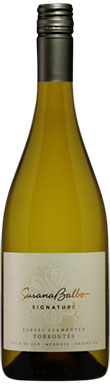

A cold and dry year which is, along with 2016, one of Susana Balbo's current favourites. Similar in character to 2020 with a rich, concentrated...
2019
Susana Balbo

Susana Balbo, Signature Barrel Fermented Torrontes, Mendoza, Argentina, 2020
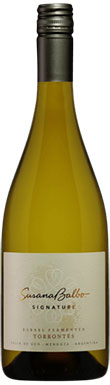
There was a warm and dry growing season in 2020, which shows in terms of additional development in the glass. A little darker in hue,...
2020
Susana Balbo
Susana Balbo, Signature Barrel Fermented Torrontes, Mendoza, Argentina, 2022
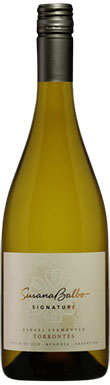
There was a cold vintage in 2022, with the grapes being destemmed and cooled down to 6°C for a two-hour maceration, before fermentation with selected...
2022
Susana Balbo
Susana Balbo, Signature Barrel Fermented Torrontes, Mendoza, Argentina, 2016
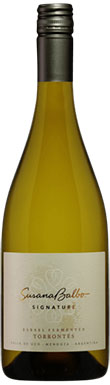
Perhaps more evidently Torrontes on the nose, yet this is still very restrained given the variety. Medium- to full-bodied, fleshy and smooth on the palate....
2016
Susana Balbo
Susana Balbo, Signature Barrel Fermented Torrontes, Mendoza, Argentina, 2018
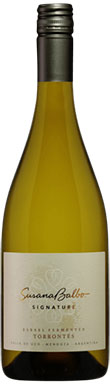
Hand-harvested after a warmer, dry growing season. Aged for four months in new French oak. Just approaching its peak with a lovely, voluptuous texture balanced...
2018
Susana Balbo
Susana Balbo, Signature Barrel Fermented Torrontes, Mendoza, Argentina, 2021
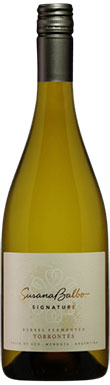
From a very cold year, which was also badly hit by frosts. Shy and closed on the nose, this is still very neutral and needs...
2021
Susana Balbo
Susana Balbo, Signature Barrel Fermented Torrontes, Mendoza, Argentina, 2017
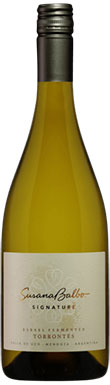
A warm and dry vintage, the 2017 is soft and generously textured, with less overt acidity than the younger wines. You could easily mistake this...
2017
Susana Balbo
