
Tommasi Amarone Classico: A tasting full of surprises


Michaela Morris tastes eight vintages of this classic Amarone, stretching back to 1995, and finds a few surprises along the way.
I have tasted many vintages of Tommasi’s Amarone Classico, on countless occasions, yet this was my first opportunity to compare vintages side by side.
During the frenzy of Vinitaly in April, I escaped to the family’s nearby spa hotel, Villa Quaranta, where I sat down to a civilised vertical of this wine going back to 1995.
Leading the tasting was Giancarlo Tommasi, who officially took the reins as oenologist in 2000 after hanging out in the cellar with his Uncle Ezio since his childhood.
Unexpectedly, the two hottest vintages in the lineup – 2003 and 2009 – showed remarkably well, challenging the stereotype of these years. Conversely, the highly touted 2007 underperformed. Both 2010 and 2013 are solid and should become more intriguing with time, but the stunner was the 1995. Only the 2000 was past its prime.
Approachable and accessible in style with a smoothing 5-8g/l of residual sugar, this consistent Amarone offers good value for money.
The cellaring potential is generally mid-term, however you shouldn’t be afraid of pulling a cork early on. And, if you happen to forget a bottle for longer, you may just be in for a delicious surprise in the vein of the 1995.
About the wine
The family’s single vineyard Riserva Ca’ Floriano and soon-to-be released De Buris sit at the top of the pyramid, however it is Tommasi’s Amarone Classico which serves as their bread and butter – at least at the premium level.
It is produced predominantly from Conca d’Oro and La Groletta, hillside holdings within the commune of Sant’Ambrogio. In years where quality is considered high enough, grapes from their 50ha Le Prunée plot on the valley floor may also be included.
Besides increasing production from 75,000 bottles in 1995 to 250,000 today, the wine has evolved over time. With the purchase of the 10ha La Groletta site in 2000, a small percentage of the deep hued, firmly tannic Oseleta grape has made it into the blend alongside main players Corvina, Corvinone and Rondinella, replacing the pale, high acid Molinara.
While Giancarlo recognises the freshness the latter can bring, he explains that they eliminated it from the blend because ‘it is an irregular yielder with big bunches and polyphenols that don’t ripen’.
Changes at the winery have been equally gradual and the effects monitored. Wooden fermenting tanks were introduced briefly, but Giancarlo switched back to stainless steel in 2013. The length of appassimento, or drying of the grapes, has also been reduced, now ending in January rather than February. ‘One-hundred days is more than sufficient for the evolution of aromas,’ he asserts.
And while the wine has always been aged in large botte, the length of time it spends in cask has decreased.
History of the estate
Giacomo Battista Tommasi founded his eponymous estate in 1902 with a modest 12ha in the hills of Valpolicella Classico.
Today, this family owned company possesses six estates throughout Italy, with vineyards totalling 600ha. Much of this expansion has occurred in the last two decades as the third generation – four brothers – passes the torch to their nine children. ‘We have more mouths to feed,’ jokes Pierangelo Tommasi, executive director of Tommasi.
Despite the new properties, Tommasi remains deeply rooted in Valpolicella. With over 100ha here, the family is the largest landowner in the classico zone.
Tasting Tommasi Amarone Classico:
You might also like:
Amarone: a buyer’s guide
Dal Forno Amarone: 1988-2010
Tommasi, Amarone della Valpolicella, Classico, Veneto, Italy, 1995

Prior to the purchase of La Groletta in 2000, Tommasi's Amarone Classico was crafted predominantly from the Conca d’Oro site. While 1995 was spared extreme...
1995
TommasiAmarone della Valpolicella

Tommasi, Amarone della Valpolicella, Classico, Veneto, Italy, 2000
The summer of 2000 was very warm with little rainfall, and from budding to veraison everything was early. Though Giancarlo tries to avoid the development...
2000
TommasiAmarone della Valpolicella
Tommasi, Amarone della Valpolicella, Classico, Veneto, Italy, 2003
The notorious 2003 vintage was marked by extreme heat and drought. An early harvest beginning on 3 September was followed by a relatively short drying...
2003
TommasiAmarone della Valpolicella
Tommasi, Amarone della Valpolicella, Classico, Veneto, Italy, 2007
Another decidedly warm year, 2007 differed from 2003 in that night time temperatures were cooler. Nevertheless, the growth cycle was precocious and Giancarlo feels they...
2007
TommasiAmarone della Valpolicella
Tommasi, Amarone della Valpolicella, Classico, Veneto, Italy, 2009
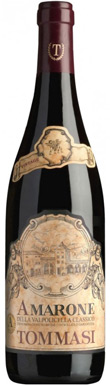
This 50th anniversary release hails from a particularly warm vintage, and it also coincides with the phasing out of Molinara. Despite a reduction from 10%...
2009
TommasiAmarone della Valpolicella
Tommasi, Amarone della Valpolicella, Classico, Veneto, Italy, 2010
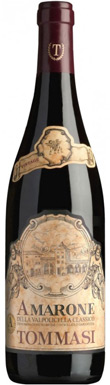
The 2010 vintage was challenging: high temperatures followed a wet spring, increasing disease pressure. It then turned chilly and damp in August, drawing out harvest...
2010
TommasiAmarone della Valpolicella
Tommasi, Amarone della Valpolicella, Classico, Veneto, Italy, 2012
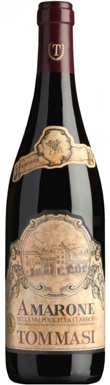
Modest nose, smoke and cherry compote. Off dry first impression on the palate, quite concentrated but mixed fruit rather than clearly delineated, or precise flavours.
2012
TommasiAmarone della Valpolicella
Tommasi, Amarone della Valpolicella, Classico, Veneto, Italy, 2013
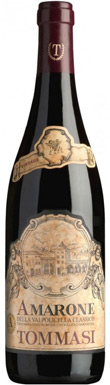
Summer was warm - rather than hot - with cool nights, particularly in September. While some producers were affected by hail and late-season rain, Giancarlo...
2013
TommasiAmarone della Valpolicella
