
Château-Grillet: The legendary Rhône white steps into a new era
One appellation, one estate, one grape variety, 3.5ha. Matt Walls checks in on this legendary Rhône white, 90 years after it gained appellation status.


This year Château-Grillet celebrates the 90th anniversary of its appellation, granted in 1936. It felt like a fitting moment for me to pay a visit to the only estate that makes wines under this appellation.
Admittedly I arrived without a gift or even a card, but I needn’t have worried. There were neither balloons nor bunting. It appears this birthday isn’t having undue impact on the serious business of making wine here.
And in 2048, Château-Grillet will have mark its 400th anniversary, after the architect and adviser to Cardinal Richelieu, Girard Desargues, moved into the property and made wine in 1648.
How much further back winemaking history extends at this site is unclear, but given that the Romans were making wine in the area over 2,000 years ago, it’s quite possibly millennia.
Though no birthday cake was forthcoming, I did get to meet the new technical manager, Aloïs Houeto, which made my visit more than worthwhile.
He’s making some small but consequential changes to this ancient estate.
Château-Grillet AP: An appellation is born

The front of Château-Grillet, turrets visible.
The first five wine appellations of France were Châteauneuf-du-Pape, Tavel, Arbois, Cassis and Monbazillac, all established in May 1936.
At the time, if you owned a château (defined as a building with at least two turrets), and your vineyard was in one single block around your property, you could apply for your own appellation d’origine contrôlée.
Canny Château-Grillet did just that, and was granted an appellation despite the fact it only amounted to 3.5ha of Viognier vines.
Sitting as it does at the heart of the larger Condrieu appellation, does it really deserve its own AP?
Houeto believes it does. ‘That’s the goal,’ he says, ‘to make a wine that’s unique, not like other terroirs in Condrieu.’
‘Salinity is the signature of Château-Grillet,’ says Houeto. He believes it becomes more apparent as the wine ages, ‘but the texture is different from the start… It can be rich, but it’s always ethereal.’
Acquisition by Artémis

Old bottles of Château-Grillet
In 2011, the Neyret-Gachet family sold the property to Artémis Domaines, the French wine group — owned by the billionaire Pinault family — that also includes Château Latour, Clos de Tart and Domaine d’Eugénie.
The last time I visited Château-Grillet, the technical director was Jaeok Cramette, a winemaker of South Korean descent.
She stepped across to manage Domaine d’Eugénie in Vosne-Romanée in 2024, after longstanding previous winemaker Michel Mallard stepped back.
Houeto took the reins at Château-Grillet during the 2024 harvest, aged just 29. He had joined Artémis Domaines in 2021 after studying agricultural engineering, followed by a diploma in winemaking.
He began by working on a research and development project at Château Latour, then in 2023 he was given a research and development role for the group as a whole. Not long after, the managing director of Artémis Domaines, Frédéric Engerer, asked him to take on Château-Grillet.
He was surprised, as it wasn’t something he had requested, but ‘I’m feeling really lucky,’ he says, ‘I’m really grateful’ to be asked.
He points out that Engerer was put in charge of Latour in his 30s, and as such he’s happy to trust other young people with positions of responsibility.
Finessing the details

Château-Grillet's new techincal manager, Aloïs Houeto
When I think about what I was doing aged 29, I can’t help but be impressed by Houeto’s relaxed and confident demeanour, given that he is now responsible for one of France’s most historic estates.
He describes his tenure in 2024 and 2025 as a learning phase. ‘Viticulture is all about observing,’ he says, ‘and you need to be in the vineyard every day.’
His first objective was to increase the organic matter in the soil, because ‘if you don’t have life in your soil, you can’t make great wines’.


Since my last visit, he has planted a number of saplings among the vines to provide them with shade.
Cover crops are more abundant; it helps the sandy granite soils retain water, says Houeto, and what he sews depends on whether the vines need more nitrogen or more carbon.
The harvest is delivered into a refrigerated cool room, ‘one of the biggest changes this year,’ he says, as it helps him to pick and press at exactly the right moment.
Each block is then vinified in miniature 10hl tanks and aged separately before blending. The winery is tiny, closer to a gym in size, with just as much polished steel.
He’s been tinkering with the maturation too, now prioritising 300L barrels over the traditional 228L size.
He uses only 5%-15% new oak, and only for the grand vin — not for the estate’s Condrieu or Côtes du Rhône.
‘It’s just details,’ he says. He has no plans to propose any major changes to the estate. But ‘the vines are like pro athletes,’ he says, ‘you have to work on small details, aiming to improve by just one tenth of a second.’
Consistency was historically Château-Grillet’s weak spot, but since 2014 it has been delivering excellent wines year in, year out.
In its current form, it will take another 90 years in its stride.
Château-Grillet wines are available in the UK via Yapp Brothers Wine Merchants.
Château-Grillet latest releases:

Producer profile: Château-Grillet

Regional profile: Condrieu plus 12 wines to seek out

Six Rhône producers on the down-low you need to know about
Château-Grillet, Château-Grillet, Rhône, France, 2022
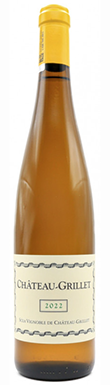

Savory white bread and lemon verbena scents. Aromatically this is quite tight still and not yet fully expressive. White flowers come with air. On the...
2022
Château-GrilletChâteau-Grillet

Château-Grillet, Côtes du Rhône, Rhône, France, 2023
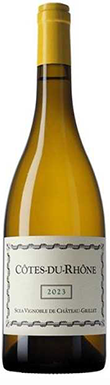
This has a lovely almond scent, with a touch of dry honey, petrichor and apricot. Floral honeysuckle notes come through too, it's very attractive. Full-bodied,...
2023
Château-GrilletCôtes du Rhône
