Many years ago, I wrote an article for an April Fool’s Day issue of a wine magazine (not this one).
In it, I celebrated the enterprise of an Australian winemaker who had created ‘Cabonnay’, an innovative if nonexistent blend of Cabernet Sauvignon and Chardonnay.
Little did I know that reality had got there well ahead of me: Caberlot, a hybrid crossing of Cabernet Franc and Merlot, had been identified by renowned Italian agronomist Remigio Bordini in the late 1960s, in a vineyard in Colli Euganei, near Padua in Italy.
Bordini was enthusiastic about the potential of Caberlot (at that point known by its registration code, L32), since this was a period when Sangiovese was, with rare exceptions, little more than a workhorse.
He believed Caberlot would produce wines with more structure and personality.
He cultivated the variety in his own private nursery for a number of years, but it wasn't until he was introduced to Wolf and Bettina Rogosky that its promise was realised.
The connection
A bunch of Caberlot grapes
(Image credit: Podere Il Carnasciale)
Wolf and Bettina Rogosky had purchased the small Podere Il Carnasciale property in 1972, located in what is today designated as the Val d’Arno di Sopra region in Tuscany, east of the Chianti Classico zone and north of Arezzo.
Decanter newsletter
Get our daily fine wine reviews, latest wine ratings, news and travel guides delivered straight to your inbox.
In those early days, the farm had no road access, water, or electricity.
At around the same time, Bordini was working with oenologist Vittore Fiore at the Castelluccio estate in Modigliana, Romagna, and by the 1980s the team – including consultant Luigi Veronelli – was credited with elevating the quality of Sangiovese in a region then known for its bulk wine.
Fiore began working as a winemaking consultant for Podere Il Carnasciale estate in the mid-1980s, after a devastating frost destroyed 0.3 hectares of olive groves in 1985 and the family decided to pivot to winemaking.
Fiore quickly introduced the Rogoskys to Bordini, once he understood their vision of quality aligned with his, and Bordini agreed to allow them to plant Caberlot.
The first vineyard was planted cautiously in 1986 on those 0.3 hectares of rocky soil, consisting of just over 3,000 Caberlot bush vines.
The first vintage of ‘Caberlot’ was 1988, and because of the small quantities produced from yields below 30 hectolitres per hectare, it was sold principally in magnums.
Carnasciale today
Podere il Carnasciale remains family-owned, with Wolf and Bettina's son, Moritz in charge, with an increasing role for his daughter Elle. Wolf Rogosky died in 1996.
The next generation has been supported by head of viticulture and winemaking, Marco Maffei since 2012, who succeeded consultant oenologist Peter Schilling.
With just 5.5 hectares of vineyard planted between 1986 and 2013 (the first year the vineyards were certified organic), plus new plantings in 2016 which bring the total vineyard area to eight hectares, the estate remains a boutique winery.
The highest, and probably one of the best Caberlot sites is the original home vineyard at 420 metres above sea level, close to the estate’s farmhouse, while the other vineyards are planted lower down near the villages of Mercatale, Bucine, and Montevarchi.
The high density bush vines of the original vineyard of 1986, Moritz concedes, makes it difficult to farm, as all work has to be undertaken manually. Furthermore, there can be a risk of excessive and unwelcome humidity beneath the canopy.
Production fluctuates but in 2016, 3,500 magnums were released together with a small release of 75cl ‘demi-magnums’ called sommelleria, destined for restaurants.
After selective manual harvesting, the grapes are chilled down overnight, destemmed, and then fermented in stainless steel tanks with manual punchdowns.
The wine is aged in medium-toast Burgundian barrels, of which about 50% are new, for 22 months, with just a single racking.
The wines
Wines from different sites are aged separately. In 2019, I was able to taste the seven components of the 2017 vintage from barrel, and the elevated home vineyard was the most perfumed and delicate.
A selection of grapes from the younger vineyards, fermented in stainless steel, results in 5-8,000 bottles of the second wine, known as Carnasciale Botte Grande which, until 2019 was a barrel selection aged in a large 40-hectolitre cask for 22 months, followed by a further six months in bottle.
Caberlot itself is bottled without fining or filtration, and is given a further 16 months of bottle ageing before release.
In addition, there is a pure Sangiovese called Ottantadue, which made in a fresher, unoaked style.
Following natural-yeast fermentation with 20% whole clusters in cement, it spends 14 months in stainless steel tanks before bottling and a few more months in bottle before release.
Unlike Caberlot, which is an IGT, Ottantadue conforms to the local regulations and is labelled as Val d’Arno di Sopra DOC.
By definition, Caberlot is a unique wine, and no other Italian estate has bottled a wine made from the grape.
Not surprisingly, it has acquired a cult status, but that would count for little if the wine itself were not of exceptional quality.
Despite the parentage of the variety, it resembles neither Bordeaux nor the Super Tuscans from the Maremma – it has its own character, swaggering rather than elegant, and Caberlot’s reputation for longevity is fully deserved.
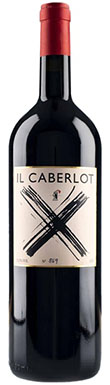
Podere Il Carnasciale, Il Caberlot, Toscana, Tuscany 2021
My wines
Very deep red. A lush, flamboyant black-fruit nose offers liquorice and heady, lifted aromas. Rich and dense with concentrated blackberry and plum fruit, it is...
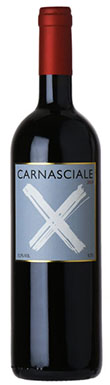
Podere Il Carnasciale, Carnasciale, Toscana, Tuscany 2019
My wines
Deep red. A lifted blackberry nose with a savoury, leafy tone leads into a rich, full-bodied and concentrated palate. It exhibits spicy, gamey flavours without...
Stephen Brook has been a contributing editor to Decanter since 1996 and has won a clutch of awards for his writing on wine. The author of more than 30 books, his works include Complete Bordeaux, now the definitive study of the region and in its third edition, and The Wines of California, which won three awards. His most recently published book is The Wines of Austria. Brook also fully revised the last two editions of Hugh Johnson’s Wine Companion, and he writes for magazines in many countries.