South African wine pros condemn Human Rights report

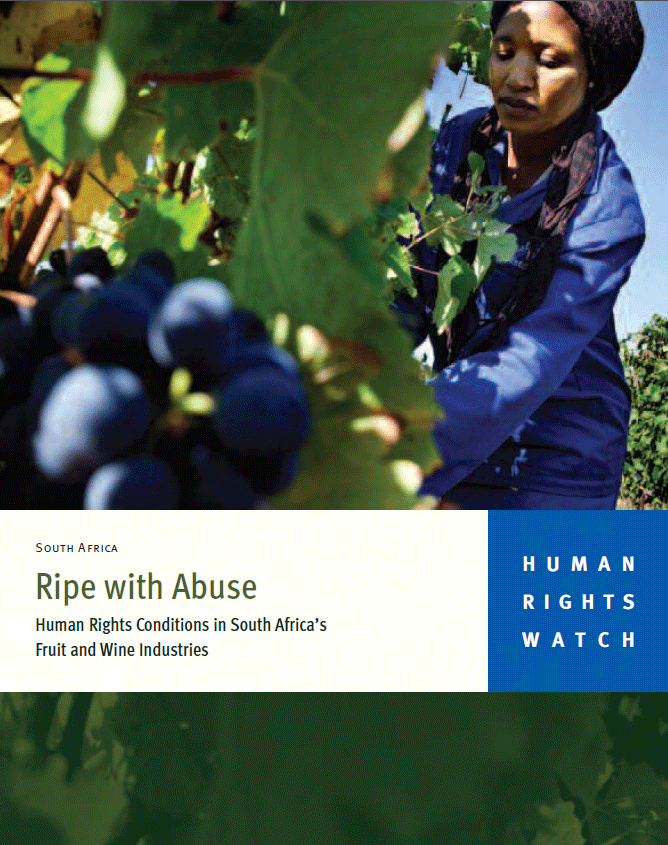
Senior members of the South African wine community have condemned the recent report into vineyard conditions as statistically unreliable and misleading.
The 96-page report, ‘Ripe with abuse: Human Rights conditions in South Africa’s Fruit and Wine Industries’ was published in August.
It said workers on fruit farms and ‘wine farms’ lead ‘dismal, dangerous lives’.
Workers, it found, were exposed to pesticides, badly paid, lacking basic sanitation, forced in one case to live in a pigsty, unrepresented by unions, and in two cases paid in wine, a throwback to the infamous ‘dop’ system of the apartheid era.
The industries were ‘rooted in human misery’, Human Rights Watch’s Africa director Daniel Bekele said.
News articles worldwide made it clear the wine industry was central to the report. In a full-page story, the Guardian opened by saying South Africa had a ‘flair for producing … world-class’ wines at affordable prices, ‘ but the provenance of South African wines is altogether less savoury…’
Now doubt has been cast on the reliability of the report.
Get our daily fine wine reviews, latest wine ratings, news and travel guides delivered straight to your inbox.
Michael Fridjhon, one of South Africa’s most experienced wine journalists, criticised the ‘dangerously small sample’ of respondents in an article in Businessday.co.za, as well as the ‘tabloid-like quality’ of the text and images.
Of the 60 farms surveyed, 21 were visited, and ‘one-third’ were wine farms, the report says. This would be 0.5% of the 4000 grape farms in the country, Fridjhon says.
‘Why would so well-intentioned a report fail to meet even the vaguest criteria for statistical accuracy, extrapolating to the broadest of generalisations from the tiniest of samples and then implicating the wine industry when most, if not all its research, was conducted outside the wine-producing sector?’
Fridjhon takes issue with the use of the term ‘wine farms’ to describe both primary and secondary industries, pointing out that it was statistically likely that some of the farms accused of abuse do not supply the wine industry at all.
HRW has not released any information on the producers involved, to protect workers from reprisals.
Su Birch, CEO Wines of South Africa, which is funded by the wine industry, told Decanter.com, ‘We have established that of the 60 farms, only 20 were so called wine farmers. We have had the “researchers” admit that the 2 farms identified as giving staff alcohol are not wine farms, a fact which they failed to mention in the report.’
In South Africa, senior members of the industry are equally dismayed. One told Decanter.com that while ‘there may well be a lot of truth in the report’:
‘Unfortunately, it is biased, unbalanced and lacks objectivity. It fails to identify the culprits and actually chooses to hide their identities. These accusations should be reported to the police as they are criminal offences and should be openly prosecuted under the South African law.’
The industry is particularly stung by the report’s perceived failure to mention the efforts the industry has taken to improve conditions for workers over the past decade.
But, Fridjhon said, while wine producers might have made great strides, he suspects some of the broad extrapolations in the report come from frustration with the government, ‘the recognition that conditions affecting farm workers have not improved, and that the legislation that has been drafted to protect “this most vulnerable” segment of society is underpoliced.’
Birch said she suspected ‘that the farms involved are marginal farmers, trapped in the past, and isolated from the realities of South Africa today and definitely not exporting.’
As to whether the report has had any effect on UK trade, there seems to be little evidence so far.
Kevin Gallagher, managing director of South African wine specialist SA Wines Online told Decanter.com, ‘we were bracing ourselves for a backlash but no one has mentioned anything. Many of our customers will know the producers and will have visited, so they can draw their own conclusions.’
pdf: Ripe with abuse: Human Rights conditions in South Africa’s Fruit and Wine Industries
Written by Adam Lechmere

Adam Lechmere is consultant editor of Club Oenologique among other things.
Formerly launch editor of Decanter.com, which he edited until 2011, he has been writing about wine for 20 years, contributing to Decanter, World of Fine Wine, Meininger’s, the Guardian and many others. Before joining the wine world he worked for the BBC, and as a music and film gossip journalist.