
Biondi Santi: producer profile & Riserva vertical
Under new ownership, this historical estate is looking ahead as much as it is at its past.


The image of an older gentleman walking along the cypress-lined avenue of Il Greppo in Montalcino dressed in the typical Italian ‘casentino’ coat is arguably one of the most famous photographs of Franco Biondi Santi. The owner of Tenuta Il Greppo, who passed away in April 2013, was considered a fiercely traditional winemaker of Brunello di Montalcino.
Scroll down to see tasting notes and scores for a Biondi Santi, Brunello di Montalcino Riserva vertical spanning 12 years between 1971 and 2016
Franco was obsessed about the freshness of his Brunello and famed for being the first to harvest each year in Montalcino. Not by chance his wines have always been austere, particularly when young, with an outstanding ability to age.
The French group EPI, who purchased the estate in 2016, have delayed the release of the 2017 vintage, simply stating ‘it’s not ready yet’ – which is not bad news at all.
In 1994, Franco held a memorable vertical tasting to demonstrate the unwavering character of his wines. Supreme acknowledgement came from Nicolas Belfrage, who, writing for Decanter, gave a score of 10/10 to the 1891 vintage (a 103-year-old wine with 12.3% alcohol, 23.90g/l of dry extract and 6.6g/l of acidity).
And in February 2020, another outstanding vertical tasting was held at the estate in Montalcino; a remarkable occasion covering 40 years of Franco’s harvests at Il Greppo. Comprising just Riservas, the tasting began with his first vintage in 1971 and ended with the presentation of his final vintage, 2012 – a special release dedicated to his legacy.
The Biondi Santi style
All of the wines show a signature freshness of fruit on both nose and palate. Most lean towards unripe as opposed to perfectly mature, due to austere acidity and tannins, however the sweetness of the fruit keeps them in a web of perfect balance without showing any fatigue, even after decades.
Some of the older wines have had their levels topped up (‘ricolmatura’) over the years, a practice carried out since 1927 when Franco’s father, Tancredi Biondi Santi, first topped up the 1888 and 1891 Riservas.
Wine Legend: Biondi Santi Il Greppo 1975
Franco was a charismatic innovator in the Italian wine world, despite his super-traditional reputation. For example, he began to ferment the Riserva in vertical oak casks, one of the few things he agreed upon with his son, Jacopo; and he understood the importance of controlling, if not chilling, the temperature of the must during fermentation.
He began to mature wine in large oak casks for a shorter time compared to the standard 48 months of his father. Although both Riserva and Annata spent the same time maturing in oak (36 months), the difference lies in the age of the vines – the Riserva used fruit from vines over 25 years old and the Annata from vines under 25 years old.
Franco was also invested in the clonal selection of Sangiovese in his vineyards, which led to the achievement of what is called BBS11, a clone that was registered by the estate in the 1970s. It is very suitable for a broad range of soils and is possibly part of the indelible signature of this wine.
The Biondi Santi estate
Tenuta Il Greppo is recognisable for its 18th century villa covered in a climbing web of ampelopsis. It rises on the southeast slope of Montalcino at an altitude of between 385 and 507 metres.
The winery was bought in 2017 by Paris-based Européenne de Participations Industrielles (EPI), owned by the French Descours family (Charles Heidsieck, Piper-Heisieck). The new ownership aspires to express the same style as the old patriarch.
A new era
The 2017 vintage will be the first Biondi Santi Brunello di Montalcino to be released that has been managed entirely by the new owners, since the 2016 was harvested by Jacopo Biondi Santi and only blended by EPI.
So, is it safe to bet on a return to the winery’s roots? The announcement about the 2017 vintage arrived in November 2022, during a recent tasting of several old Riserva wines at the Ritz in London, during which the 2016 vintage was launched.
Today we can delight in these wines thanks to the fresh and austere style, not just because of the traditional ‘topping up’ that occurred in the cellar every 10 to 15 years.
Franco Biondi Santi began pressuring his winemaker, Paolo Vagaggini to pick the grapes of Tenuta Il Greppo in August. ‘The total acidity was always his point of reference, and it read at the higher end of six grams,’ recalls Vagaggini. To achieve his own idea of balance, Biondi Santi was forced to use low yields, select the grapes from older vines, and macerate them for a relatively short time: not more than 12 to 15 days – the resulting wine almost always more elegant than powerful.
Today, the search for freshness remains unchanged, but the strategy is quite different. According to Giampiero Bertolini, CEO of the estate, Biondi Santi is now working in four pillars.
First, they implemented regenerative viticulture in hopes of restoring health to the soils, improving their vitality and thus also adding soil structure.
Secondly, they embarked on a project in 2019 with star viticulturist, Pedro Parra to study and identify prime parcels and their different soils. Twelve specific soils were discovered thanks to this project, which resulted in as many individual vinifications.
One of the most significant changes in the winery’s renovation is the introduction of smaller oak including barriques, which had never before entered Il Greppo. The estate is keen to point out that the use of oak is to preserve the differences between different vinifications and not to change the style of the wine.
‘We replaced 45% of the oak in the winery,’ noted Giampiero Bertolini, ‘mostly Slavonian oak from the Italian cooper, Garbellotto. We introduced four barriques, smaller oak casks from 10 to 50 hectolitres with three different toasts. We found oak casks in the winery dating back to 1890, but we still use the 1984 casks for the fermentation of the Riserva.’
Whatever the intention, it’s safe to surmise that a slightly higher oak proportion could be expected in future releases.
The third main change, and possibly one of the most revolutionary for Biondi Santi, is the new clonal selection. Franco Biondi Santi was a great innovator and it was through him that the famed BBS11 Sangiovese clone from the estate has become so celebrated and widespread.
Now, thanks to research by the University of Florence, 40 different clones have been identified: 20 selected post-BBS11, while others date back to vines planted in 1930. Could this help the complexity of the wine? Absolutely.
The fourth and final change declared is the replanting of the estate’s oldest vines, which began in 2018. Including the five hectares acquired in 2019, the estate today works 33 hectares of vines (of which 30 are dedicated to Brunello), with yields around 42q/ha and an average age of 25 years. Only six of these hectares are yet to be replanted.
Fewer than 100,000 bottles are produced at Biondi Santi annually. ‘We are aiming to reach 125,000 bottles in the future,’ declares Bertolini. But these target numbers will not radically change the commercial strategy of the brand. Today, Italy is the primary market, followed by the USA and UK. Biondi Santi aims to consolidate these markets, rather than having limited quantities spread around the world.
Another exciting announcement was the company’s intention to release old Riserva wines, though in miniscule quantities – just 50 bottles for the UK. This offers an incredibly rare opportunity to taste all 42 vintages produced at the estate since 1888. Montalcino treasure!
The 2008 was drinking as lean as the 2018 vintage; the cool 1999, which usually I love in both Tuscany and Piedmont, showing a bit under the weather; the oldest vintage at the table, 1975, was a bit evolved; while the 1985 is a wine of never-ending emotion, an everlasting display of aromas and complexity with exceptional structure and precision, and one of the greatest Brunello di Montalcinos ever made.
These wines set the stage for the 2016 Riserva, which seems to be the first step of a new era at Biondi Santi. A great Brunello that stands out among its competitors with no shortage of personality, offering a decidedly harmonious transition from old to new.
Tasting Biondi Santi Riservas:
The Biondi Santi wines below were tasted by Aldo Fiordelli at two separate tastings; the first in February 2020, and the second in November 2022.
Related articles
- Il Marroneto: Producer profile & 10 wines rated
- Fuligni Brunello di Montalcino Riserva: vertical tasting
- Rosso di Montalcino: No longer a ‘baby Brunello’?
Biondi-Santi, Riserva, Brunello di Montalcino, Tuscany, Italy, 1971
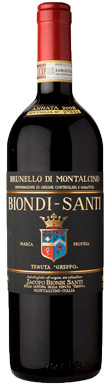

This was the first vintage overseen by Franco Biondi Santi, and it was an outstanding harvest at Il Greppo, with a rainy spring followed by...
1971
Biondi-SantiBrunello di Montalcino

Biondi-Santi, Riserva, Brunello di Montalcino, Tuscany, Italy, 1975
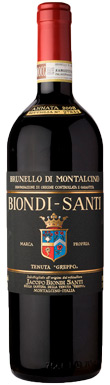
Franco Biondi Santi joined the estate in 1971, so this is one of his first Riserva; not bad at all. This bottle will appeal greatly...
1975
Biondi-SantiBrunello di Montalcino
Biondi-Santi, Riserva, Brunello di Montalcino, Tuscany, Italy, 1983
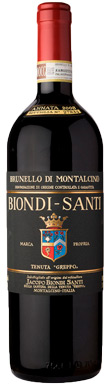
This bottle was not refilled. The vintage was warm and - compared to the average of the period - Franco's notes record that 'the harvest...
1983
Biondi-SantiBrunello di Montalcino
Biondi-Santi, Riserva, Brunello di Montalcino, Tuscany, Italy, 1985
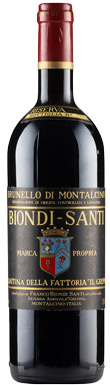
Celebrated, elegant and ageworthy, the 1985 vintage was extreme in Tuscany, with a particularly hard winter and very hot summer. The main character of this...
1985
Biondi-SantiBrunello di Montalcino
Biondi-Santi, Riserva, Brunello di Montalcino, Tuscany, Italy, 1995
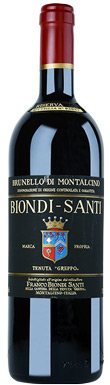
One of two Riserva re-releases from Biondi-Santi in 2019, the 1995 was selected as a more elegant expression. The summer was warm with a couple...
1995
Biondi-SantiBrunello di Montalcino
Biondi-Santi, Riserva, Brunello di Montalcino, Tuscany, Italy, 1997
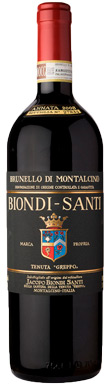
Little has changed at Biondi Santi in terms of their general approach to winemaking over the years. The Riserva is made from the estate's oldest...
1997
Biondi-SantiBrunello di Montalcino
Biondi-Santi, Riserva, Brunello di Montalcino, Tuscany, Italy, 1999
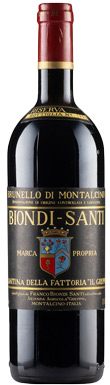
The 1999 vintage was a cooler year among the warmer 1997, 1998, 2000 and 2001. It's an austere year, for which there are still a...
1999
Biondi-SantiBrunello di Montalcino
Biondi-Santi, Riserva, Brunello di Montalcino, Tuscany, Italy, 2006
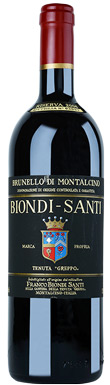
As Biondi-Santi is holding back their 2012 Riserva for another year, the estate is instead re-releasing two older Riservas from diverse vintages. The 2006 is...
2006
Biondi-SantiBrunello di Montalcino
Biondi-Santi, Riserva, Brunello di Montalcino, Tuscany, Italy, 2008
The 2008 vintage was not one of the best years in Montalcino, mostly for its lower concentration. Today, it's often compared to the recently released...
2008
Biondi-SantiBrunello di Montalcino
Biondi-Santi, Riserva, Brunello di Montalcino, Tuscany, Italy, 2010
The only Riserva in the line up for this masterclass, Biondi-Santi's 2010 shouldn't be a pick for drinking now – instead, it demands more time in...
2010
Biondi-SantiBrunello di Montalcino
Biondi-Santi, Riserva, Brunello di Montalcino, Tuscany, Italy, 2012
The 2012 Riserva is the last vintage produced by Franco Biondi Santi, and so this release is dedicated to him. Of the 39 Riservas the...
2012
Biondi-SantiBrunello di Montalcino
Biondi-Santi, Riserva, Brunello di Montalcino, Tuscany, Italy, 2016
2016 was one of the best vintages of the past 20 years in Tuscany. This Riserva was managed by Biondi-Santi technical director, Federico Radi under...
2016
Biondi-SantiBrunello di Montalcino
