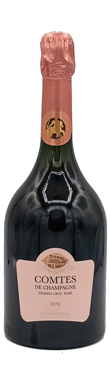
Taittinger’s prestige cuvée Comtes de Champagne, made from 100% Chardonnay, is one of the region’s most recognisable wines. Lesser spotted, though, is its pink cousin.
The newly released 2012, however, is one of its most impressive vintages.
‘The story is a bit different from the white version,’ says Taittinger cellar master Alexandre Ponnavoy.
While the white cuvée debuted in 1952, prestige-level rosé Champagne was a later development, and Comtes Rosé didn’t appear until 1970.
Although initially Chardonnay dominant, the rosé has evolved over time to become Pinot Noir dominant, reflecting a ‘fashion throughout the 1990s and 2000s for fruitier, crisp rosés with lots of red fruit,’ says Ponnavoy.
The Comtes Rosé 2012, though, signals a slight change in direction from some of the deeper, fruitier rosés released over the last decade.
This is a release of beautiful expressive fruit but, in comparison to 2011 for example, an ultra-refined level of silky polish and restraint that, although still a very different wine from the white, seems to approach it in delicacy.
Why is Comtes Rosé 2012 so good?
Ponnavoy has begun a process of refinement in the winemaking – especially the production of the red wine used in the blend – but believes much of this apparent bump in quality in 2012, quite evident over the more unusual 2011, is simply down to the vintage.
‘Between the warmth of 2011 and the minerality and freshness of 2013, you have 2012,’ he says.
It was a year that promised disaster in Champagne, beset by frost, disease and low yields. It was saved by a clement run up to harvest that yielded grapes of phenomenal concentration of both ripeness and acidity.
‘You have to imagine the wonderful potential of aging here,’ he says.
Indeed, ageing is something that keen-eyed Champagne fans might remark on. Taittinger has started keeping hold of Comtes Rosé a little longer than the white Comtes before release. This extra ageing on lees is also a factor in the 2012’s immediate quality.
‘After several tastings we decided not to sell after eight or 10 years, but after 12, to achieve all the complexity of the cuvée,’ he says, ‘It’s a long piece of work!’
Unlike some other vintage and prestige rosés, this is not a wine made simply by adding red wine into a white blend destined for another cuvée – something Ponnavoy believes would be a ‘huge mistake’ for a wine with its own identity.
Instead, Comtes Rosé is blended from the bottom up each vintage. All the grapes are sourced from grand cru villages in the Montagne de Reims and Côte des Blancs.
It is a rosé d’assemblage, or a blended rosé, made by blending in a specially made red wine to the white base before bottling for the secondary fermentation.
It is the village of Bouzy, famous for its southern exposure, chalk soils and historical red wine production, that appears central to the blend. ‘We have done lots of trials, but if you don’t use Bouzy you lose the identity of the wine,’ says Ponnavoy.
In 2012 the rosé proves itself to be much more than a sideshow to the white release; this is an age-worthy, remarkable rosé worth buying.
Comtes Rosé 2012 tasted and rated
Related articles