
Built to last: The wonders of Rioja’s old wines with tasting notes from 1890
Producing great wines for the long haul is one of the hallmarks of Rioja. There’s a fascinating backstory here, spanning almost 200 years and leading to classic vintages to enjoy today and for many years to come.


Rare indeed are the fine wine regions that can compete with Rioja in their capacity to hold amazing historic tastings. Marqués de Riscal (with wines made in the 19th century), Marqués de Murrieta, La Rioja Alta, Viña Tondonia and Martínez Lacuesta, to mention a few, can share with confidence very old wines that today show vividness and complexity.
It was not always the case. In 1833, Cyrus Redding published A History and Description of Modern Wines. Although he visited Spain, he wrote nothing about Rioja. At that time, it was not a fine wine region. There was certainly a long tradition of cosechero (carbonic maceration) wines, which can be delicious over a few months, but tend to decline quickly. These wines were all but destroyed when they were sent to consumer regions in wineskins on the back of mules.
Scroll down to see 12 old Riojas from 1890, 1895, 1920, 1928 and others – all built to last
Rioja grapes need care, know-how and equipment to produce great wines.
In 1790, the priest Manuel Quintano brought the Bordeaux know-how to Rioja, and it worked very well. But all the other producers – and local governments – opposed the move to adopt those superior wines, and the innovation was abandoned. More than half a century later, liberalism had replaced late feudalism. This was the necessary breeding ground for great Rioja.
Two expatriate Marquises, with no connection between them, were the key players in the birth of Rioja as an outstanding wine. Both intended to undertake so-called ‘industrial investments’, to produce high-quality wine at just the right political moment.
In the mid 19th century, the Marqués de Riscal and Marqués de Murrieta brought to Rioja not only the science and technology developed in Bordeaux, but also an entrepreneurial mindset focused on luxury markets. Viticulture was improved, destemming and extended maceration were introduced, controlled ageing of wines in oak barrels was mastered. But, most of all, they fostered the notion of pursuing excellence at an international level.
The results were impressive. The first wines produced in Rioja using the Bordeaux method received many accolades, even in France. Rioja became the wine of the well-off people in Spain. Those wines travelled very well and improved over time in bottle. More than a century later, they still demonstrate that they have the capacity to last for generations. As Jochen de Vylder, owner of the auction house Ampersand, says: ‘Old Riojas are some of the most interesting wine investments, given their capacity to keep for many decades.’
Solid assets and classic brands

What was once a tiny industry became a major player in the wine markets, thanks to another innovation: the railway. When the line between Haro and Bilbao came into operation in 1875, Rioja wine found an easy route to urban markets in Spain and France. Several wineries were established around the Haro train station: R López de Heredia, CVNE, Bilbaínas, Gómez Cruzado, La Rioja Alta and Rioja Santiago. The great Rioja was born.
Wine production increased exponentially when phylloxera devastated French vineyards. On the positive side, many French investors set up business in Rioja, accelerating the transfer of technology and management know-how. On the negative side, most exported wine was of mediocre quality. The whole business came to a halt when, after finding a remedy for the plague of phylloxera, the French imposed prohibitive import tariffs on Spanish wines and developed wine production in Languedoc and Algeria.
Every cloud has a silver lining, though: what was deemed a disaster at the time is a blessing from today’s perspective. Powerless against competitive mass producers from eastern Spain or La Mancha, Rioja had to focus on quality. Winemakers decided to concentrate on a few markets with a limited number of affluent customers – namely the bourgeoisie in urban Spain, Cuba, Puerto Rico and Buenos Aires, along with a few other places abroad (until Spain lost its markets in the Americas). The second golden period for Rioja came after the post- phylloxera crisis, during the 1920s.
One of Rioja’s most solid assets is the reliability of its brands. Most of those brands were built on the work done in the bodega. Rioja’s business model was not based on bodegas owning vineyards; most grapes were bought from small vine-growers. Therefore, many classic Rioja wines are identified by the name of the winery rather than by the vineyard. In some cases, the brand is a large vineyard’s name – for instance Viña Tondonia, Viña Pomal, Viña Real. However, quite often it represents the blend of grapes and wines from different vineyards, some of them far removed from each other.
All the classic brands are concentrated in Rioja Alta and Rioja Alavesa. There is no intrinsic quality factor to it, but a very practical reason: until recently, Rioja Oriental focused on selling grapes to those wineries. Nowadays, an increasing number of wineries in Oriental show the greatness of this region, but there is no historic track record yet.
Impressive ageability

Those aforementioned industrial investments of the 19th century produced wines that improve over many decades, developing nuanced complexity and an overall impression of greatness. Many wines produced between 1862 and 1900, and between 1915 and 1964, make real everybody’s dream of getting more beautiful with age. They look seductively harmonious and are apparently fragile, yet indestructible.
Luis Hurtado de Amézaga, Riscal’s technical director and a direct descendant of the original Marqués, intends to ensure that those patterns are reproduced in the wines he makes today: ‘Our key aim when we grow vines organically, reduce yields, select old clones and take the utmost care in the winery is to make wines that, like those in the 19th century, will amaze next century’s wine lovers.’
There are reasons for this impressive ageability: low-yield vineyards that were barely fertilised, fair ripeness, balanced grapes, field blend vineyards, slow, non-reductive winemaking. Yet there are also some mysteries.
These wines have good acidity and are quite low in alcohol (between 9.5% and 12.5%). Some of the vines used were old, but the vineyards behind the amazing 1920s vintages were relatively young, planted at the beginning of the 20th century. Tempranillo tannins are dense and, especially when blended with a bit of Viura, very resilient to oxidisation. However, there are centennial wines that are not very tannic, yet stupendous.
These wines were aged in American oak, and it’s worth noting that there wasn’t even a single ageing system at the time: while Riscal tended to age in oak for a relatively short period (three to four years), Murrieta, Paternina and others aged for decades. Both styles keep wonderfully in the bottle. For Juan Carlos Sancha, professor of oenology and wine producer at his eponymous winery, the key is low pH: ‘We are focusing our holistic research on producing balanced wines with low pH that should be capable of improving over many years; fruit-bomb wines with high pH are bound to decline quickly.’
It’s also worth pointing out that top white Rioja also ages wonderfully. These white wines were made without any significant protection against oxidisation, with no forced lees contact, but with a long time in barrel and few rackings. Some white wines from the 1920s up to 1970 are now simply delicious, with an amazing, austere elegance and genuine overall expression. They keep fresh, are showing far from any decline, and are absolutely unique. I have no logical explanation for that. María Vargas, chief winemaker at Marqués de Murrieta, bottled her Castillo Ygay Blanco Gran Reserva 1986, a wine with incredible life ahead of it, 28 years after the vintage. ‘It is something intrinsic to our terroir and the way we care for the wines,’ she says.
10 top old Rioja vintages
1862 The oldest bottle of Rioja in existence. The first bottling by Riscal, it’s still alive – although decadent – and giving lots of intellectual pleasure.
1895 Together with 1899 and 1900, the greatest vintages of the 19th century, by Riscal; still amazingly opulent and fresh, with incredible depth and complexity.
1920 The first great vintage in the 20th century, probably because climatic conditions were optimal, but also because the vines replanted after phylloxera had reached maturity. Try R López de Heredia.
1928 Declared ‘Very Good’ rather than ‘Excellent’, this is in my view the most impressive vintage in a decade that yielded many great wines. The Paternina was glorious.
1934 The first Rioja vintage to be declared ‘Excellent’ (since the appellation was created in 1925). Murrieta is renowned in this vintage, although I have never tried the wine.
1946 Qualified as ‘Normal’ (that is, bad) – yet the best white wine I have ever tasted, a Castillo Ygay, is from this vintage. Similarly, 1945 is also ‘Normal’, although Riscal’s 1945 is the most iconic red Rioja in history.
1947 This makes an amazing coupling with 1948. The best wines show perfect balance and suave texture, with complex and vivid aromas. 1948 tends to be slightly warmer, more concentrated. Many wines are still available in secondary markets. Viña Real 1947, La Rioja Alta and Imperial 1948 are all jewels.
1952 Probably one of the vintages with a longer life ahead of it. Most top wineries produced outstanding wines in 1952, and there is excellence even among some of the less renowned names, such as Viña Albina by Riojanas, Bilbaínas Gran Reserva or Berberana Reserva Especial.
1959 In my opinion, wines from this vintage are more elegant than the more famous 1958. Conde de los Andes and Siglo Saco are good examples.
1964 The perfect vintage. Lots of big names. Most producers released their best wines ever. Martínez Lacuesta Reserva Especial and Royal by Franco-Españolas are worth pursuing.
More recent great Rioja vintages are 1981, 1982, 1994, 1995, 1996 and 2001.
Different styles, different tastes

How do these old vintages taste today? Of course, that depends on the brand and also the vintage. Some red wines are deep in colour, deceptively young on the nose, with intense macerated fruit notes and a bit of exotic spice that is by no means simply related to oak. They are tightly grained but very smooth, of soft texture and with extraordinarily long finishes. Riscal is the flagship for this style. Its most characteristic vintages are 1895, 1899, 1900, 1929, 1936, 1939 and 1947. Possibly, this is the style of Rioja that is closest to Bordeaux.
A different style shows much longer ageing in oak, with less intense colours, and undergrowth and aromatic herbs on the nose, all subtly balanced, with light tannins and a poised finish. CVNE’s Imperial, Murrieta and Paternina are top examples. Reference vintages include 1928, 1939, 1942, 1947 and 1952; some of these wines may be taken for an old Burgundy.
In between, there’s a graceful style in which concentration joins freshness, with evidence of ripe fruit, dried fruits, mint and rosemary, plus an amazing agility in mouth, a mellow texture and a round, often very slow, finish. Conde de los Andes, La Rioja Alta, R López de Heredia and Martínez Lacuesta represent this style well, with many nuances among them.
A fourth style, and one that is extremely interesting, is represented by wineries that did not intend to produce top wines. In excellent vintages, the results went far beyond their best expectations. Try almost anything from 1929, 1959 or 1964; Viña Albina and Faustino are excellent examples. The likelihood of a nice surprise is quite high, and they are still affordable.
Some wines are just in a class of their own, however. Riscal 1945, and Viña Real 1947 and 1962 are unique and rare examples.
There are also distinctive styles for white Rioja wines. Viña Tondonia, for example, represents a soft and creamy, open style, with dried fruits and an unending finish. It has a dramatic beauty, in the manner of Francis Bacon. Murrieta’s Ygay is completely different: more akin to Kandinsky, it’s higher in acidity, austere, precise and well structured. Both are jewels.
There are many other gems, such as Bodegas AGE 1946, a white wine that was made to be drunk when young but more than 70 years later was more than pleasurable.
Vintages for the future
The big question is: will today’s wines reach such a level of excellence and uniqueness in time? My response is yes, definitely. Rioja went through some difficult years during the 1970s and 1980s but has recovered to be better than ever.
After experiencing bad vintages, producers know that identity and quality are the only ways ahead. There are no short cuts to excellence. Besides, they have learned so much about vineyards and wineries since then, and they now know how to care for their vines and wines.
Proof of that is the excellent development of wines from 1994, 1995 and 2001. The best examples from those vintages are bound to revive the glories of the past for future generations. I would also bet on 2004, 2005, 2010 and 2012.
Some classic wineries, such as Paternina, have disappeared, while a few might not yet have reached their full potential. Others were down for some years and are now on the up. Significantly, there are also several newer wineries, such as Muga, Roda and Pujanza, that are aiming high, with wines clearly built for the long run.
In addition, many contemporary producers, for whom ‘vineyard’ is the key reference, are developing new approaches while keeping Rioja’s raison d’être and special identity. I am sure that many of them will be behind tomorrow’s jewels. I know that they taste a disproportionate quantity of old wines with precisely that purpose in mind.
In conclusion, we can drink the beauties of the past with the confidence that a stream of new beauties is on its way.
Where to find old Rioja vintages
Most renowned auction houses include old Rioja wines in their sales. Old Riojas can often be found on the wine lists of top restaurants in Spain, too. The following hold particularly good collections:
Atrio, Cáceres
Horcher, Madrid
Bodega Cigaleña, Santander
Rekondo, San Sebastián
Restaurante Via Veneto, Barcelona
Venta de Moncalvillo, Daroca de Rioja
12 great Riojas with impressive ageability
Related articles
- Rioja’s rising stars: the winemakers to watch out for
- Top Riojas to enjoy this winter
- Expert’s choice: White Rioja
Marques de Murrieta, Castillo de Ygay Gran Reserva Especial, Rioja, Northern Spain, Spain, 1946
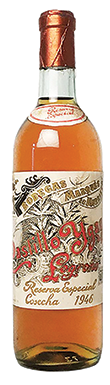

The best white Rioja I have ever tasted. Still bright and not very intense, amber colour. Restrained nose, with notes of tea leaves, a hint...
1946
Marques de MurrietaRioja

Marqués de Riscal, RM (Reserva Médoc), Rioja, Northern Spain, Spain, 1895
If the wine were younger it would still be perfect; at 125 years of age, it is beyond any praise. Deep bright garnet colour, intense...
1895
Marqués de RiscalRioja
CVNE, Imperial Cosecha Especial, Rioja, Northern Spain, Spain, 1928
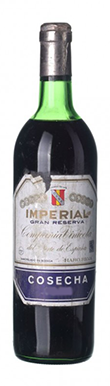
Deep and dark garnet colour, as if the wine were much younger. A most enticing aromatic profile, with floral and cedar notes, delicate spiciness, dried...
1928
CVNERioja
La Rioja Alta, Gran Reserva 890, Rioja, Northern Spain, Spain, 2010
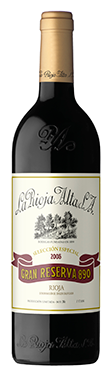
I have no doubts that this wine will live longer than its ancestor. Indeed, I think that today's 890s are the best ever. Since the...
2010
La Rioja AltaRioja
Marqués de Riscal, Barón de Chirel, Rioja, Northern Spain, Spain, 2017
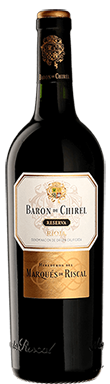
Likely to become a good heir to the icons of 19th century, with some post-modern touches. Aged in French oak, instead of American, with possibly...
2017
Marqués de RiscalRioja
Bodegas Martínez Lacuesta, Reserva Especial, Rioja, Northern Spain, Spain, 1964
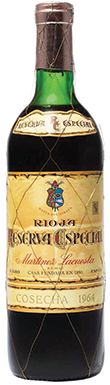
Archetypical 1964, the wonder vintage in Rioja. The word to define this wine is balance. Fair aromatic intensity, with orange peel aromas, cinnamon and clove...
1964
Bodegas Martínez LacuestaRioja
R Lopez de Heredia, Rioja, Northern Spain, Spain, 1920
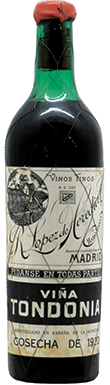
Unique Rioja style, a dark wine with sweet fruit and spice in the nose, hints of chocolate and tobacco leaf, and a reminiscence of plum...
1920
R Lopez de HerediaRioja
R Lopez de Heredia, Gran Reserva, Rioja, Northern Spain, Spain, 2001
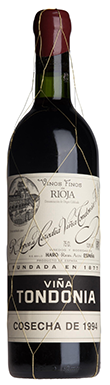
López de Heredia provides the best justification for Rioja's classification on ageing. The Gran Reserva tends to be much more dense and complex than the...
2001
R Lopez de HerediaRioja
Marques de Murrieta, Castillo de Ygay Gran Reserva Especial, Rioja, Northern Spain, Spain, 2011
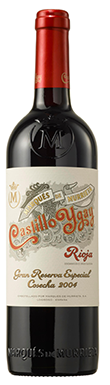
The essence of classicism, built upon utmost care in the vineyard and the strictest selection. Made from selected plots within a single vineyard, aged in...
2011
Marques de MurrietaRioja
CVNE, Imperial Gran Reserva, Rioja, Northern Spain, Spain, 2016
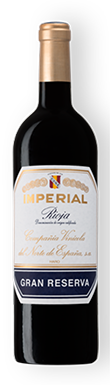
CVNE reinvented their Imperial wines several times. This new version is probably one of my favourites, because it puts together lots of ripe fruit intensity,...
2016
CVNERioja
Bodegas Martínez Lacuesta, 125 Años Gran Reserva, Rioja, Northern Spain, Spain, 2010
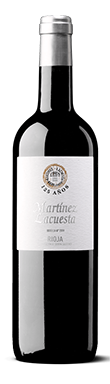
This wine is a successful attempt by the winery to revive its old glories. A special selection of Tempranillo grapes carefully aged for a very...
2010
Bodegas Martínez LacuestaRioja
La Rioja Alta, La Rioja Alta, Rioja, Northern Spain, Spain, 1890
Tasted in a half-bottle. Remarkably developed, but still alive, with pungent undergrowth and dry herbs, a bit of umami, remarkably suave aromas, although a bit...
1890
La Rioja AltaRioja
