
Tasting Cain: a vertical from this Napa mountain Cabernet estate
Chris Howell, winemaker of Cain Vineyards & Winery in Napa’s Spring Mountain District who narrowly escaped the fires that swept through California in 2020, caught up with Decanter’s Stephen Brook in London recently to taste through a vertical of his flagship Cain Five.

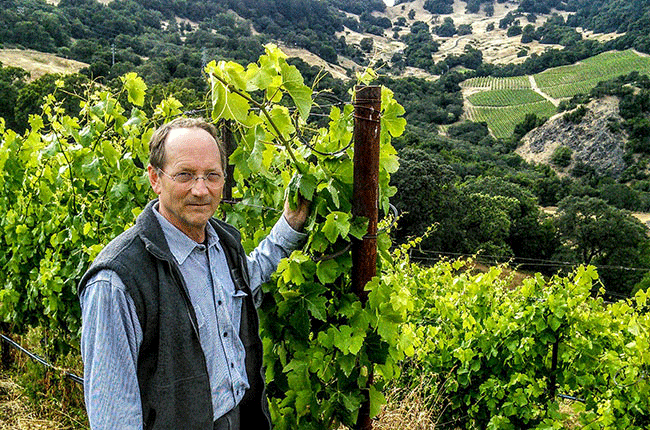
Chris Howell of Cain Vineyards & Winery is not your typical Napa winemaker. After studies in philosophy, biochemistry and genetics, he learnt to appreciate good wine on a visit to Europe.
He then made his own back in the United States as a hobby. ‘It was a Muscat – my first orange wine!’
Scroll down for Stephen Brook’s tasting notes and scores of seven Cain wines
It must have been a dream job: a substantial vineyard high on Spring Mountain, which he could run as he saw fit. He and his wife Katie lived on the property in a beautiful house.
This perfect existence came to a sudden halt in 2020, when the property was devoured by the Glass Fire that swept through Napa and Sonoma, and the couple were lucky to escape with their lives. But they lost their home and the winery.
With support from neighbours and friends, they were able to begin reconstructing their lives. Cain lives on, although diminished. Only 10% of the vineyard remained usable for the 2021 vintage, which was produced in a corner of Raymond winery in Napa.
As before, Cain Five remains the principal wine. It had existed before Howell arrived, and has been a blend of the five Bordeaux varieties since its creation in 1985.
Napa’s Spring Mountain District AVA is not the Médoc, as Howell knows full well, so the wine, though Bordelais in conception, is intended to express the Cain terroir.
‘In Bordeaux there’s an economic dimension to planting five varieties, as they may not all ripen well in any year,’ he says. ‘That’s not often an issue in California, where the problem tends to be overripeness.’
Howell is convinced the sedimentary and volcanic soils, as well as the elevation of up to 640m, have an impact on the flavour and style of the wine, though he can’t pin that down precisely.
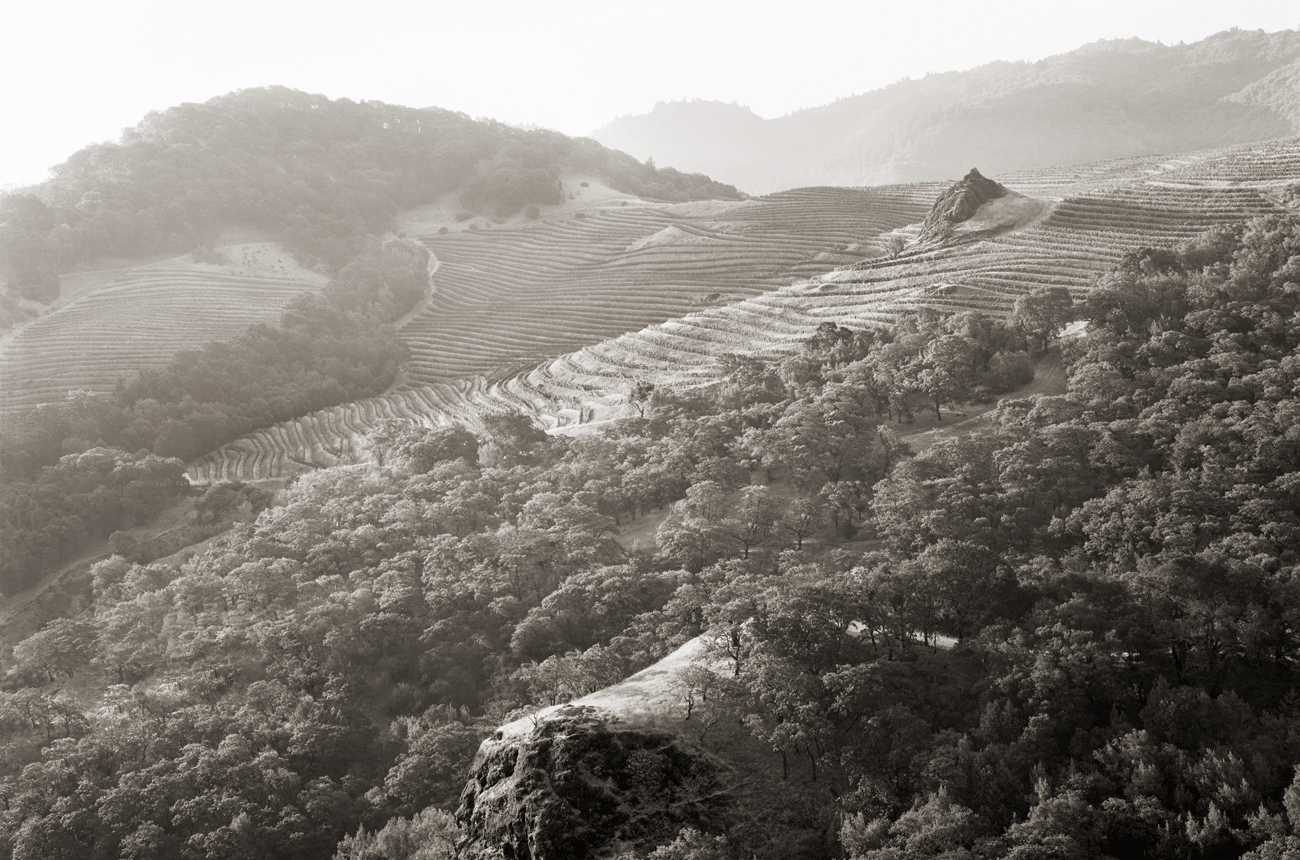
Cain Five, Concept and Cuvée
‘We vinify each variety separately after picking fairly early,’ he explains. ‘There’s this tendency in Napa to wait for full phenolic ripeness, which usually means the grapes are overripe and any terroir characteristics have been lost. That may be why many Napa Cabernet Sauvignons taste much the same.
‘By picking early here at this altitude, Cain Five has its own character that we don’t override with winemaking,’ he says. ‘We’re looking for elegance rather than power, and want Cain Five to age over time.’
There are two other wines from the estate. Cain Concept, made from purchased fruit from the benchlands of Rutherford and Oakville, is richer and broader than Cain Five.
The other wine is Cain Cuveé, a softer, more accessible wine to approach young. Usually containing more Merlot in the blend and aged in larger barrels, it is also a mix of two vintages.
‘Rather than make a conventional second wine from inferior estate fruit, I decided to produce something entirely different,’ says Howell. ‘Back in 1993 I didn’t see the point of making a second wine of a label hardly anyone had heard of!’
Howell strongly believes in the idea of terroir. ‘But for that terroir to be expressed in a wine, the vines need to be deep-rooted, and the soil must be alive, with micro-organisms in sync with other plants and the vines.
‘You also need a light touch in the cellar,’ he notes. ‘But that’s just common sense.’
The spoken word: Chris Howell of Cain Vineyards & Winery
On the term ‘Bordeaux blends’: ‘I don’t like it. Napa really shouldn’t need to refer to other regions for validation. Moreover, the term means little to many Americans who probably haven’t tasted much Bordeaux. And wine should be defined by vineyards more than varieties. Napa will come of age when it no longer needs to refer to Bordeaux.’
On winemaking: ‘When I came here, I was more influenced by a scientific approach than I am now. Today I feel more open and conscious that we’re still learning. I’m a believer in less intervention, but not in no intervention.’
On ripeness: ‘The problem with ripening is that you can’t go backwards. Defining levels of ripeness is cultural and personal, too, so it’s blurred.’
Cain: a vertical of Cain Five, plus Concept and Cuvée
Related content
The Judgment of Napa: the Cabernets and results
Are Bordeaux and Napa close to ‘tipping point’ on global warming? – Study
Cornell Vineyards: producer profile
Cain Vineyard & Winery, Cain Five, Napa Valley, Spring Mountain, California, USA, 2016

A beautifully balanced wine from a beautifully balanced vintage. The nose is succulent and rich in blackberry fruit. It's concentrated, of course, but also svelte...
2016
Cain Vineyard & WineryNapa Valley

Cain Vineyard & Winery, Cain Five, Napa Valley, Spring Mountain, California, USA, 2015
Yields were low in this vintage, which may account for the wine's density. The nose is rich and spicy, with blackcurrant and vanilla aromas. Although...
2015
Cain Vineyard & WineryNapa Valley
Cain Vineyard & Winery, Cain Five, Napa Valley, Spring Mountain, California, USA, 2014
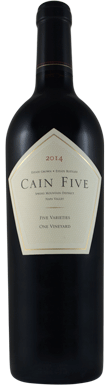
This is an exquisite wine, with fragrant, floral, red-fruit aromas that are lifted and fresh. The attack too is fresh and precise, with good underlying...
2014
Cain Vineyard & WineryNapa Valley
Cain Vineyard & Winery, Cain Five, Napa Valley, Spring Mountain, California, USA, 2012
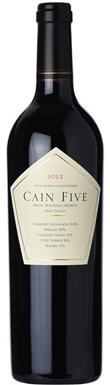
An excellent vintage, this is deeper in colour than most from Cain. The nose is reticent, with cherry, blackcurrant and vanilla aromas. Broad and fleshy,...
2012
Cain Vineyard & WineryNapa Valley
Cain Vineyard & Winery, Cain Five, Napa Valley, Spring Mountain, California, USA, 2007
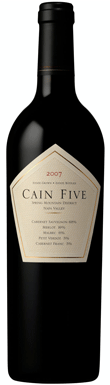
There's nothing flamboyant or flashy on the nose, which is discreet and lifted. It's still tannic and tight on the palate, with good acidity that...
2007
Cain Vineyard & WineryNapa Valley
Cain Vineyard & Winery, Cain Concept, Napa Valley, California, USA, 2010
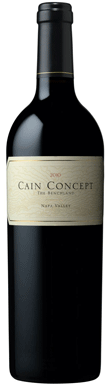
From Napa Valley's benchland vineyards. The nose is rich but discreet, with blackcurrant aromas. It's full-bodied – more so than Cain 5 – with firm...
2010
Cain Vineyard & WineryNapa Valley
Cain Vineyard & Winery, Cain Cuvée NV13, Napa Valley, California, USA
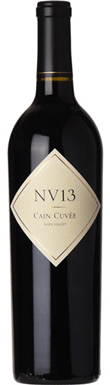
This wine is a blend of the 2012 and 2013 vintages. It's relatively light in colour, and has a lively aroma of red fruits. Medium-bodied,...
Cain Vineyard & WineryNapa Valley
