
Capezzana: Producer profile & tasting back 90 years
The little-known Tuscan appellation of Carmignano has some hidden treasures, as the recent tasting at Capezzana demonstrated...


By uncorking a bottle of 1930 Villa Capezzana, the Contini Bonacossi family reminded us just how deep the history of winemaking is in Carmignano. On 18 September the estate celebrated 90 years of winemaking with a tasting of 12 exceptional vintages.
There are few wineries in Italy, much less in the world, that can claim a history as deep as Capezzana’s. The estate’s cellars unveil old wines that are much more than simple marketing ploys or bottles destined for collectors of old labels: Capezzana has continuously turned out great, sound wines, perfect to drink even with decades of age…and not only for oxidative wine lovers!
Carmignano is an obscure appellation. At the crossroads of the Tuscan provinces of Florence, Prato and Pistoia, on the slopes of Montalbano, evidence of vines here imported from France dates back to the 14th century. Called at the time ‘uva francesca’, what was most likely Cabernet Franc or Carmenere arrived in Carmignano by way of Caterina de’Medici. Throughout the 18th and 19th centuries, Cabernet Sauvignon was commonly planted next to Sangiovese and Canaiolo and thus the Carmignano appellation has always included international grape varieties, making it a historic precursor to the widely known super-tuscan category.
Carmignano’s unique, consistent ability to turn out long-haul wines is credited to this blend. Close to Capezzana there are other great producers such as Piaggia, Fattoria Ambra and the biodynamic Fattoria di Bacchereto. Yet despite such an impressive history and quality producers, Carmignano often remains out of the public eye. In my opinion, this is because the entire appellation accounts for only 200 hectares of vineyards; too small to be critically assessed in the market and too scarce to arouse the interests of wine hunters.
‘Peculiar’ climate
Furthermore, the climate is so peculiar that climatologists are not able to agree on a solid profile. Montalbano straddles the Tuscan coast’s Mediterranean climate and the continental climate of Chianti. Over the last two months of the growing season (September–October) it is not unusual to have more rain than average and, unfortunately, storms or hail are also common. Vineyard altitude, exposure and soils are therefore more crucial than elsewhere. Soil composition is, in fact, another firm determinant of these multilayered wines. ‘We are in a chaotic patchwork of soils. We have vineyards on Galestro schist, Alberese chalk, but also pebbles and green clay. So, although it can be very challenging to work with such a wide range, today we can say that this is one of the secrets of our complexity,’ said Filippo Contini Bonacossi, when presenting the tasting.
The estate spans over 650 hectares of which 78ha are planted to vineyards and 140ha to olive trees which turn out delicious, highly sought-after olive oil each year. The age of the vines at Capezzana ranges from just a few years for the newest plantings up to 55 years in the case of the oldest. Since 2016, Capezzana has been certified organic; an approach which, considering the size of the property, is an important and crucial matter for the environment in the region at large. ‘For us, it guarantees that there is no contamination around the vineyards,’ says the family. Vittorio Contini Bonacossi, who passed away two years ago, was a leading player in establishing an organic district in the Montalbano region. Aside from improving the vineyards, his goal was to preserve the biodiversity of these hills, thus enhancing the complexity of the wine.
Villa Capezzana
Villa Capezzana, the historic label of the estate bottled since 1925, is a blend of Sangiovese and Cabernet Sauvignon. Up until 1995, Canaiolo was also included in the blend. ‘Canaiolo brought aromas to the blend, softening the firm acidity of the Sangiovese,’ notes Bonacossi. Not surprisingly, it was here at Capezzana that Canaiolo ‘graspo rosso’ – a special clone of this indigenous grape – was identified and selected. Despite the elegant nuance of Canaiolo, Bonacossi notes that it is not included anymore in Capezzana’s top wine, ‘because it lacks acidic structure and is sensitive to disease in the vineyards’.
In the winery, only indigenous yeasts are employed. Nevertheless, the fermentation takes place in just seven days followed by another two weeks of maceration. Stylistically, Capezzana has come quite far from the muscular wines of the 1990s such as the 1998, with dry extracts up to 33.29g/L. The 1998 vintage was a turning point – in that year, the estate introduced oak barriques and tonneaux after decades of the steadfast use of large oak vessels. Recent years have seen a return to the classic Capezzana style emblazoned with a new, more balanced style of extraction, despite global warming. The traditional botti were reintroduced in 2015 and are still used today.
Since 2006, the estate has held back 3,000 bottles every year in their cellars in order to preserve Capezzana’s unmatched depth of history. Often celebrated for their highly lauded Vin Santo, the estate showed a truly impressive lineup of Villa Capezzana Carmignano in September, most notably the complex, well-intact 1930, the utterly elegant 1981 and the refined 2010 and 2016.
Capezzana: Tasting wines back to 1930
You may also like:
Antinori’s 2017s: Tignanello & Solaia tasted
Buying a vineyard property in Tuscany: What are the options?
Passopisciaro: Producer profile
Capezzana, Villa di Capezzana, Vino da Tavola, Tuscany, Italy, 1930
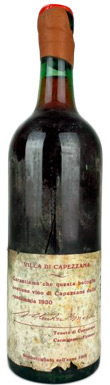

One could be tempted to think naive thoughts when tasting such an ancient vintage. Instead, Villa Capezzana 1930 was not only in good shape, it...
1930
CapezzanaVino da Tavola

Capezzana, Villa di Capezzana, Vino da Tavola, Tuscany, Italy, 1969
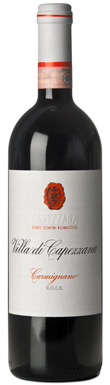
Not too intense on the nose but displaying good concentration on the palate, the 1969 vintage was a balanced season with rainfalls at the right...
1969
CapezzanaVino da Tavola
Capezzana, Villa di Capezzana Riserva, Carmignano, Tuscany, Italy, 1974
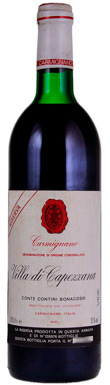
1974 was a unique harvest under a blanket of snow which arrived between the end of October and the beginning of November. The growing season...
1974
CapezzanaCarmignano
Capezzana, Villa di Capezzana Riserva, Carmignano, Tuscany, Italy, 1977
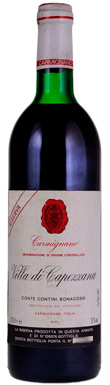
After a rainy spring and a warm summer, some rainy days were registered in September. In the following weeks, good weather allowed the grapes to...
1977
CapezzanaCarmignano
Capezzana, Villa di Capezzana Riserva, Carmignano, Tuscany, Italy, 1981
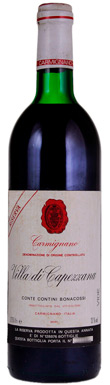
The 1981 vintage registered a favourable climate, not too hot yet dry, resulting in very good ripening. Indeed the wine is one the most elegant...
1981
CapezzanaCarmignano
Capezzana, Villa di Capezzana Riserva, Carmignano, Tuscany, Italy, 1988
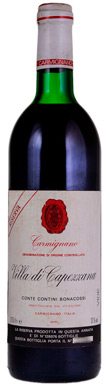
In the first half of the year, with the exception of March, there was little rain. The summer was also dry, with punctuated rainfall in...
1988
CapezzanaCarmignano
Capezzana, Villa di Capezzana Riserva, Carmignano, Tuscany, Italy, 1995
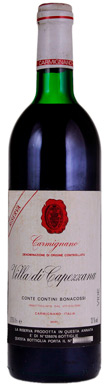
This vintage is usually favoured by connoisseurs because of its tension and typicity. 1995 was the watershed vintage between the cold and the warm years...
1995
CapezzanaCarmignano
Capezzana, Villa di Capezzana, Carmignano, Tuscany, Italy, 1998
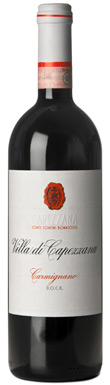
The first vintage to introduce tonneaux instead of botti grandi, marked with a change from the old brown label. An exceptionally warm summer moved the...
1998
CapezzanaCarmignano
Capezzana, Villa di Capezzana, Carmignano, Tuscany, Italy, 2006
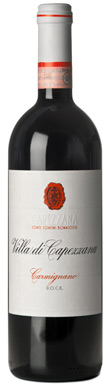
Despite another great vintage in Tuscany, this 2006 lacks the overall harmony to reach the highest level, being the product of the years when concentration...
2006
CapezzanaCarmignano
Capezzana, Villa di Capezzana, Carmignano, Tuscany, Italy, 2010
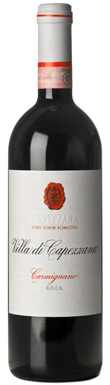
Exciting and unnerving' at the same time because of its relatively early ripening, 2010 was one of the last classic vintages with the harvest at...
2010
CapezzanaCarmignano
Capezzana, Villa di Capezzana, Carmignano, Tuscany, Italy, 2016
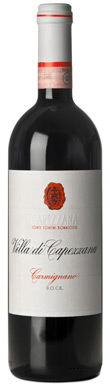
A mild winter was followed by a rainy spring, giving great water reserves for the summer. The growing season was without extremes, the grapes reaching...
2016
CapezzanaCarmignano
Capezzana, Villa di Capezzana, Carmignano, Tuscany, Italy, 2017
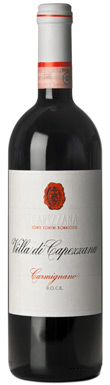
The 2017 vintage was so dry and warm that by the end of September there were 400ml of rainfall registered compared to the annual average...
2017
CapezzanaCarmignano
