
Château La Mission Haut-Brion: An estate second to none
Linked with its illustrious first growth Pessac-Léognan neighbour for more than 450 years, this storied estate is reaching new heights, sometimes spoken of as an unofficial first growth in its own right.


Château La Mission Haut-Brion is situated next door to the Bordeaux 1er Grand Cru Classé Château Haut-Brion, in the rather unlikely location of Talence, a residential suburb about 20 minutes from Bordeaux city centre. In many vintages, it rivals (and in certain years, exceeds) its more famous neighbour.
Yet La Mission continues to fly ‘under the radar’ – a mystery as the quality at La Mission places it at the level of an unofficial sixth first growth.
A recent visit to the Pessac-Léognan estate, in the illustrious company of Domaine Clarence Dillon’s president, HRH Prince Robert of Luxembourg, and deputy managing director Jean-Philippe Delmas, demonstrated the quality here with a memorable tasting of La Mission en magnum.
Delmas introduced the wines as ‘the finest vintages we produced in each of the past four decades’. Even Prince Robert was forced to admit that this sort of review was ‘certainly not a normal event at the château’.
Scroll down to see notes and scores for six emblematic wines from La Mission Haut-Brion
A spiritual dimension
Those who visit Château La Mission Haut-Brion will leave enriched with a greater understanding of the history of this special place. In 1540, Arnaut de Lestonnac became the first owner of the estate, and more than 100 years later, in 1664, Mme de Lestonnac bequeathed the land to a group of Lazarist fathers.
As happened in many parts of Burgundy, the combination of great terroir with the skill and commitment to work of the priesthood elevated the inherent quality of La Mission to even greater heights.
Perhaps as a result of this holy influence, Château La Mission Haut-Brion possesses a unique feel most strongly experienced when visiting the beautiful little chapel constructed by the Lazarists. Compared to the greatest Bordeaux properties, there’s an extra dimension of spirituality in this place. And the wines are undeniably divine.
‘It has a certain aura – some say mystical,’ says Delmas, who is the deputy managing director for both La Mission and Haut-Brion. When asked whether those working at the estate share this feeling, he replies: ‘The presence of the Lazarist fathers left La Mission with an enduring sense of serenity and purity that remains emblematic of the wines to this day. There’s no doubt that those who work at the estate feel this energy.’
Reaching new heights
Although the early history of Château La Mission Haut-Brion is influential, it’s the relatively more recent ownership of the estate that has elevated it to its present level. In 1919, Frédéric Woltner acquired the property, and together with his wife and descendants, began to push La Mission forward.
However, it was the purchase of La Mission in 1983 by Domaine Clarence Dillon (owners of Haut-Brion since 1935), together with investment in a new, ultra-modern vat room in 1987, subsequent renovation of the château, chapel and cellars, and the construction of a new chai in 2007, that have enabled La Mission to reach its current heights.
At the time of the purchase from the Woltners, the president of Domaine Clarence Dillon SA was Madame la Duchesse de Mouchy, daughter of C Douglas Dillon, former US ambassador to France and former secretary of the treasury to President John F Kennedy. Her son, Prince Robert, joined the management team in 1997 before becoming president in 2008.

Building an estate
Chateau La Mission Haut-Brion has 25.5ha under vine for its reds, with a mixture of Cabernet Sauvignon, Merlot and Cabernet Franc (see box, p58) planted in gravelly soil. In addition to the red grand vin, the château also produces a top-quality second wine – La Chapelle de la Mission Haut-Brion – from the same vineyard area.
Since the 2006 vintage, La Chapelle has also benefited from the addition of fruit that was previously used for Château La Tour Haut-Brion – a classified Graves estate that had been bequeathed to the Woltner family in the 1930s.
The estate adds another string to its bow as the producer of perhaps Bordeaux’s best dry white. From 1927 to 1930, Frédéric Woltner sold a white wine labelled as Château La Mission Haut-Brion Blanc. Then, in 1931, he purchased a small neighbouring estate known as Clos Laville, which mostly produced white wine.
He used the two white vineyards to produce a wine that was labelled ‘Château Laville – Terroir du Haut-Brion’ until 1934, when it was renamed Château Laville Haut-Brion. In 2009, the wine came full circle, reverting to its original name, Château La Mission Haut-Brion Blanc.
The Semillon and Sauvignon Blanc grapes that go into the white wine are handpicked in baskets, with fermentation in barrel before ageing in almost 50% new wood. It’s a rich, intense and profound Pessac-Léognan that deservedly commands high prices.
Recently, Delmas says, warmer vintages have resulted in higher proportions of Sauvignon Blanc being used to add extra freshness, with 65% in the blend of 2023. There is also a second white wine, La Clarté de Haut-Brion, which is produced together with Château Haut-Brion.
Care and attention
Both Château Haut-Brion and La Mission are undoubtedly wines of the highest order, despite the fact that the former is designated a first growth, while the latter merits the somewhat lesser classification of Cru Classé de Graves.
Despite the difference in official classification, Delmas stresses that both domaines receive the same amount of attention: ‘The teams remain the same for La Mission and Haut-Brion, and the same level of care is given to both estates, from the vineyard to the cellar.’
Asked about the differences between the two wines, Delmas says: ‘There’s a more subdued and charming atmosphere at La Mission. This immediate charm is reflected in the wine – Haut- Brion is more statuesque in style, a little more reserved, and doesn’t reveal itself as readily.’
Delmas goes on to explain that the châteaux share similar subsoils, with Haut-Brion possessing three different soil types whereas La Mission is dominated by a flat, relatively uniform terrace that surrounds the château. Planting density is also different, with an average of 10,000 vines per hectare for the red grapes at La Mission and 8,000 at Haut-Brion.
Delmas describes a key difference in the orientation of the vineyards on the neighbouring estates, at Haut-Brion the plots being aligned for the greater part north-south, while those of La Mission lie generally more east-west.

La Mission Haut-Brion at a glance
Founded: 1540 by Bordeaux merchant Arnaud de Lestonnac
Owners: The Dillon family purchased the estate in 1983 Classification Cru Classé de Graves since the 1953 classification
Varieties planted: Red 48% Cabernet Sauvignon, 41% Merlot, 11% Cabernet Franc – average vine age about 30 years. White 63% Semillon, 37% Sauvignon Blanc – average age above 40 years
Area planted: 29ha (including about 4ha of white grape varieties)
Soils: Quartz gravel over a subsoil of limestone, clay and shelly sand
Wines: Château La Mission Haut-Brion, La Chapelle de La Mission Haut-Brion, Château La Mission Haut-Brion Blanc, La Clarté de Haut-Brion (produced with Château Haut-Brion)
Annual production: Averaging about 60,000-70,000 bottles for the grand vin and 48,000 bottles of La Chapelle; Château La Mission Haut-Brion Blanc has an annual production of 6,000- 8,500 bottles; La Clarté de Haut-Brion about 12,000 bottles
Key personnel: Jean-Philippe Masclef, technical director; Pascal Baratié, vineyard manager
Compare and contrast
Critics often love to compare and contrast La Mission and Haut-Brion, with Robert Parker Jr renowned for particularly favouring certain vintages of La Mission. The wines from the 1953 and 1975 vintages were notable successes, especially in the context of not being contenders for ‘great’ Bordeaux vintages.
Parker awarded the 1982 a perfect 100 points, with the 2006 another standout achievement in a rather difficult year. Delmas proudly notes that ‘since 1982, La Mission has achieved more perfect scores than any other Left Bank property’.
Asked about the key challenges now being faced by the winemaking team, Delmas explains that ‘recent warm years have led to re-evaluating the use of “green” operations such as leaf removal, thinning and debudding’, adding: ‘These operations were once systematic but are not necessarily so today, although a year like 2023 brought them back to the forefront of our work.’
The 2023 wines are still embryonic but, in a tricky vintage, show huge promise. Both La Chapelle and the grand vin are intense and structured with crisp, ripe, dark fruit characters and the ingredients for long-term ageing. La Mission Blanc is surprisingly delicate right now, given the harvest took place ‘in sweltering heat’, between 24 August and 5 September.
While for the reds, Delmas confirms the harvesting period was the longest ever recorded, stretching across 23 days of picking from 6 September to 3 October.

The sixth first growth
It was a privilege to be able to taste the best wines from the previous four decades. The 2010 seems to be entering a phase in which it’s exuding charm to go alongside the power and structure of this top-class vintage. The 2000 is brooding, less fruit-driven, and will benefit from further ageing.
The 1990 showed perfect maturity, a delicate touch and sweetness of ripe fruit, allied to crisp acidity. The 1983 was perhaps the surprise choice to be shown, given competition from 1982. This is a wine with a wilder, more rugged edge, fully mature yet with at least a decade ahead of it. Prince Robert and Delmas agreed that in 1983, La Mission significantly outperformed Haut-Brion.
Château La Mission Haut-Brion is an estate that has a very long history of producing profound wines from its great terroir. Delmas represents the third generation of his family to be involved in the management of Haut-Brion, and the second at La Mission.
‘My grandfather’s [Georges] focus was on balancing acidity and sugar,’ he explains. ‘My father’s [Jean-Bernard] objectives were to balance acidity and sugar, together with ensuring the ripeness of tannins. My job is to do all this but also to preserve the freshness of fruit and produce wines which are not heavy, and which people want to drink.’
The team at Château La Mission Haut-Brion is certainly producing wines that manage to be both understated yet very fine, distinctive and capable of very long ageing. There are subtle differences between first growth Haut-Brion and La Mission, but there’s very little between them, quality-wise. The description of La Mission as Bordeaux’s ‘sixth first growth’ seems very fair.
Tasting wines such as these is undoubtedly a special event, as is visiting the estate. There’s an aura about La Mission, a pervasive sense of spirituality. The skills originally employed by the priesthood in the 17th century are fully embraced by the current team. This is a Bordeaux estate that possesses an extra dimension, and one that all wine lovers should try.
Château La Mission Haut-Brion
Andy Howard MW’s pick of the crop
Related articles
Château La Mission Haut-Brion, La Mission Haut-Brion Blanc, Pessac-Léognan, Bordeaux, France, 2017
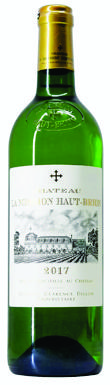

Tropical fruit notes intermingled with lime zest, subtle perfumes of oak and grassy, leafy notes of Sauvignon Blanc. The Semillon adds the power. A profound...
2017
Château La Mission Haut-BrionPessac-Léognan

Château La Mission Haut-Brion, Pessac-Léognan, Cru Classé de Graves, Bordeaux, France, 1990
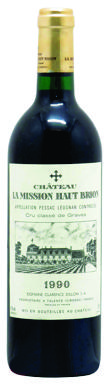
A glorious example of 1990 – not excessively weighty but marked by freshness, poise and wonderful ripeness of dark berry fruit. Impeccable balance. The initial...
1990
Château La Mission Haut-BrionPessac-Léognan
Château La Mission Haut-Brion, Pessac-Léognan, Cru Classé de Graves, Bordeaux, France, 2010
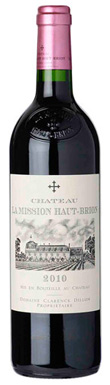
Luxurious, rich and ripe in the mouth, there are fragrant violet notes on the nose, a smoothness to the tannins and supple oak which indicate...
2010
Château La Mission Haut-BrionPessac-Léognan
Château La Mission Haut-Brion, Pessac-Léognan, Cru Classé de Graves, Bordeaux, France, 2000
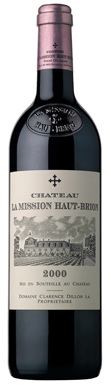
Compared to the 1990, this is clearly a much more 'modern' wine with deep, youthful colour, dark cassis, kirsch and black olive notes on the...
2000
Château La Mission Haut-BrionPessac-Léognan
Château La Mission Haut-Brion, Pessac-Léognan, Cru Classé de Graves, Bordeaux, France, 1983
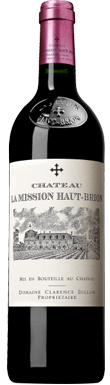
Still remarkably dense and dark in hue, showing little outward signs of 40 years ageing. Has a 'wild', almost rustic nose (the Woltner's apparently were...
1983
Château La Mission Haut-BrionPessac-Léognan
Château La Mission Haut-Brion, La Chapelle de La Mission Haut-Brion, Pessac-Léognan, Bordeaux, France, 2010
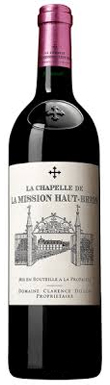
Supple tannins, fresh, vibrant dark fruit and bright acidity. La Chapelle de La Mission 2010 is a 'slimmed-down' version of the wonderful Grand Vin but...
2010
Château La Mission Haut-BrionPessac-Léognan
