
Château Margaux vertical: 1928-2010
Through the lens of 17 memorable vintages, Charles Curtis MW charts the garlanded history of Château Margaux, one of Bordeaux's most refined first growths.

Château Margaux has long been an enigma to me. It has a very high proportion of Cabernet Sauvignon in its vineyards—more than any other first growth save Château Latour—and Cabernet often dominates the wine.
Both the 2000 and 2010 vintages are 90% Cabernet. Yet despite the preponderance of this grape, the word that springs most readily to mind in describing the wines of this château is ‘finesse’.
Scroll down to see Charles Curtis MW’s notes and scores for 17 vintages of Château Margaux
Château Margaux often strikes me as an eminently silky and approachable wine, in contrast to Latour, which seems more muscular and rough-hewn, particularly in its youth.
This ripeness may be down to the depth of the gravel beds, something the former director Paul Pontallier often emphasised. But gravel is typical in the Médoc, while the finesse of Château Margaux is altogether unique.
The birth of Château Margaux
It is thought that the estate dates to the 12th century; Penning-Rowsell says in The Wines of Bordeaux that it belonged to the English king Edward II, although I can find no corroboration for this. Vines were first planted by Pierre de Lestonnac in the late 16th century. By the end of the 17th century, it had attained its present size, and the property came to increasing prominence in the following century.
Early American presidents Thomas Jefferson and John Adams highly lauded the wine of Margaux after their visits in the 1780s. Confiscated during the Revolution, the château was sold several times during the 19th century and saw the turn of the 20th century as the property of banker Count Frédéric Pillet-Will, who emblazoned his name on the label at the time.
Under his administration, the château created the second wine, Pavillon Rouge de Château Margaux. The estate now produces three separate bottlings, the grand vin, Pavillon Rouge and a straight Margaux. The selection for the grand vin is particularly severe.

The château ran into financial difficulties during the phylloxera crisis near the end of the Pillet-Will period, but the family was saved by an infusion of cash from the count’s son-in-law, Louis-Charles de La Trémoille. According to author Nicholas Faith, in his work on the château, La Trémoille resolved to sell the property after losing in the parliamentary elections, and the château was sold to a consortium of investors in 1921, organised by the courtier Pierre Moreau.
Among the purchasers was négociant Fernand Ginestet, whose importer in Saigon loaned him the funds to invest. The Ginestet family would increase their share gradually until they became the sole proprietors in 1950 under Fernand’s son Pierre.
At a previous tasting at the Beau Rivage Hotel in Geneva, I enjoyed two vintages from the Ginestet years, the 1928 and the 1949. Both still showed exceptionally well in 2012, and the 1928 was particularly youthful. Another famous vintage from the Ginestet tenure was the 1966, which I have enjoyed on several occasions and is still in form today.
Although the wines from the later years of this period have not always enjoyed the best reputation, there were undoubtedly memorable high points during the period. As at many châteaux, the years following the energy crisis and recession of the early 1970s were difficult, exacerbated by poor vintages in 1972, 1973 and 1974.
A first growth revival
The Ginestet family was forced to sell the jewel of their empire, although it took them several years to do so. My selection includes the 1978 vintage which was the first vintage completed after the acquisition of the estate by André Mentzelopoulos. His purchase marked the beginning of the true renaissance of Château Margaux. Mentzelopoulos invested greatly in the estate and hired the famous oenologist Emile Peynaud.

Mentzelopoulos was succeeded by his wife and daughter, Corinne, upon his death in 1980, and Corinne became the driving force at the château. She appointed the legendary Paul Pontallier in 1983 as oenologist. He later became the managing director and was the face of the château for 33 years until he passed away suddenly in 2016.
Today, Corinne Mentzelopoulos is still at the helm, joined by her daughter Alexandra and her son Alexis. The managing director is Philippe Bascaules, the technical director is Sébastien Vergne and the commercial director is Aurélien Valance.
Lay of the land
When I visited in 2000, the size of the estate was given as 262ha, nearly the same as in the 17th century. 78ha is planted to vines, with 66ha of black grapes and 12ha of Sauvignon Blanc.
Approaching the château from the south along the famous alley of ancient plane trees, one is surrounded by vineyards on every side, but most of the vineyards (and those most prized) lie behind the château to the north, on the gentle slopes overlooking the Gironde. There are two principal sites for the best grapes.
The walled clos of Le Cap de Haut is split between Cabernet Sauvignon and Merlot, while the rocky confines of Le Puch Sem Peyre (‘well without stones’ in Gascon) are wholly devoted to Cabernet Sauvignon.

Further to the west, the Sauvignon Blanc for Pavillon Blanc is planted in soils with more limestone, and there is a small amount of Cabernet Franc and some 60-year-old vines of Petit Verdot along the road to St-Julien.
The Cabernet is planted along the gravel mounds from whence came the original name of the property, La Mothe de Margaux, while the Merlot is planted where there is more clay, and ceramic drains are installed as needed.
There is even a small parcel called Les Brauzes along the border with Château Palmer that had a hard layer of clay which impeded drainage of this section, so much so that Mentzelopoulos had it excavated and replaced with earth from elsewhere on the estate. The property practises sustainable agriculture, mainly employing organic principles (although it is not certified) and does not use pesticides.
The grapes are picked when ripe, but not exaggeratedly so. Fermentation is done in a combination of oak and stainless-steel vats. After a fermentation that can approach four weeks, the finished wine is run into casks where it will age for up to two years before fining with egg whites and bottling.
The entire process is traditional, measured and balanced, and this harmony comes through in the finished wine. The beauty of Château Margaux is in its elegance, and this vertical tasting easily demonstrates how richly it merits its centuries of accolades.
How this vertical tasting was organised
As a companion to the soon-to-be-published vertical of Château Haut-Brion, host Mark Taylor (long-time fine wine collector and inventor of The Durand® – a patented, two part device that enables the removal of older and fragile wine corks whole and intact), treated us to the opportunity to luxuriate in the deliciously silken wines of Château Margaux. The preparations begin several hours before the start. Master Sommelier Michael McNeill and I open and taste the wines with the help of Ohio-based collector John Hames, looking for cork taint and other faults. We double-decant the younger wines to clean them of sediment and help them open up, then bag the wines and number them to protect their identity.
Moments before tasting (right after a glass of white Burgundy and a light snack), a phalanx of volunteers pours the wines, and we begin to ponder them. This year, however, we encountered a problem – one of the bottles of the 1982 vintage was oxidized and could not be served. In this instance, Mark Taylor would replace the bottle if possible, but he did not have a replacement for the 1982. We decided after much debate that we would open a bottle of the 1978 (the first vintage for the present owners), and half of the tasters would get the former and the other half, the latter.
The most striking aspect of this vertical tasting was the rock-solid consistency and quality of the wines under the Mentzelopoulos ownership. The 2000, 2009, and 2010 vintages understandably proved to be high points. The only disappointment (if any) was the 2004 vintage, a notoriously challenging one in Bordeaux.
I do not mean to say the wines do not evolve, since I have had the 1990 vintage on many occasions, and it has changed over time. This year it seemed more solid, firm, and almost more youthful than it has in the past, when it has seemed voluptuous and approachable. The evidence of this tasting suggests that prudent collectors would wait for the 2010, 2009, 2006, and 2003 vintages. The delightfully accessible 2002 vintage and all those produced before it seem ready to drink.
My sense is that the monumental 1982 still has a long future before it, while the 1978, though delightful now, should be enjoyed sooner rather than later.
See Charles Curtis MW’s notes and scores of 17 Château Margaux wines
Related articles
- September fine wine releases on La Place de Bordeaux 2023
- Top wine consultant Stéphane Derenoncourt to focus on ‘new projects’
- Bordeaux: Hopes rise for 2023 harvest but mildew leaves mark
Château Margaux, Margaux, 1er Cru Classé, Bordeaux, France, 2010
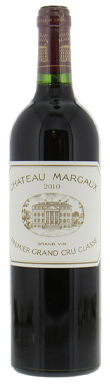

Fresh and youthful aromas of understated curranty fruit with cedar, smoke, and spice accents lead to a silky, archetypical Margaux texture with silky tannins, perfect...
2010
Château MargauxMargaux

Château Margaux, Margaux, 1er Cru Classé, Bordeaux, France, 2009
<p>If you want to drink a Margaux 2009 any time soon, you need to go for the Pavillon - the grand vin is still extremely...
2009
Château MargauxMargaux
Château Margaux, Margaux, 1er Cru Classé, Bordeaux, France, 2006
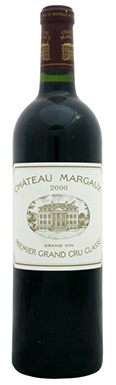
Once inky dark and tannic, the 2006 Margaux impressed me now as the picture of elegance, with enticing aromas of ripe blackcurrant and mulberry, hints...
2006
Château MargauxMargaux
Château Margaux, Margaux, 1er Cru Classé, Bordeaux, France, 2004
The 2004 Margaux tasted blind struck me as classic claret, with a bouquet of currant, graphite, mint, and smoke, with a supple elegance, fresh acidity,...
2004
Château MargauxMargaux
Château Margaux, Margaux, 1er Cru Classé, Bordeaux, France, 2003
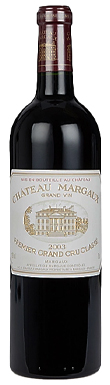
This monumental wine boasts a super-ripe bouquet of fig, plum and blackberry fruit, with cedar, pepper and earth notes. The spice from the cask ageing...
2003
Château MargauxMargaux
Château Margaux, Margaux, 1er Cru Classé, Bordeaux, France, 2002
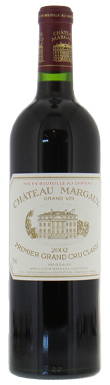
Surprisingly dark colour and the aromas are still reasonably youthful, with notes of pomegranate and raspberry shaded with cedar and smoke. The feel on the...
2002
Château MargauxMargaux
Château Margaux, Margaux, 1er Cru Classé, Bordeaux, France, 2001
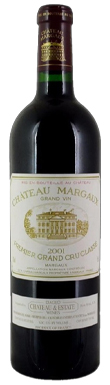
2001 as a vintage was unfortunately eclipsed by the one preceding it. This superb wine shows restrained, elegant blackcurrant fruit aromas, edged with spice and...
2001
Château MargauxMargaux
Château Margaux, Margaux, 1er Cru Classé, Bordeaux, France, 2000

This thrilling wine from a textbook year is dark in colour and shows pronounced aromas of ripe mulberry and black plum fruit, with hints of...
2000
Château MargauxMargaux
Château Margaux, Margaux, 1er Cru Classé, Bordeaux, France, 1998
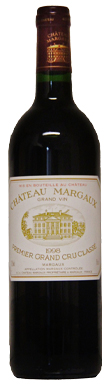
The slightly lighter colour and developing aromas demonstrate that this is starting to mature. Still, the abundant blackcurrant fruit aromas are touched with mint and...
1998
Château MargauxMargaux
Château Margaux, Margaux, 1er Cru Classé, Bordeaux, France, 1995
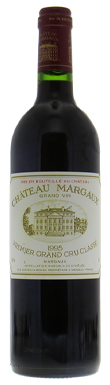
A surprise. Initially deceived by its light colour, I was taken by the beguiling intensity of plummy fruit aromas with hints of smoke, earth and...
1995
Château MargauxMargaux
Château Margaux, Margaux, 1er Cru Classé, Bordeaux, France, 1990
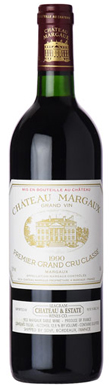
This is a great wine and, like all the greats, it is always changing. In some recent showings it has been effusively plump and energetic,...
1990
Château MargauxMargaux
Château Margaux, Margaux, 1er Cru Classé, Bordeaux, France, 1982
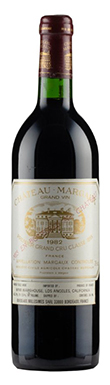
Vibrant, elegant and characterful – a complex nose full of floral scents, baked blackcurrants and cherries, totally beguiling yet delicate and graceful. A smoky palate...
1982
Château MargauxMargaux
Château Margaux, Margaux, 1er Cru Classé, Bordeaux, France, 1978
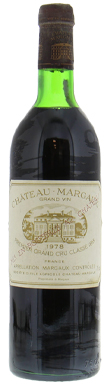
Holding together well and remains tannic and firm. Although the vintage generally is somewhat overlooked, Château Margaux has always been counted among the most successful...
1978
Château MargauxMargaux
Château Margaux, Margaux, 1er Cru Classé, Bordeaux, France, 1966
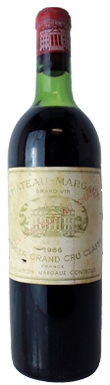
Superbly rich, this is an eloquent argument that there are no great wines, only great bottles (or magnums in this case). While some may overlook...
1966
Château MargauxMargaux
Château Margaux, Margaux, 1er Cru Classé, Bordeaux, France, 1961
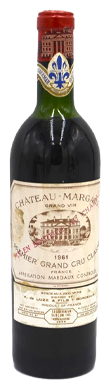
This vintage is unlike the wines Château Margaux produces today, with their silky elegance and almost reticent charm. Instead of today's subtle style, this displays...
1961
Château MargauxMargaux
Château Margaux, Margaux, 1er Cru Classé, Bordeaux, France, 1949
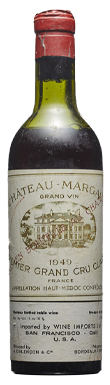
Mature and evolved, but still lovely. Shows a beautiful, translucent garnet colour with an orange rim. The bouquet is hugely aromatic, with mature cherry fruit...
1949
Château MargauxMargaux
Château Margaux, Margaux, 1er Cru Classé, Bordeaux, France, 1928
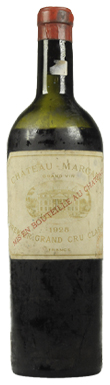
Lively blackcurrant and truffle nose, with mysterious hints of mineral and earth. Has an almost rustic edge, with a suggestion of leather and game. On...
1928
Château MargauxMargaux