
Comparing Bordeaux’s two Château Pichon estates
Feminine charm versus masculine power: is an outdated cliché still sufficient to explain the differences between Pauillac’s two famous second growths? Panos Kakaviatos investigates, and Jane Anson tastes through the vintages...
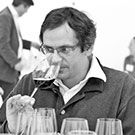

Visitors to Bordeaux cannot help but admire the gorgeous architecture of Pauillac’s two celebrated second growths – Château Pichon-Longueville Baron and Château Pichon Longueville Comtesse de Lalande – facing each other along the Médoc’s famous D2 highway, known as the Route des Châteaux.
With emblematic turrets and an ornamental pool that, since 2006, conceals an elaborate underground cellar, the larger 19th-century Pichon Baron château is one of the most photographed in the Médoc.
Across the road, the more discreet estate of Pichon Comtesse – which includes an even more recently built winery with many small tanks, to enable parcel-by-parcel fermentation – exudes perhaps a more feminine charm.
Scroll down to see Jane Anson’s Château Pichon tasting notes
The masculine-feminine depiction dates back to the mid-19th century when the once unified 50ha estate was divided in two, after Baron Joseph de Pichon Longueville died.
Three daughters inherited 30ha to form what became known as Pichon Longueville Comtesse de Lalande, and a son took 20ha of what became known as Pichon Longueville Baron.
For many years, women ran Pichon Comtesse, most recently the charismatic May-Eliane de Lencquesaing (1978-2007), who had amassed an impressive private glass collection that enchants visitors.
Wine commentators around the world also compare the wines in gender-based terms. Pichon Comtesse wines are more ‘feminine and elegant’, while Pichon Baron wines are more ‘deeply powerful and intense’, wrote Karen MacNeil in The Wine Bible. And Decanter’s Ian D’Agata dubs Pichon Comtesse as ‘one of Pauillac’s more feminine wines’.
Some clichés die hard – and some merit deeper study. The directors of both Pichons today are perplexed by this long-standing characterisation of their properties, but could it be that their very different winemaking is reinforcing it more than ever?
Take, for example, the 2005 vintage. Influential US wine critic Robert Parker gave the Pichon Comtesse a modest 86 points from barrel, critical of its ‘much lighter style’, but Pichon Comtesse director Nicolas Glumineau features the vintage in tastings to prove such criticism wrong.
Glumineau, who arrived at the estate from Château Montrose, St-Estèphe in 2012, heralds the wine as typical of the expressive Pichon Comtesse style.
By contrast, Pichon Baron’s Christian Seely has only recently included his 2005 in public tastings.
‘I’m happy with talking about Pichon Baron as a wine that reveals itself over time and sometimes – the 2005 is a case in point – it can be so reserved and austere that it is quite difficult to taste at the beginning.’
The masculine moniker is however ‘a tricky issue’, Seely says, ‘having known powerful, austere females in my life’.
For Glumineau, reducing descriptions of his wine to a feminine image is ‘a mistake’ and more ‘about marketing’, although he emphasises that elegance is very much part of Pichon Comtesse’s DNA.
Pichon Baron at a glance
Management Since 1987, AXA Millésimes
Managing director Since 2000, Christian Seely
Technical director Jean-René Matignon; AXA advisor Daniel Llose
Plantings Cabernet Sauvignon 62%, Merlot 33%, Cabernet Franc 3%, Petit Verdot 2%
Size 72ha, producing about 12,500 cases of the first wine
Second wines Les Griffons de Pichon Baron; Les Tourelles de Longueville
Average bottle price £70-£150 (depending on vintage)
Baron: soulful power
Since Christian Seely began working as director at Pichon Baron in 2000, he and his team have blazed a trail towards making more powerful wines. Of 72ha owned by the estate today, the first wine is made primarily from older vines growing on the estate’s prized 40ha plateau of gravel beds with poor soils that force the vines to penetrate deep into the ground.
But that was not the case in the 1990s. ‘When I arrived, we [along with long-standing technical director Jean-René Matignon] reached a strategic decision to make considerably less but better Pichon Baron than before,’ Seely explains.
Grapes from Merlot vines west of the plateau, which had been used to make Pichon Baron in the 1990s, now go into the second wine Les Tourelles de Longueville. This is a blend based on 65% Merlot; it is aged in 30% new oak – and is intended for earlier consumption. About 11,000 cases of Les Tourelles 2014 are expected.
Since 2012, Seely and his team have also introduced another second wine called Les Griffons. This new wine sits alongside Les Tourelles in quality but has a different stylistic intent. It has much more Cabernet in the blend as it is made from various parcels that are ‘geographically and in personality closer to the character of Pichon Baron’. For the 2014, some 5,000 cases of Les Griffons have been made – the most since the wine was introduced.
The resulting increase in Cabernet Sauvignon in the blend of the grand vin – from about 60% Cabernet Sauvignon and 40% Merlot in the 1990s, to an 80/20 blend today – lends a more foreboding aspect to Pichon Baron when compared to Pichon Comtesse, which is typically 58% to 78% Cabernet Sauvignon. In addition, the wine is aged in 80% new oak, as compared to 50% for Pichon Comtesse, accentuating Pichon Baron’s larger-scaled aspect.
Seely recalls tasting the ‘beautiful’ 1959 Pichon Baron – essentially made from vines on the 40ha plateau – and while the intention is not to ‘copy’ that older wine, it is to make wines that best reflect the ‘soul of the place’, he says. The 2005 vintage marked a ‘turning point’ in terms of both quality and quantity.
‘It showed how great the wine can be, and it ensured that I would keep my job, given the high-risk strategy of making half as much wine as we had before,’ Seely remarks. The average annual production of Pichon Baron is now about 12,500 cases – about the level of a smaller vintage of Pichon Comtesse.
Pichon Comtesse at a glance
Management The Rouzaud family of Louis Roederer Champagne purchased the estate in 2007 from May-Eliane de Lencquesaing
Managing director Nicolas Glumineau
Consultants Eric Boissenot and Denis Dubourdieu
Plantings Cabernet Sauvignon 50%, Merlot 30%, Cabernet Franc 12%, Petit Verdot 8% (Cabernet being increased)
Size 89ha, producing 12,500-15,000 cases of the first wine
Second wine Réserve de la Comtesse
Average bottle price £70-£150 (depending on vintage)
Comtesse: expressive charm
While Pichon Baron has enjoyed consistent direction under Seely for some 15 years, Pichon Comtesse witnessed some significant changes over the same period – both before and after its purchase in 2007 by the owners of Louis Roederer Champagne.
In 2011, Thomas Dô-Chi-Nam, who had been Pichon Comtesse technical director since 1992, left the estate to work at Château Margaux. That same year, Sylvie Cazes replaced Gildas d’Ollone as managing director. But in 2012, Glumineau replaced Cazes.
Consultants have also varied. For example, in 2006, Hubert de Boüard of Château Angelus in St-Emilion was hired for the estate. He advocated de-leafing vines on both sides, which resulted in a more concentrated style of Pichon Comtesse that garnered more points from US critic Robert Parker than the 2005, but is not the kind of wine that Glumineau necessarily seeks, he says.
Shortly after Glumineau arrived at the estate, he tasted a vertical of all Pichon Comtesse wines from 1970 to 2010, admiring the ‘very Pauillac’ nature of vintages such as 1989, 1996 and 2010. He does admire the Cabernets in Pichon Baron: ‘They are great wines. I love the silky tannins with a cocoa powder-like feel at the end of the tongue.’
However, although he allows that the 2005 Pichon Comtesse ‘could perhaps have used a bit more density’, he has no intention of making the same wine as ‘across the street’. Picking times for Cabernet are not necessarily later under his direction, but they are being tailored to each of the parcels, so that the Cabernets can achieve that ‘greater density’. The 2014 and 2015 vintages, for example, convey ‘something very Pauillac’ for Glumineau, ‘in balance with the charming expression of Comtesse’.
With regard to Cabernet Sauvignon, Glumineau’s vision is to increase its density in a subtle manner in the Pichon Comtesse blend, while maintaining the wine’s elegance and freshness. Upon purchasing the estate, the Louis Roederer group commissioned a detailed geological study of the vineyard, which found too much Merlot had been planted on deep gravelly soils that are better suited to Cabernet.
A replanting programme now under way should increase the vineyard’s percentage of Cabernet Sauvignon from the current 50% up to as much as 65%, says Glumineau, who gives an example of a 2ha plot called La Turcade, where the Merlot vines were uprooted just after the 2015 harvest, to be replaced by Cabernet Sauvignon in 2018.
Distinct personalities
Nevertheless, the percentage of Merlot in Glumineau’s ideal blend for the grand vin – about 25% – remains higher than that at Pichon Baron. Indeed, the higher percentage of Merlot in Pichon Comtesse has often been cited as a factor in its softer, ‘more feminine’ expression, by comparison to Pichon Baron. Pichon Comtesse is also known for its Cabernet Franc and Petit Verdot, which Glumineau likes most at about 10% of the overall blend – in fact, Cabernet Franc has not featured at all in the Pichon Baron blend since 2006, when it was just 2%.
So, although both Pichon estates focus on making wines of the utmost quality, stylistic goals differ substantially. Whereas Seely has been cutting down the amount of Pichon Baron grand vin, Glumineau hopes to produce ‘more first-label wine’ and ‘certainly’ has no plans to create another second wine in addition to the existing (since 1973) Réserve de la Comtesse.
Current production of Pichon Comtesse varies between 12,500 and 15,000 cases – generally higher than Pichon Baron. Glumineau would like higher yields as well. In 2014, the yield was 36hl/ha. ‘It has to be higher – we could make 45-50hl/ha,’ he says, pointing to the success of higher yields in wines made in the 1980s, a decade that cemented Pichon Comtesse’s position as a ‘super second’. Over lunch after a tasting, Glumineau serves a wonderfully balanced 1985 by way of example.
At Pichon Baron, although Seely does not seek ‘super-low yields’, the average yield from vines grown on the estate’s 40ha plateau is about 30hl/ha – the overall average yield for the grand vin is higher, though, when factoring in other plots used to make it.
Both Glumineau and Seely respect one another’s wines. Seely, for example, particularly likes the ‘deeply romantic’ 1982 Pichon Comtesse, which was served at his mother’s second wedding.
But they stress that the common origin of both estates does not mean at all that they are similar. Readers should note that just because the two Pichons face one another across the D2, their vines are not equally divided either side it. In fact, most of Pichon Comtesse’s vineyard plots are situated on the same side of the road as those of Pichon Baron. Pichon Comtesse also has a vineyard to the south of the appellation, in St-Julien.
‘The fascination people can sense with grand cru wines in Bordeaux – and with properties from other regions of the world that show the same level of quality – is how properties that are very close to each other can produce very different wines,’ comments Seely. ‘So it is perfectly normal that two neighbouring properties are very different in character and personality; in the case of Baron and Comtesse, they happen to share parts of the same name.’
As the tasting notes below by Jane Anson illustrate, the two Pichons express different styles of Pauillac. The debatable masculine/ feminine cliché may not wholly explain the difference between the two, but it points in a logical direction.
See Jane Anson’s tasting notes comparing the two Château Pichon estates:
You may also like:
Pauillac vs Pomerol
Super Tuscan evolution: Comparing Tignanello and Solaia
Comparing Artadi terroirs: Single vineyard wines
Château Pichon Baron, Pauillac, 2ème Cru Classé, Bordeaux, France, 2009
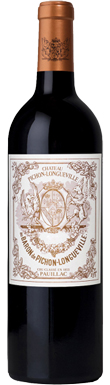

<p>Straight away the deep, rich colour tells you that this is a sexy, powerful wine, barely hitting the next stage of evolution at seven years...
2009
Château Pichon BaronPauillac

Château Pichon Baron, Pauillac, 2ème Cru Classé, Bordeaux, France, 1990
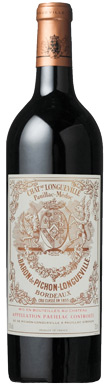
Approaching its 26th birthday, this has an enticing grilled-fruit nose and still feels full of vivacity. The tertiary flavours are showing through with tobacco and...
1990
Château Pichon BaronPauillac
Château Pichon Baron, Pauillac, 2ème Cru Classé, Bordeaux, France, 2014
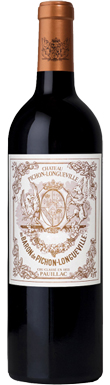
From vines that have reached an average of 35 years old, this is rich, firm and broad-shouldered, with dark bilberry fruits overlaid with steely flint...
2014
Château Pichon BaronPauillac
Château Pichon Baron, Pauillac, 2ème Cru Classé, Pauillac, Bordeaux, France, 2002
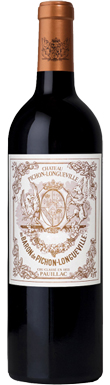
Perhaps not the most lauded vintage, but after nearly 14 years this 2002 is showing well. It majors on the austere face of Cabernet fruit,...
2002
Château Pichon BaronPauillac
Château Pichon Baron, Les Tourelles de Longueville, Pauillac, 2ème Cru Classé, Bordeaux, France, 2014
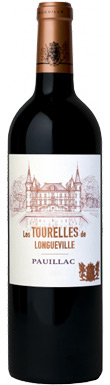
With its higher Merlot content, this is certainly the better choice of the two Pichon Baron second wines for drinking over the next five to...
2014
Château Pichon BaronPauillac
Château Pichon Longueville Comtesse de Lalande, Pauillac, 2ème Cru Classé, Bordeaux, France, 2010
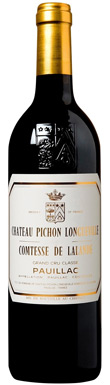
Brilliant – double decant and wait an hour so the wine can better express its sensual aromas of faded rose, cassis, homemade strawberry jam, graphite...
2010
Château Pichon Longueville Comtesse de LalandePauillac
Château Pichon Longueville Comtesse de Lalande, Pauillac, 2ème Cru Classé, Bordeaux, France, 2005
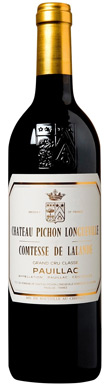
This needs time in the glass, but unfurls to reveal cedar, cinnamon, tobacco, cassis and rose notes. It's heady and confident stuff that I've tasted...
2005
Château Pichon Longueville Comtesse de LalandePauillac
Château Pichon Longueville Comtesse de Lalande, Pauillac, 2ème Cru Classé, Bordeaux, France, 2014
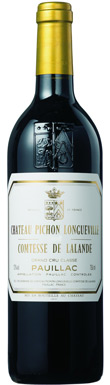
Strongly scented on the nose. Smooth and supple, this has bite and tang and grip, a juicy almost sweet centre with lovely aspects of creaminess...
2014
Château Pichon Longueville Comtesse de LalandePauillac
Château Pichon Longueville Comtesse de Lalande, Pauillac, 2ème Cru Classé, Bordeaux, France, 1996
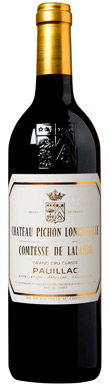
I have had better bottles of this particular vintage from Pichon Comtesse, and in this lineup the Pichon Baron is the one that stood out,...
1996
Château Pichon Longueville Comtesse de LalandePauillac
Château Pichon Longueville Comtesse de Lalande, Reserve de la Comtesse, Pauillac, Bordeaux, France, 2014
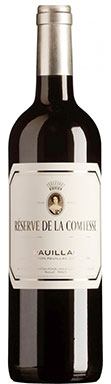
The excellence of this second wine vindicates the appointment of Nicolas Glumineau as technical director in 2012. The nose shows black fruit aromas, and there's...
2014
Château Pichon Longueville Comtesse de LalandePauillac
