
First taste: Louis Roederer Cristal 2014
Simon Field MW tastes and rates the newly released 2014 vintage of one of Champagne's most famous names.

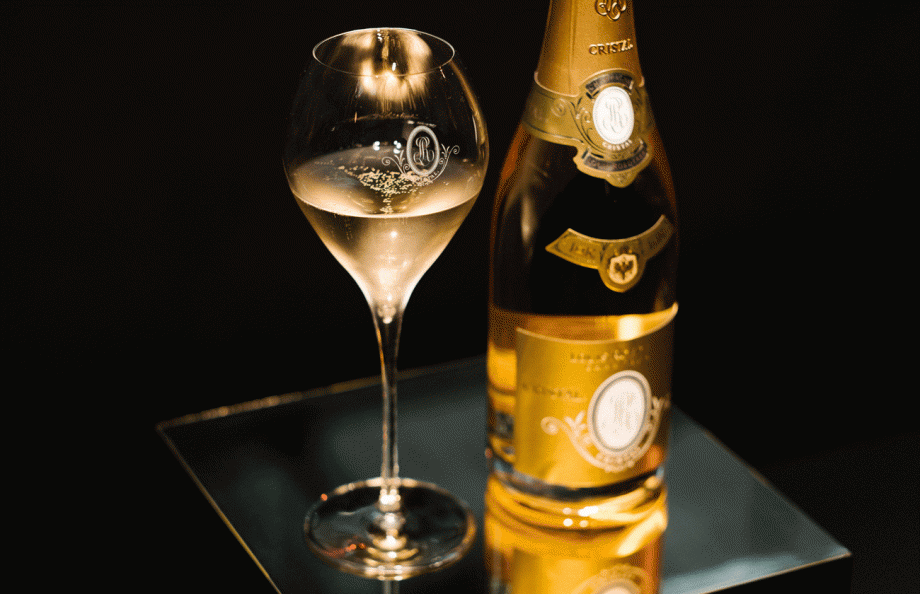
Jean-Baptiste Lecaillon, chef de cave at Louis Roederer since 1999, describes the unpredictable 2014 vintage as a ‘weather waltz’: an unusually warm spring, almost like summer, was followed by a cool, somewhat autumnal August, and finally a sunny and dry September that was almost like summer again.
In the face of such whimsical patterns, the winemaker needs to be on their guard. More importantly, says Lecaillon, one needs to have complete confidence in the land itself.
He describes his 2014 Cristal as ‘a wine of soil, and not a wine of climate’, adding that ‘climate plays an increasingly unpredictable game’.
‘Chalk is, and always will be, the essence of Cristal’, he says.
Scroll down for the tasting note and score for Louis Roederer Cristal 2014
Biodynamic approach
Louis Roederer only uses fruit from its own 45 plots to make Cristal. These vineyards are all farmed organically, and in 2021 they achieved biodynamic status.
These practises have been in place since 2014, allowing the vines’ roots to dig deep and to counter the potential problems provoked by what Jean-Baptiste describes as summer’s ‘oceanic’ weather.
He didn’t encounter any problems with the notorious Drosophila Suzukii fruit fly either; ‘organically-grown skins are too thick for them,’ he says, extending the putative protection to all threats from moisture and more specifically, botrytis.
All the more important because 2014, unlike 2013, enjoyed a long growing season, with all fruit picked during the seven days after 20 September.
And the results? Fabulous! Lecaillon describes the ‘density, radiance and elegance’ of the 2014, and one is disinclined to disagree.
Winemaking
There is great purity too, maintained by minimal intervention in the winery, altough there is the occasional experimentation with yeast (the black box of the winery) and oak. One third of the 2014 was fermented in large oak casks. Malolactic fermentation was suppressed and the dosage, as usual, was around 7g/L.
The plots (39 of the 45 available were used this time) are vinified separately and then blended – a process that Lecaillon prefers to describe as ‘composition’, the art of fine-tuning to make sure, in his words, ‘that we do not lose the essence of this great domaine’.
The emphasis is on dry extract – which denotes the viscosity or body of a wine – allied to low pH. He describes the juxtaposition of these two factors as a wine’s ‘passport to ageability’.
Gastronomic wine
Or indeed a passport to perfection, one might say. Poetic to the last, Lecaillon reminds us that Cristal, which dates back to 1876, recalls the epoch of Baudelaire and Matisse’s ‘luxe, calme et volupté’.
‘Consider this’, he says, ‘100 years ago, Champagne was a dessert wine; 50 years ago, it was an aperitif. Now it is a fully fledged gastronomic wine, its texture and complexity unchallenged. There can be no better example of this than Cristal 2014’.
Louis Roederer Cristal 2014 will launch on the UK market in mid-February, with a retail price of around £260-£270 per 75cl bottle.
Stockists include Berry Bros & Rudd, Harrods, Selfridges and The Finest Bubble. It will be available in Waitrose and Majestic from early March.
See the tasting note and score for Louis Roederer Cristal 2014
Related content
Best Champagnes tasted by our experts in 2021
First taste: Salon 2012 and Delamotte 2014
First taste: Louis Roederer Collection 242
Louis Roederer, Cristal, Champagne, France, 2014
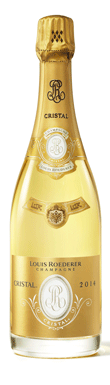

By 2014, all of the grapes made for Cristal were being farmed biodynamically and certified organic since 2012. So alive on the nose, bursting with...
2014
Louis Roederer

