
First taste masterclass: Billecart-Salmon’s Elisabeth Salmon Rosé 2008
Peter Liem recently co-hosted a Decanter virtual masterclass to mark the release of Billecart-Salmon's Elisabeth Salmon Rosé 2008, with Mathieu Roland-Billecart, the house's CEO. A tasting also of the Rosé NV was the perfect lead-in to the unveiling of the the house's prestige rosé.

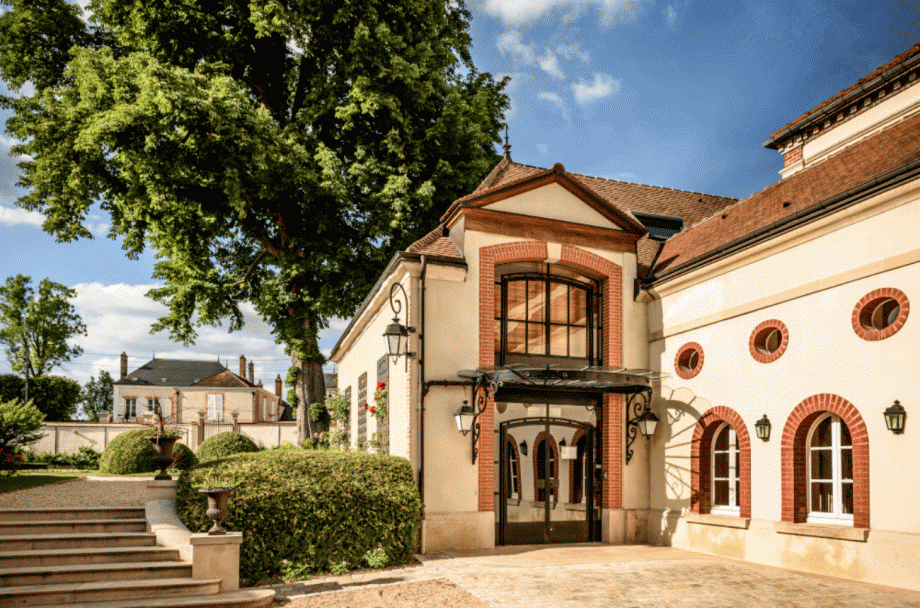
While Billecart-Salmon makes a wide range of excellent Champagnes, for many people it’s most strongly associated with its rosé.
In fact, Billecart-Salmon has been making rosé Champagne for a notably long time, almost since the house was founded in 1818. ‘We don’t have an exact date, but we’ve been making rosé since at least 1840,’ says Mathieu Roland-Billecart, the house’s CEO. ‘We know that, because we have labels from that time saying oeil de perdrix, which was the old name, and also letters from customers asking for our ‘tinted’ Champagne.’
Scroll down for Peter Liem’s tasting notes and scores for Elisabeth Salmon Rosé 2008 and the NV Rosé
Rosé takes off
However, rosé was not historically a very common or popular style of Champagne, and as it was largely made by macerating red grapes, it often had a reputation for being heavy and tannic.
‘It wasn’t until the 1960s that my great-uncle Jean decided to make a rosé with the finesse and elegance that is a signature of our house today, and as part of this he moved away from the maceration technique to the blended technique,’ explains Roland-Billecart.
‘Still, rosé was not really a focus for people, and it took some time for the house’s rosé to get noticed. It was only really in the 1990s, when the chefs in Paris, plus some of the top names in the US, started saying, “Look, even if you don’t like rosé, you have to try this one”.’
Tickets now on sale for Decanter’s next virtual masterclass:
Tickets are now on sale for Decanter’s next Virtual Masterclass, Château Margaux: Five Centuries of Passion – CLICK HERE TO FIND OUT MORE
Not a Decanter Premium subscriber yet? To avoid missing out and enjoy priority booking become a Decanter Premium member today
Brut Rosé NV
As the house’s primary ambassador for many wine lovers, Billecart’s non-vintage rosé is a Champagne that appeals to connoisseurs and casual drinkers alike, thriving on its fine texture and graceful, elegant poise.
‘Its DNA today is a fine balance between little red fruits and citrus,’ Roland-Billecart says. ‘The red fruits like strawberries and raspberries give you fruitiness, and the citrus gives you that little kick at the end, a freshness and balance.’
The base of the blend is made up of 40% Chardonnay, 30% Pinot Noir and 30% Pinot Meunier, to which is added about 7% of red wine. This red wine is always Pinot Noir, from low-yielding vines between 40 and 80 years old, although the goal is concentration of flavour rather than of structure. ‘We don’t seek power, we seek fruitiness,’ says Roland-Billecart, ‘so we vinify in stainless steel to keep a degree of freshness and as little tannin as possible.’
He also cites the house’s characteristically cool fermentations as a key contributor to the wine’s character. ‘We slow the fermentation process by cooling the temperature of our tanks to around 13˚C, which means the process takes two to three weeks. This is again something that my great-uncle started, because he noticed that we were able to extract more finesse using this technique.’
Watch the full Decanter Billecart-Salmon virtual masterclass
Elisabeth Salmon Rosé 2008
Elisabeth Salmon was created in the 1980s as a counterpart to the house’s highly regarded prestige cuvée, Nicolas François. ‘The reason for its birth was quite simple,’ explains Roland-Billecart. ‘A lot of clients and distributors said, “Well, you make a great rosé and you make a great Nicolas François, so surely you can make a prestige rosé”.’ And that’s really the genesis of it.’ The first vintage was 1988, released in 2001.
Named for the other half of the house’s founding couple, Elisabeth Salmon is typically a blend of 55% Pinot Noir and 45% Chardonnay. ‘We love Meunier as a grape variety, but we don’t think it ages as brilliantly as Pinot Noir and Chardonnay,’ he notes.
In terms of terroirs, it’s all grand cru except for the premier cru Mareuil-sur-Aÿ, which many in Champagne regard as grand cru in quality.
The Chardonnay comes from Chouilly, Cramant and Le Mesnil-sur-Oger, while the Pinot Noir comes from six villages, although Roland-Billecart thinks of these as three pairs instead of six different crus, due to their geographical locations: Aÿ and Mareuil-sur-Aÿ, Bouzy and Ambonnay, and Verzy and Verzenay.
As a vintage Champagne, Elisabeth Salmon clearly differs in personality from the non-vintage rosé, while retaining the signature of the house’s style. ‘It is Billecart before being Elisabeth Salmon, so it’s still about finesse, elegance and balance,’ says Roland-Billecart. ‘But I think what defines Elisabeth is more depth. And it always has a little spiciness that comes from the red wine.’ The red wine, from old vines in the Mareuil vineyard of Les Valofroys, is a little more powerful than the one used for the non-vintage rosé, as it’s intended for longer ageing, and there’s slightly more of it, about 9%.
2008: a great but atypical vintage
The 2008 vintage in Champagne is undoubtedly one of the finest of the last 20 years, although Roland-Billecart observes that it wasn’t entirely typical.
‘The Chardonnay had great depth and provided more structure, while the Pinot Noir was bringing more minerality, which is not what you’d expect.’
He also notes that 2008 was the first time that the house included barrel-fermented wines in this cuvée, which represent about 17% of the blend. ‘It was a relatively late harvest by today’s standards, and it’s defined by its freshness and salinity,’ he says.
‘One of the reasons we used barrel-fermented wines is because they bring more oxidation and more depth. Elisabeth doesn’t always need that, but in this year we thought it did, and with time we’re glad we did it.’
While the 2008 Elisabeth Salmon has a personality all its own, I asked him if there was a vintage of the past that it reminded him of. ‘I can find three links: 1996, for its sharpness and acidity, and 2002, because of the spiciness on the back palate. And there’s a wiseness to the 2008 which we had in 2007 as well. Maybe it’s viticulture, maybe it’s us getting better at our work, but I can see Elisabeth Salmon evolving for the better.’
Tasting Billecart-Salmon rosés including Elisabeth Salmon Rosé 2008:
You may also like:
When should I open my NV Champagne?
How to store Champagne at home
How Champagne’s 2020 vintage is shaping up
Tickets now on sale for Decanter’s next Virtual Masterclass:
Tickets are now on sale for Decanter’s next Virtual Masterclass, Château Margaux: Five Centuries of Passion – CLICK HERE TO FIND OUT MORE
Not a Decanter Premium subscriber yet? To avoid missing out and enjoy priority booking become a Decanter Premium member today
Billecart-Salmon, Rosé NV, Champagne, France
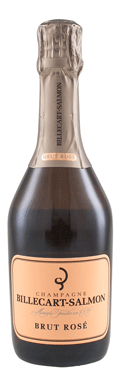

Currently based on the 2016 harvest, this is floral and citrussy, showing a lithe, graceful balance. It’s a blend of 40% Chardonnay, 30% Pinot Noir...
Billecart-Salmon

Billecart-Salmon, Elisabeth Salmon Rosé, Champagne, France, 2008
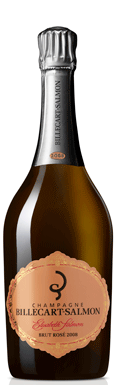
<p>Ripe berries on the nose with red apple, peach and tangerine notes over hazelnut and pastry nuances. Fresh and compact on the palate with zesty...
2008
Billecart-Salmon
