
First taste: Sassicaia 2018
Aldo Fiordelli charts the history of this Super Tuscan estate, set to celebrate its 50th anniversary in 2021, and reports on the weather conditions and style of the latest-release 2018 vintage.


The first vintage of Sassicaia was not warmly received due to its concentration compared to the lightness of local wines at that time. Today, 50 years later, this Bolgheri wine is the greatest example of elegance one could look for in a Bordeaux blend in Italy.
The lighter 2018 vintage is, if possible, a glorification of this style. The significant 50th anniversary this year could influence the judgment.
Scroll down for Aldo Fiordelli’s Sassicaia 2018 tasting note and score
Seventy years of learning
In 1968 a wine made mainly from Cabernet Sauvignon was a fundamental change to the Tuscan tradition of using Sangiovese. No one before had ever dared make a Bordeaux blend on Italian soil, and certainly not in an unknown area as far as viticulture was concerned.
The innovative decision to plant Cabernet at Tenuta San Guido was partly due to the similarity Mario Incisa della Rocchetta had noted between Tuscan soil and that of Graves: namely pebbles and gravels.
We should really date the origin of Sassicaia 20 years earlier: from 1948 to 1967, this wine remained a strictly private affair, only to be consumed at Tenuta San Guido. Twenty years of efforts and attempts before the first release in 1968 well represent both the sobriety and the consistency of this family.
Technically speaking, those two decades were precious for the Marchese to realise that leaving the wine to age improved it considerably.
‘For the family Incisa della Rocchetta,’ added the estate director Carlo Paoli, ‘it’s important to consider the work done in the first 20 years of production, even if never marketed’. This fact explains why the estate hasn’t celebrated the ‘50th anniversary’ with a special label for the 2018 vintage.
‘When one buys icon wines made by other producers,’ said Brett Fleming, managing director of Armit wines, ‘it could be argued in some cases that you are buying a brand, but what sets Sassicaia apart is you are not buying a brand, you’re buying wine.
‘It does not need to be associated with anything else to make it famous, nor does it need to be challenged in qualitative terms, as its winemaking excellence and terroir expression is proven with over 50 years of production. It was not born out of a marketing idea, but from passion to have wine to drink, that then became an icon. This is what people are buying and this is their expectation that is satisfied when they do!’
The 2018 season
The season started with a good omen: snow. In February it snowed twice in Bolgheri, a situation that had not been recorded for many years. One of those was the celebrated 1985 vintage. From an agronomic point of view the snow was positive, causing a vegetative stop and encouraging the natural elimination of vine pests, as well as feeding the water reserves.
Throughout the months of May and June, climatic conditions were still characterised by sporadic rain alternating with sunny days that mostly involved the workforce in the vineyards with more frequent interventions to protect the vines. ‘On 3 June I was still wearing my sweater,’ said Carlo Paoli. Sources at the estate recall that on Monday 25 June, a rapid disturbance also caused a slight hailstorm, although fortunately it only slightly affected the vineyards located on the hills.
July was dry and hot, and from 12 August temperatures returned to the seasonal average. During the weekend of 25-26 August, thunderstorms were expected, but instead, there was only strong wind. This lowered the temperatures and brought refreshment to the vines, enhancing aromas and phenolic ripeness in the grapes.
The entirely manual harvest began with a delay of seven to eight days compared to the norm: Cabernet Franc was first to be picked, from 6 September, and harvest ended on 4 October with the collection of Cabernet Sauvignon grapes located at higher altitudes of around 360m above sea level (Vigna di Castiglioncello and Vigna del Quercione).
One of the key factors of Sassicaia’s consistency is the varying elevations which characterise the estate’s vineyard sites, contributing to the wine’s complexity and character.
‘In 2018 we have fantastic quality,’ added managing director Carlo Paoli, ‘with an excellent level of phenolic and technical maturation, not excessive sugar content, guaranteeing moderate alcohol content and excellent aromatic complexity. However, we selected the grapes more severely than usual: the lower vineyards were not allowed to build the final blend of Sassicaia’.
Sassicaia 2018 style
The estate produced 260,000 bottles of Sassicaia from almost 100 hectares in 2018, ‘more or less the same quantity as 2017, which anyway was severely reduced by the drought,’ added Paoli, explaining the careful selection of the grapes for this vintage.
Sassicaia 2018 is certainly less powerful than 2015, nevertheless the dry extract of the former is 32mg/L against the 33mg/L of the latter. This latest release is also less concentrated than 2016, and almost the opposite of the exuberant 2017, but the lighter character of the 2018 vintage has highlighted the freshness of fruit in Sassicaia.
Not really ready to drink now despite its filigreed precision, it will need until the autumn of 2021 to completely express its famed elegance. ‘It could even squat more in the next few months,’ said Paoli. ‘The 1988 vintage had the same palate at the beginning. I’m confident in October it will develop fantastic expression.’
Newly released Sassicaia is usually more than restrained, particularly on the nose and in structure. Compared to the exuberant 2017, the 2018 might not immediately appeal to less involved consumers, but it will to Sassicaia collectors: the consistency of the past vintages is fuelling strong demand.
‘We cannot provide a number of bottles available for the UK market,’ comments Fleming, ‘but frankly it does not matter as I cannot satisfy the demand we are being asked to supply. We are fortunate to be the first to release the new vintage of Sassicaia to the world, and if our experience is anything to go by, the other global markets will also struggle to meet demand. There are no new vineyards, or expansion plans so this will probably never change’.
Decanter’s sources estimate, for this vintage, that Sassicaia represents around 30% of the estate’s total production, meaning almost 17,000 bottles will be available for the UK market – a scarce supply for a huge demand which feeds the myth of Sassicaia.
Tasting Sassicaia 2018:
You may also like:
First taste: Ornellaia 2018
Barolo 2016 ‘MGA’ late releases tasted
Italian wine investment: Tuscany and Piedmont
Anson: Tasting Sassicaia – half a century of vintages
Tenuta San Guido, Sassicaia, Bolgheri, Sassicaia, Tuscany, Italy, 2018
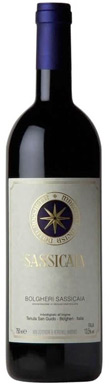

<p>Notes of woodsmoke, blackcurrants and a hint of mint. Tobacco and cigar box add complexity. Dark, dense and concentrated. Nominated by Aldo Fiordelli.</p>
2018
Tenuta San GuidoBolgheri

