
Groundbreaking Gaja: A lifetime’s work
A recent tasting in London offered a rare chance to try wines from the Gaja cellars from every decade back to the 1950s. And a chance to reflect on the incredible life and career of Angelo Gaja at the celebrated Piedmont estate.


When you attend an event titled, ‘The tasting of a lifetime’, you can be fairly certain there will be some rather interesting wines on show. And when the winery in question is Gaja, you’d better be ready for some very special bottles!
That was certainly the case when the family visited London last October, gathering an impressive audience of journalists, sommeliers, buyers and more in the beautiful ballroom at the Dorchester – and assembling an even more impressive array of wines from throughout the winery’s distinguished history.
Scroll down to see notes and scores for Gaja’s wines from the 2020s to 1950s
Gaia Gaja may be the international face of the family these days, but it was heartening to see that her father, Angelo (now 83) and her brother, Giovanni, had also been able to make the trip so soon after the harvest, presenting a united front. Angelo will likely never really retire, but his three children (Rosanna was not present at the event) have taken over the day-to-day operation of the company.
And so, while celebrating the past, there was a strong focus on the future. For instance, the family were keen to speak about their ‘white wine project’ which includes a new, dedicated white wine facility with its own winemaking team, and the inclusion of some high-altitude fruit from vineyards in Alta Langa. ‘We see the potential of making our white wines in Alta Langa,‘ declared Gaia.
It’s certainly a big investment, however they clearly see the benefit of these higher, cooler sites in the face of increasingly hot and dry summers. ‘I believe the new winery will allow us to be more flexible,’ added Angelo.

Gaja: A brief history
The Gaja family’s wine history began in the mid-19th century, when Angelo’s great-grandfather, Giovanni, used to sell his wine at the family’s little osteria. But it was his daughter-in-law, Clotilde Rey, who set the foundations for Gaja’s future by acquiring more vineyards and improving quality in order to demand higher prices.
Clotilde’s son, Giovanni, continued in a similar vein, acquiring more land and pursuing quality. He was also the first to emblazon the bottles with ‘GAJA’ in large type on the label – an exercise in branding that continues today.
Giovanni’s son, Angelo, joined the winery aged 21 in 1961. He worked tirelessly among the vines until 1968 when he got his big break and was finally allowed into the cellar. Ever since, the Gaja name has projected the twin ideas of innovation and quality, combining modern thinking with the heritage of the family business: Angelo was one of the first Italian winemakers to work with barriques, and actively embraced international varieties alongside the local Nebbiolo.
In the late-1970s, Angelo had secretly planted Cabernet Sauvignon right in the heart of the village of Barbaresco, literally under the nose of the mayor’s residence – who happened to be his father. ‘Darmagi’ was Giovanni Gaja’s response when he was told about the vineyard, meaning ‘what a shame’ in the local dialect. Two generations later, the family view is slightly different: ‘It represents the identity of my father…the curiosity,’ said Gaia. ‘The future is for curious people,’ added Angelo, with a wry smile.
Keen to push himself with new challenges, Angelo purchased the Pieve Santa Restituta estate in Montalcino in 1994, closely followed by the purchase of Ca’Marcanda in Bolgheri in 1996. More recently, he began collaborating with local producer, Alberto Graci on the IDDA project on Etna in 2017, bringing a Piemontese approach – and Angelo’s eye for innovation – to the volcano’s wines.
Sorí San Lorenzo was one of Barbaresco’s first single-vineyard wines when the 1967 vintage was released. This was followed by the release of the 1970 Sorí Tildin (which marked its 50th vintage in 2023 with the 2020 bottling) and Costa Russi (1978). In 1996, Angelo infamously declassified these three great cru wines from Barbaresco DOCG to Langhe DOC, in order to include around 5% of Barbera with the Nebbiolo: he was keen to return to a traditional recipe commonly seen in the first half of the century, before the foundation of the Barbaresco DOC in 1966 (it became a DOCG in 1980). Angelo’s decision stood until 2013, when his family persuaded him to revert to 100% Nebbiolo and to declare the crus once more as Barbaresco DOCG.
Groundbreaking
In 2004, Gaja was one of the first wineries to employ the services of Simonit & Sirch, who introduced a new way of pruning the vines to minimise what Marco Simonit calls ‘wounding’ of the plant, helping to extend the productive life of the vine and to reduce the chance of trunk diseases such as Esca. ‘It took 10 years for the vines to adapt,’ notes Gaia. Today, Simonit & Sirch are in demand across the globe.
Also in 2004, Angelo changed coopers and reduced the amount of new oak – just at the time that the use of new oak was reaching its apogee with winemakers, journalists and consumers alike. This decision, despite prevailing trends, has helped to give Gaja’s wines more transparency in recent years.
Angelo has broken new ground at every turn; from planting Cabernet in the centre of Barbaresco town, to being among the first to employ viticultural pioneers, Simonit & Sirch. From leaving the Barbaresco denomination, for which the estate had been a leading light, to launching projects in Tuscany and Sicily.
Despite approaching his mid-80s, with Angelo (Decanter Hall of Fame recipient in 1998) at the helm the winery is in rude health. But what has become abundantly clear is that its future looks just as bright as its past has been.
Tasting a lifetime’s work
While all the wines tasted were fascinating in their own rights, there were three that really stood out:
1964 Barbaresco is an absolute time capsule: Angelo was still working in the vineyards, not yet invited into the cellar. It was in this year that the village of Barbaresco was connected to a mains water supply for the first time, which Angelo explained was a turning point for the winemaking – previously, wells were utilised as the main water source, which was impractical and less hygienic. Finally, the Nebbiolo was harvested in mid-November, far later than in today’s warmer climate, which just serves to underline the climate crisis.
2001 Barbaresco is from an excellent vintage for Nebbiolo in Barbaresco. It was made at a time when more new oak was used, and is also the sole example from the estate of a Barbaresco DOCG – the single vineyard wines at this point were declassified as Langhe DOC.
Sorí San Lorenzo Barbaresco 2020 is the current release of one of Gaja’s three acclaimed single-vineyard wines. One of Barbaresco’s first ‘cru’ releases when it launched with the 1967 vintage, it remains to this day one of the finest examples of Nebbiolo within the Barbaresco area – and even beyond. The 2020 stands out for its fragrance and sapidity; both delicate and tense with plenty of depth.
Notes and scores for Gaja: 1958-2020
Wines poured spanned the winery’s impressive back-catalogue, covering the 2020s, 2010s, 2000s, 1990s, 1980’s, 1970s, 1960s and 1950s, giving an extraordinary overview of an estate (and a man) who has done much to define modern winemaking in Italy.
Related articles:
Gaja: A family portrait
Barbaresco 2013: A retrospective of one of the top vintages in the last decade
Piedmont’s up-and-comers plus the 10 bottles to seek out
Gaja, Alteni di Brassica, Vino da Tavola, Piedmont, Italy, 1992
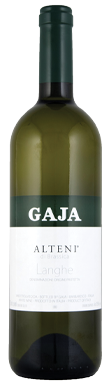

A terrible year for red wines – Gaja refrained from bottling any in 1992 – but surprisingly good for the whites. This Sauvignon Blanc was sourced from...
1992
GajaVino da Tavola

Gaja, Gaia & Rey, Vino da Tavola, Piedmont, Italy, 1989
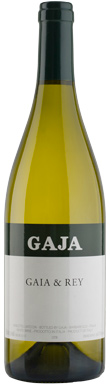
Gaja's first white wine, Gaia & Rey was first released in the 1983 vintage and dedicated to Angelo's grandmother, Clotilde Rey, and his daughter, Gaia,...
1989
GajaVino da Tavola
Gaja, Costa Russi, Barbaresco, Piedmont, Italy, 2020
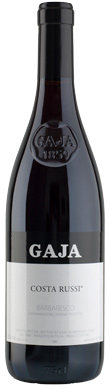
Current production of Costa Russi is just half what it was, as problems with frost and heat in 2017 led to vines dying and needing...
2020
GajaBarbaresco
Gaja, Sorí Tíldin, Barbaresco, Piedmont, Italy, 2020
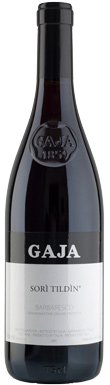
Sorí Tíldin occupies the top of the hill, overlooking Costa Russi. A south-facing amphitheatre of vines on sandier soils, it's planted vertically to allow for...
2020
GajaBarbaresco
Gaja, Sorí San Lorenzo, Barbaresco, Piedmont, Italy, 2020
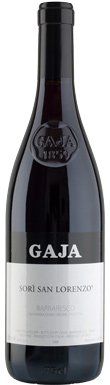
Sorí San Lorenzo was one of the first single-vineyard Barbaresco bottlings, first released with the 1967 vintage. The closest of Gaja's three crus to the...
2020
GajaBarbaresco
Gaja, Sperss, Barolo, Piedmont, Italy, 2018
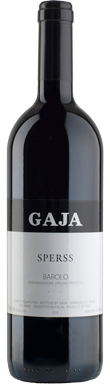
Sperss is sourced from a seven-hectare site in Serralunga, purchased by Angelo in 1988. This 2018 is a more delicate expression due to the cool,...
2018
GajaBarolo
Gaja, Conteisa, Barolo, Piedmont, Italy, 2015
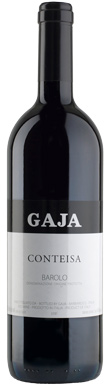
Conteisa is made from vines in the small portion of Cerequio which lies within the commune of La Morra (around 80% is situated over the...
2015
GajaBarolo
Gaja, Barbaresco, Piedmont, Italy, 2001
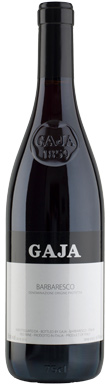
2001 was an excellent vintage for Nebbiolo in Piedmont, and Gaja's benchmark Barbaresco is showing beautifully today with two decades under its belt. There was...
2001
GajaBarbaresco
Gaja, Darmagi, Langhe, Piedmont, Italy, 2000
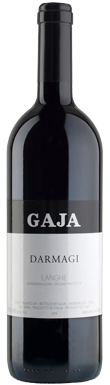
<p>Darmagi is the result of Angelo's foresighted plan to reach an international audience when the wines of Piedmont were little known outside of Italy. He...
2000
GajaLanghe
Gaja, Sperss, Langhe, Piedmont, Italy, 1997
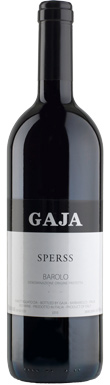
Although Sperss today is bottled as a Barolo, from 1996 until 2001, Gaja included around 8% of Barbera in the wine and bottled it as...
1997
GajaLanghe
Gaja, Barbaresco, Piedmont, Italy, 1974
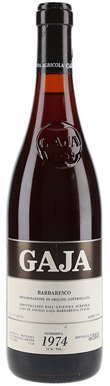
1974 is ‘not at the level of '78 or '71, but it has incredible freshness and lifted perfumes,‘ said Gaia, explaining why it was included...
1974
GajaBarbaresco
Gaja, Barbaresco, Piedmont, Italy, 1964
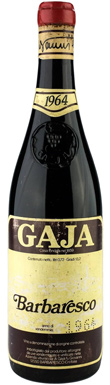
1964 was the first vintage of Barbaresco released following the creation of the DOC in 1966. At this point, Angelo was still working in the...
1964
GajaBarbaresco
Gaja, Barbaresco, Piedmont, Italy, 1958
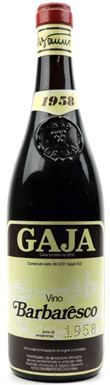
Before the DOC was founded in 1966, there was much more leeway to make wines how producers wanted. ‘There are no bottles of 1958 that...
1958
GajaBarbaresco
