
Anson: How legendary Mouton Rothschild 1945 tastes now
Can this lauded wine still live up to its historical significance, and do you know what happened to Mouton Rothschild during the Second World War? Jane Anson reports from a special tasting and charity dinner at Versailles palace.


It’s a lot of pressure to put onto a single wine.
The Mouton Rothschild 1945 has always carried the weight of history upon its shoulders, and yet here we were asking it to also live up to being tasted at the Palace of Versailles, a place with plenty of its own stories strapped onto its – albeit larger and more resplendent – shoulders.This wartime victory wine was served over a dinner in Versailles’ Gallery of Great Battles. Paintings of 15 centuries of French military successes, from Clovis to Napoleon, looked over us as we sat around a table that stretched from one end of the 120-metre-long gallery room to the other.It seemed impossible that the wine itself could live up to the expectation.
‘The silence in the room spoke volumes’
Somewhere between 27 and 30 bottles of Château Mouton Rothschild 1945 were being shared between 200 guests. The bottles had stayed in the Mouton cellars for close on 75 years.
It’s hard to give a real market price for this wine; I have seen it between £12,000 and £45,000 depending on market and provenance.
The silence in the room as it arrived, at the end of a meal that had also featured the 1996, 1990 and 1982 vintages drunk by collectors who had likely had many of the world’s greatest wines on a regular basis, spoke volumes.
A piece of history
The Battle Gallery room was inaugurated in 1837, just 16 years before the first Rothschild, the English Baron Nathaniel, arrived at Mouton.
All three of the current Rothschild owners, Philippe and Camille Sereys de Rothschild and Julien de Beaumarchais de Rothschild, attended the Versailles dinner, along with their fathers, Jacques Sereys and Jean-Pierre de Beaumarchais.
Somewhat ironically, the family didn’t technically own the Château when the wine we were gathering to drink had been made, because at that point it had not yet been restored to them after the wartime Vichy government stripped the family of its French nationality and confiscated its property.
It was restored to them in late 1945, and in 1947 Baron Philippe gained sole ownership, buying out his brother and sisters’ shares.
Mouton Rothschild during the Second World War
During the war, it was his team at Mouton, led by Edouard Marjary and cellar master Raoul Blondin, who looked after the estate as best they could – although Marjary was himself in the Resistance and so rarely in Pauillac.
Philippe de Rothschild, who would not take on the Baron title until the death of his father in 1947, spent almost five years away from Pauillac during the war.
In June 1940, days after he left, Mouton was placed under public administration and occupied by an anti-aircraft garrison of the German army.
By August 1940, Philippe was arrested under orders from Vichy and imprisoned first in Morocco and then Clermont-Ferrand.
His wife, Lili, worked with lawyers to secure his release in 1941, and from there he crossed the Pyrénées mountains to join the Free French forces in England in 1942. He took part in the D-Day Landings on 21 June 1944.
He landed at dawn in the Bay of the Seine, then moved on towards Bayeux, but the Germans had already left and Philippe popped in to look at the Bayeux Tapestry. ‘Worth a detour, even during an invasion,’ he wrote in his autobiography.
Philippe was in charge of civil affairs, organising supplies of food and electricity. But, after making it to Paris in September 1944, he found his wife had been arrested and his daughter, Philippine, was living with her cousins just outside of Paris.
He was then posted to Germany as a liaison between French and British troops, and was one of the first of the Allied forces into Belsen. He knew by then that his wife, Lili, had been sent to a concentration camp, but not what had happened to her.
Philippe was later awarded both the Croix de Guerre and the Legion d’Honneur, but his autobiography shows that even then his natural tendency was to try to come to terms with what had happened.
‘The French were tearing each other’s heart out,’ he wrote of 8 May 1945, when peace was declared in Europe.
‘I couldn’t sustain the loathing I felt… what use is revenge? Shooting a man… will not bring his victims back to life.’
He later went out of his way to help those who were accused of collaborating, including a cellar-hand at Mouton, who he told to lie low for a year, and when he returned gave him back his job at the estate, where he would stay for the rest of his life.
‘The only peace I could find was a Mouton, walking among the vines,’ he wrote of that time.
He put the German prisoners who were still being held at the Château to work clearing up the buildings and the land, tidying the park and laying a road that led from Mouton to Pontet Canet that he called his ‘road of revenge’.
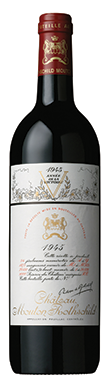
The Mouton 1945 label
The Mouton 1945 vintage also represents both this desire to come together to build something lasting, and the necessity of acknowledging the truth of what happened.
The label is the perfect example of this. For a start, the artist chosen, Philippe Jullian, was a young French artist that Philippe had met when he was in England during the war.
Jullian was born in Bordeaux in 1919 and was grandson of Camille Jullian, for those who know the many Bordeaux squares and roads named after him. He himself had suffered under the German occupation, writing in his diary of life in Paris under German occupation, ‘The atmosphere is tense with raids, the fear of departures to Germany.’
The commission to paint the label saw him submit several suggestions, some with French flags and other symbols of the country’s relief and pride at victory, but Philippe chose the one featured around Churchill’s famous V for Victory sign.
The reason, he said, was that he wanted to pay tribute to the role of the Allies in ending the war, and to show the gratitude that he felt to them.
With all of this in mind, it’s no exaggeration to say that a wine like this is a shared experience. Not just those of us in the room tasting it but everyone who engages with its story.
I learnt plenty about it just by posting on Twitter that I had drunk it. I knew about the frosts on 2 May that decimated the crop and made this the smallest vintage since 1915, ensuring the stunning concentration in the grapes that remained.
But I hadn’t made the connection as fellow writer Joe Fattorini did, that 2 May was also the day of the fall of Berlin, when German troops surrendered to the Russians led by Marshal Georgi Zhukov, just days after Hitler committed suicide.
A few sadder details I could add myself – most painfully that Lili had died in Ravensbrück concentration camp barely a month before that frost, on 23 March, 1945.
The wine shows no signs of flagging
I’ll never have another wine like this. Michael Broadbent called it ‘tireless’ in 2001, and it shows no signs of flagging today.
It comprehensively demonstrates that Mouton Rothschild was making extraordinary wine in 1945, against all the odds, 28 years before it was promoted to First Growth status.
It also shows that we all owe a debt to Raoul Blondin, cellar master for 50 years, for having protected the vines sufficiently to have coaxed this wine out of them.
Was it the greatest wine I had ever drunk? Hard to say. The Lafite 1959 still competes for the title, although both show the absurdity of playing that game. Was it my favourite wine experience ever?
For reminding us all what wine can mean, I think I’d have to say yes, hands down.
Full tasting note for Mouton Rothschild 1945
Wines served had been re-corked by the Château within the last 30 years.
The wine was tasted at a charity evening held to raise funds for the Palace of Versailles and Notre Dame Cathedral, following the Sotheby’s auction of 75 cases of Mouton Rothschild wines – including the 2005, 2007, 2009, 2010, 2013 vintages – in Hong Kong, London and New York. Auction sales reached USD$2.7m.
Château Mouton Rothschild, Pauillac, 1er Cru Classé, Bordeaux, France, 1945

I almost picked Petit Mouton 2006 because it's at a great stage for drinking right now, but who am I kidding that Mouton 1945 wasn't...
1945
Château Mouton RothschildPauillac

