Champagne crusader Pierre Péters: producer profile
Sixth-generation owner Rodolphe Péters is passionate about blanc de blancs, and continues to innovate at his family Champagne house, discovers Simon Field MW.

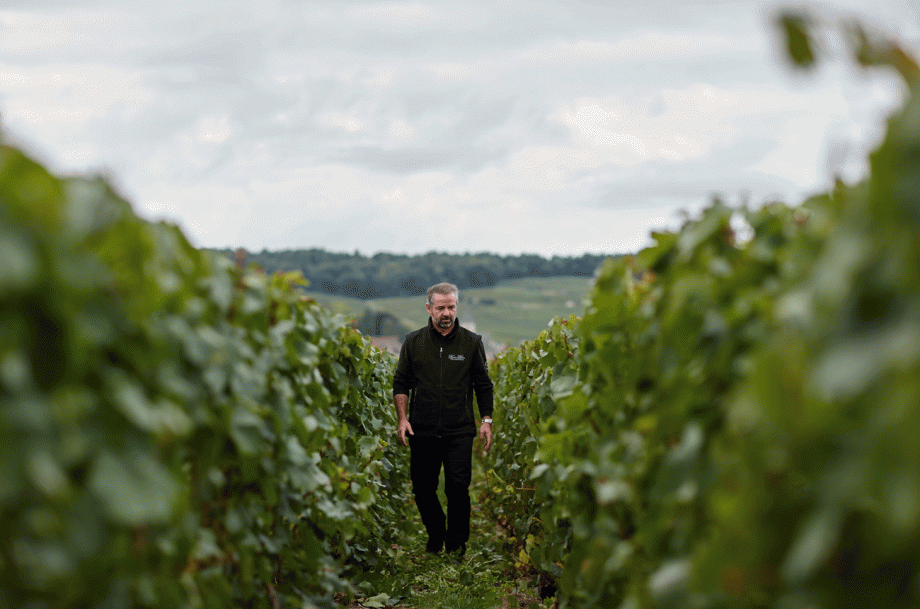
Rodolphe Péters describes himself as a ‘Champagne crusader’. His mission? To demonstrate the incredible diversity of blanc de blancs Champagne, with an emphasis on wines which, although nominally labelled as non-vintage, are in fact exceptionally complex multi-vintage blends.
There is nothing new here of course – think Krug Grande Cuvée or Laurent Perrier Grand Siècle – but Rodolphe’s particular contribution has focused on the use of a Perpetual Reserve, itself aged in differing containers to engender further complexity.
Scroll down for Simon Field MW’s Pierre Péters tasting notes and scores
Having initiated the concept in 1997, Rodolphe was one of the first in the region to enrich his base cuvée in this way. It’s oft imitated now, but that is the way with success stories.
His flagship Cuvée de Reserve is made up of 50% base wine (currently from the heady vintage of 2018) and 50% Reserve Wine, and is dosed at 6g/L.
Preparing to lead
Rodolphe is an oenology graduate who followed the Péters tradition of working outside the family to gain broader experience. This he did in spades, gaining an MBA, a global perspective and, more prosaically, an understanding of the entire Champagne supply chain (bottles, corks and the like) before re-admittance, prodigal-like, and full of ideas.
He represents the sixth generation; his great grandfather was one of the first authentic ‘growers’ and his grandfather, Pierre, set up the brand in 1946 and thus is memorialised with his name on the bottles.
Grand cru vineyards
As so often in Champagne, marriage brought three plots of gold-dust (2.5 hectares in the Chétillons lieu-dit in Le Mesnil-sur-Oger), a key component of the current holdings of 20 hectares, 16ha of which focus on the very grand Côte des Blancs villages of Avize, Oger, Le Mesnil and, most importantly, Le Mesnil-sur-Oger.
There are also 2.5ha in the Sézanne and 1.5ha in the Côte des Bar, virtually all of which is sold.
All of the wines exported are labelled Grand Cru; impressive indeed as 80% of production leaves France, with the UK and US the most important markets.
Purity, precision and discreet power are the watchwords chez Peters; the wines positively flourish in the glass with a little air, and they are made to last. Dosage is generally kept low (4-6 g/L the norm), although Rodolphe is not a great fan of zéro dosage. His explanation is detailed and scientific.
Vintage trio
Sustainable viticulture is the order of the day, and it should come as no surprise that the approach is parcellaire, a significant number of his 82 plots vinified separately before the unnervingly complex blending (assemblage) takes place.
The difference between two near-adjacent plots in Le Mesnil-sur-Oger is instructive; Les Chétillons is a little higher up; all the topsoil has eroded away leaving just chalk; just a few metres further down Les Montjolys has more top-soil, including clay and argile à silex (clay and flint); the wine is richer, more forward and slightly spicy.
Since 2012 these have been bottled separately and make up two of Rodolphe’s vintage trio, the other being L’Esprit, an enchanting blend of the best fruit from the four key villages named above. Rodolphe describes this wine in terms of the four seasons, each village contributing its own personality, some more sunny, some more austere.
For all the prestidigitation in the winery, Rodolphe is a ‘farmer at heart’. He is very anxious about the 2021 vintage; frost is a problem only in so far as it reduces quantity, but the current battle is against latent mildew.
He is less of a fan of the lauded 2012 – better for Pinot Noir he maintains – but pleasantly surprised by the pretty and forward 2016, the surprisingly complex 2014 and, in particular, the classically constructed 2013.
The season in 2013 followed a late cycle, with 100 days between flowering and harvest, a key quality indicator for Rodolphe and not often achieved these days. The crop was eventually brought in in the middle of October. He is also excited about 2019, which he compares to 1988. His focus on the fruit is underlined by the development of a nursery (pepinière) and his ongoing adherence to the concept of massal selection in order to preserve the genetic heritage of his beloved Chardonnay grapes.
And in non vintage…
There are five non-vintage wines in the core range; the Cuvée de Réserve, then the Extra Brut and the Grand Réserve which are both variants upon the theme outlined above.
The other two are a little more esoteric: the Réserve Oubliée which is made up entirely from the Perpetual Reserve and, in homage to his son, the colourful L’Etonnant Monsieur Victor, the former wine aimed at the restaurants, the latter at collectors. Given that the Perpetual Reserve is in itself hugely complicated (part aged in stainless steel, part in concrete and part in cask), there is a liminal expectation focused on complexity.
Energy and dynamism
Finally this very busy man – he reminds me a little of Michel Chapoutier in his febrile quest for perfection – has helped the Perrins (and the ‘hands on’ Brad Pitt!) to create Fleur de Miraval, a fascinating and innovative rosé Champagne, which once again plays on the potential of older wines (some of them from bottle!).
He is also currently involved in a project in Santa Barbara with Etienne de Montille. Expect some fantastic Californian fizz with a distinctly Côte des Blancs twist over the next few years. The project is called ‘Racines’.
An impressive range then, by turns dynamic and innovative. For all that, Rodolphe is firmly grounded, a ‘man of the soil’ as he describes himself; his interest is in Chardonnay only (the Rosé de saignée apart) and in the promotion and greater understanding of the wines from the famous vineyards located to the south of Epernay. Chardonnay in Champagne can be surprisingly hard to understand, running a gamut from exotic approachability to the edge of austerity. Few if any winemakers are better placed than Rodolphe Péters to demonstrate its versatility and sheer quality.
See Simon Field MW’s Pierre Péters tasting notes and scores
Related content
Champagne: the art of blending
Investment in Champagne
30 top rosé Champagnes to sip this summer
Pierre Péters, Les Chetillons, Champagne, France, 2014
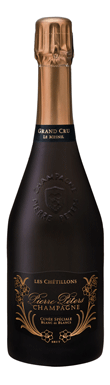

A comparative tasting of neighbouring vineyards, Les Montjolys and Les Chétillons reminds one of the tortoise and the hare. Les Chétillons is incredibly reserved at first, but with a little air and a little time, spring flowers take boom, then hawthorns and acacia appear and even a hint of white pepper calls from behind the chalky foundations. The wine grows on the palate too, and what starts as austerity slowly but surely is transformed by the rigour of an innate and enviable complexity.
2014
Pierre Péters

Pierre Péters, L'Etonnant Monsieur Victor MK14 NV, Champagne, France
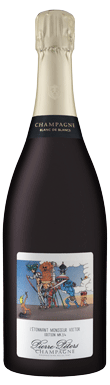
With some of the most flamboyant labels in Champagne, this series of bottlings celebrates Rodolphe’s son Victor and his somewhat unusual take on the world of art. This label, the sixth in the current series, is based, somewhat loosely, on the painting by Dali; The Temptation of St Anthony. The wine is posited as ‘the best of the best’ – that is to say, the blend of the best tank of wine from the base year (2014 in this instance) which comes from Le Chétillon en Haut, with the best of the reserve wine. Once again the idea is to juxtapose the fresh and youthful with the mature and complex; this is very successfully rendered, luxuriant honeycomb and generous fruit at its core (tangerine and mango come to mind) yet with a marked oyster shell salinity on the finish. A bittersweet wine of symphonic proportions.
Pierre Péters
Pierre Péters, Les Montjolys, Champagne, France, 2014
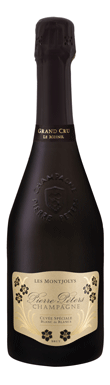
A sister to Les Chétillons, its vines just a little lower, with a little more clay over the chalk bedrock. Pale dreamy lemon, then an appealing attack of sourdough which, on warming, presumes upon notes of gingerbread; in the same vein the almonds defer to marzipan and the lemon pith is joined by nectarine and Mirabelle plum. Generous and precise at the same time; all that one should expect from a great wine from a great village (Le Mesnil-sur-Oger)
2014
Pierre Péters
Pierre Péters, L'Esprit, Champagne, France, 2016
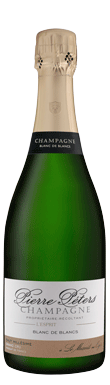
Sourced from four of the great grand cru villages of the Côte des Blancs, L’Esprit is an archetype of a classy Chardonnay-based Champagne. Rodolphe identifies seasonal elements from each of the villages; steely wintery austerity from Le Mesnil, ripe summer generosity from Avize, spring flowers from Oger and autumnal hints of spice and sousbois from Cramant. Be that as it may, today the wine sings with great charm, its frothy billowing core silky and wonderfully elegant; notes of apple charlotte, praline and lemon pith are all evidenced and the finish is long and persistent, with a teasing twist of salinity.
2016
Pierre Péters
Fleur de Miraval, Fleur de Miraval NV (ER1), Champagne, France
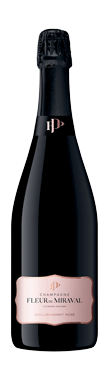
Very pale pink, almost creamy white. Dominant leesy autolysis on the nose. On the palate, full-bodied mature weight with some opulent red fruit richness, blood orange crispness and the softness of mature fruit. Extremely accessible and charming from the moment it is poured, and certainly achieving the ambition of richness and maturity with youthful rosé crispness. The vintage used in the Chardonnay base wine was 2016, a year which was good but not great for Chardonnay and better for Pinot Noir.
Fleur de Miraval
