
Which Ports should you drink this winter?
Richard Mayson picks out vintages to seek...


See Richard's top six picks below, plus his detailed vintage guide back to 1960.
When it comes to vintage Port, we’ve never had it so good – an unprecedented run of fine vintages in 2017, 2016 and 2015 were all worthy of an outright declaration, with 2018 and 2019 looking promising too.
Fortunately, some of the rather good years in the 2000s and 1990s are now becoming approachable. They divide between so-called ‘classic’ declarations and single-quinta vintage Ports (SQVPs). The main difference is that SQVP is generally ready to drink after 10 years rather than 20, and priced at £25-£45 a bottle, these wines are less than half the price of a bottle from a fully declared vintage.
The most recent single-quinta year that is becoming approachable is 2010. From a large crop, those estates with old vines at their core produced some lovely, balanced, fruit-driven wines that are just being released. With a backbone of fragrant Touriga Nacional and Touriga Franca, Cockburn’s Quinta dos Canais looks like a good wine for the medium term.
In complete contrast, 2008 was a low-yielding year with a lot of single-quinta Ports, many yet to be released. In general, the wines are aromatic but still show restraint and are characterised by their freshness and purity of fruit backed by structured tannins. Taylor’s Quinta de Terra Feita and Graham’s Quinta dos Malvedos both look very promising.
A run of three good years in the mid-2000s produced SQVPs, all of which are now fully ready to drink. 2006 and 2005 made big, ripe-flavoured wines. A few shippers, notably Niepoort, thought 2005 was good enough to declare outright. Both vintages made wines that can be enjoyed now and will last into the 2030s and beyond.
By contrast, 2004 was a near-disaster due to untimely rain, but swung to success with a fine harvest that produced balanced, well-structured wines perfect for drinking now. Warre’s Quinta da Cavadinha 2004 is well defined with plum and black cherry fruit supported by firm tannins.
See Richard Mayson’s Port vintage guide here
Raring to go
When it comes to fully declared years, 2011, 2009, 2007, 2003 and 2000 are, on the whole, not yet ready to drink. The opulent 2003s will be ready first with Cockburn’s, Croft and Ramos Pinto just on the cusp.
For Port to drink now, go back a decade to two contrasting years: 1997 and 1994. The latter year proved to be a watershed after some patchy declarations in the 1980s and early 1990s: Croft, Ramos Pinto and Taylor’s performed well in a recent comparative tasting, showing the characteristic eloquence of the 1994 vintage. The 1997s were more demure at the outset and perhaps a little more forward now. Fonseca and Taylor’s already show purity of fruit and have the structure to continue to drink well for the next 20 years or so.
Going back to the 1980s, there is a caveat emptor on some of the 1985s, though Fonseca is faultless and in my opinion the leading wine of the vintage. Dow’s, Graham’s and Warre’s all performed well in 1983, as well as three years earlier in 1980. These wines would be my selection for drinking this Christmas, unless of course you have access to the 1977s and 1970s.
From 1977, Fonseca is a tower of strength with Dow’s and Graham’s 1970 both worthy of being ranked alongside the 20th-century greats.
How to serve
All vintage Port, be it single-quinta or a classic declaration, is treated in the same way, with the minimum of intervention before bottling. All throw a crust (sediment) in bottle as they age and require decanting.
Leave the bottle upright for an hour or two then slowly pour the wine into a decanter against a good light (a candle if you want to be romantic). Nothing needs to be wasted: decant the wine before dinner and the sediment makes a good addition to a casserole or gravy.
Seasonal treat: Mayson’s top bottles of Port to drink now
You may also like:
Know your Port styles
Quinta do Noval Port: A look back in time
Top 10 whiskies for Christmas
Top 20 sweet & fortified wines for Christmas
Ramos Pinto, Port, Douro Valley, Portugal, 1994
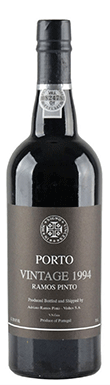

Based on the Quinta do Bom Retiro in Torto valley, the 1994 is magnificent: opulent, ripe plummy fruit on the nose, dark chocolate concentration. Rich...
1994
Ramos PintoPort

Croft, Port, Douro Valley, Portugal, 2003
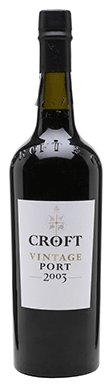
Starting to emerge in the glass with bold black fruit and some liquorice. Firm tannins rising in the mouth. Chocolate-driven richness persists in the end.
2003
CroftPort
Graham's, Port, Douro Valley, Portugal, 1983
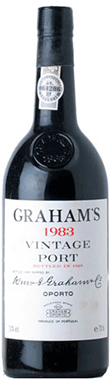
Still quite tight-knit on the nose, mid-weight with gentle, rather lovely cherry fruit and a spicy vestige of the firm tannins that were the hallmark...
1983
Graham'sPort
Fonseca, Port, Douro Valley, Portugal, 1997
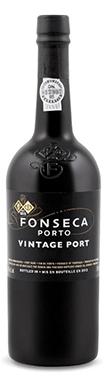
A declaration rather over-shadowed by 1994 and looking good value against its peers. Open, ripe berry fruit aromas come singing from the glass; rich plummy...
1997
FonsecaPort
Graham's, Quinta dos Malvedos, Port, Douro Valley, Portugal, 2005
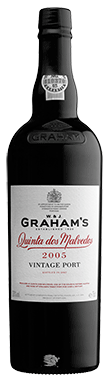
From Graham’s flagship estate, this is deep yet refined on the nose with a touch of floral fruit emerging. Sweet, ripe and broad, black cherry...
2005
Graham'sPort
Taylor's, Quinta de Vargellas, Port, Douro Valley, Portugal, 2004
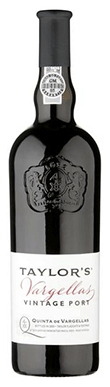
From Taylor’s flagship estate, which fared well in 2004. Nose still a bit demure, but with lovely berry fruit underlying. Ripe, peppery palate, mid-weight, beautifully...
2004
Taylor'sPort
