
Producer profile: Château Haut-Bailly
Revitalised by its new owners since the 1950s, this relatively small but well-positioned Graves estate is regaining the high status it enjoyed a century ago, reveals John Stimpfig


Why is Château Haut-Bailly still such an insiders’ wine? Is it because this discreet, bijou estate makes only a few thousand cases of grand cru classe de Graves. Or is it also because canny collectors jealously like to keep it a closely guarded secret?
See Decanter’s Haut-Bailly tasting notes below
One thing is clear – today Haut-Bailly is one of the most consistent and quintessentially elegant clarets. Another is that its estimable quality stems from an exceptional red wine terroir, which its various owners and custodians have often done their utmost to reflect during its illustrious history. In effect therefore, Haut-Bailly has been doubly blessed – both by its proprietors and its position.
The vineyard sits adjacent to the château in a single unified block on the highest ridge of the Pessac-Léognan AC. The vines fall away on a gentle gradient, giving perfect exposure. A special mesoclimate protects it from spring frosts, while a mix of gravelly soils and subsoils provide minerals, moderate water stress and excellent drainage. Jean-Bernard Delmas, formerly of Château Haut-Brion, has famously described it as ’a truly great terroir’.
Haut-Bailly at a glance
Area under vine 30ha
Soils Sand and Pyrenees gravel
Average vine age 35 years
Varieties planted 60% Cabernet Sauvignon, 34% Merlot, 6% made up of Cabernet Franc, Petit Verdot, Carmenère and Malbec
Vine density 10,000 vines per hectare
Average annual production 180,000 bottles
Other wines La Parde Haut-Bailly (second wine); Pessac-Léognan (third wine); Rosé de Haut-Bailly; Château Le Pape
Auspicious beginnings
At its core lies a unique, 4ha (hectare) plot with vines that are 120 years old, co-planted to a density of 10,000 vines per hectare. The majority here are Cabernet Sauvignon with equal quantities of Merlot, Cabernet Franc, Carmenère, Petit Verdot and Malbec. ‘The quality and concentration of this vineyard is incredible and it never fails to perform,’ says Haut-Bailly’s president Véronique Sanders (of whom much more later). Indeed, she calls it ‘the beating heart of Haut-Bailly’.
It was conceived and planted by Alcide Bellot des Minières, who acquired the property in 1872. A colourful character, des Minières embarked on a quest to transform Haut-Bailly. Under his tenure, the estate entered a remarkable golden age in which its reputation and prices equalled and occasionally bested the Bordeaux first growths.
The good times continued into the 20th century but dwindled between the wars. When Daniel Sanders, a Belgian wine merchant, bought it in 1955, it had changed hands a number of times and endured a damaging period of neglect. Although money was short, Daniel and his son Jean began systematically reversing this decline. They replanted vineyards and re-equipped the cellars under the advice of Emile Peynaud, who began as consultant here in 1956.
In 1979, Jean took over from his father, but the labour of love remained a work in progress, partly because he had to maintain his day job to finance the ongoing improvements. ‘There was no full-time team, as there is now,’ says Jean’s granddaughter Véronique. Nevertheless, the wines improved immeasurably and by the late 1980s, Jean had heroically planted the vineyard to its maximum capacity.
Despite this, he was forced to sell his beloved Haut-Bailly less than a decade later, because family members wanted a share of the property. Both he and Véronique, who joined in 1997, were devastated. ‘I was heartbroken,’ she recalls. ‘It was my childhood dream to live there and run it after my grandfather. I recall crying when it was time to go home to Lille.’
Rebuilding the dream
Remarkably there was a happy ending to this Cinderella story. Haut-Bailly’s new proprietor was Robert G (Bob) Wilmers, an extremely successful American banker who had come to Bordeaux looking to buy a vineyard. ‘I studied the market for a couple of years and luckily Haut-Bailly came up for sale. I’d always liked the wines, so I bought it,’ he says in his direct, deadpan and understated way. ‘I was delighted then and I’m even more delighted now.’
Crucially, Wilmers and Jean formed a close personal bond. As an absentee owner based in Buffalo, Texas, he asked Jean to continue running the estate. Consequently, Véronique quickly apprised that all was not lost. ‘So I met and told Bob that I had always had this intense desire to one day run Haut-Bailly. Incredibly, he granted my wish, with the proviso I would first study under my grandfather.’
After a two-year apprenticeship, she took over in 2000. ‘It was a daunting responsibility because I was so young, but also because we no longer owned it. My initial target was to make wine which was at least as good as my grandfather’s. I was scared to death of failing.’
Judging by her early vintages, she passed with flying colours. Moreover, she and Wilmers rapidly realised that they could do even better. ‘The potential was obvious,’ says Wilmers. ‘All that was lacking was the capital investment to improve the infrastructure.’ They agreed on a three-step improvement programme, beginning with the vines.
First, Sanders drafted in professor Denis Dubourdieu as external consultant, and Kees van Leeuwen, now professor of viticulture at Bordeaux Sciences Agro, also conducted a precise study of the estate’s soils. In 2002, she appointed a young and very talented Gabriel Vialard to be technical director, modernising the vineyards, viticulture and winemaking.
The cellars were comprehensively improved in terms of size, scope and efficiency. ‘But there was no massive revolution,’ says Sanders. It was more a case of fine-tuning: ‘We put in smaller vats and created a special cellar for the malolactic fermentation. We do a more gentle extraction now, with less pumping over.
Perhaps the biggest difference has been the more stringent selection process. Compared to Jean’s 10,000-12,000 cases of the grand vin, Véronique makes just 6,000-8,000. Haut-Bailly also produces a third wine, named simply Pessac-Léognan, in order to maintain a higher level of quality in the second wine, La Parde Haut-Bailly. Another step change was much more ‘haute-couture’ viticulture. For instance, in the 4ha plot, each vine is individually marked, pruned and picked according to its variety and age. In Jean’s day, it was simply treated as one and harvested together.
Last came the château and gardens, which were renovated to preserve their existing character. The result is one of harmony, charm and elegance – as reflected in the wine.
Haut-Bailly – a timeline
1461 Earliest records of vines on the estate’s gravelly rise
1630 Owners Firmin Le Bailly and Nicolas de Leuvarde expand and consolidate the vineyard to its present-day size of 33ha
1872 Alcide Bellot des Minières buys Haut-Bailly
1918 Haut-Bailly is bought by Frantz Malvesin
1955 Estate acquired by the Belgian Daniel Sanders
1979 Jean Sanders takes over from his father
1997 Véronique Sanders joins Haut-Bailly
1998 Robert G Wilmers purchases the property from the Sanders family
2000 Véronique Sanders appointed estate manager (and subsequently president)
2002 Gabriel Vialard becomes technical director
2012 Robert G Wilmers buys and renovates Château Le Pape
Magic formula
This all took a number of years – and not an inconsiderable amount of cash. ‘Bob’s investment was a bubble of pure oxygen for Haut-Bailly,’ says Sanders. ‘His understanding that the quality of the wine was paramount and that everything flowed from there enabled us to move not just faster, but also further.’
The impact really showed in the 2004 vintage. ‘That was the first big step,’ says Sanders. Another came in 2008, and it’s no coincidence that these two classical vintages are not the most lauded in Bordeaux. ‘This is one of the strengths of Haut-Bailly,’ she adds. ‘We always outperform in the so-called off-vintages.’ The 2013 has to be tasted to be believed, proving Haut-Bailly never misses.
With every vintage, her aim is constant: to bring out the best of Haut-Bailly’s prized terroir. What she’s looking for is a subtle balance between finesse and concentration. ‘My goal is fruit purity, freshness, smoothness and structure with soft, ripe tannins and pronounced aromatics.’ The blend varies from year to year, sometimes quite dramatically, which is further testament to Haut-Bailly’s remarkable consistency. Her harvest-time secret is always to pick the Merlot early for freshness and wait and wait for the Cabernet, harvesting it at the last possible moment.
‘Ultimately, I want a new golden era for Haut-Bailly, as we enjoyed in the 19th century,’ she says. Some (myself included) would argue that she and Wilmers have already achieved it. In today’s market it’s impossible to outperform and out-price the first growths. But Haut-Bailly has unquestionably closed the gap, taking the estate to new heights. Today it is a grand cru classé de Graves that enjoys the equivalent of ‘super-second’ status, often without the attendant price-tag. Most recently, Wilmers bought and renovated an estate nearby called Château Le Pape, which already shows great promise under Sanders’ supervision. ‘Bob always has plans. He is always looking. He often jokes by saying, “I have a good team here and I want to keep it busy”.’
Sanders clearly thrives on the challenge and couldn’t be more fulfilled. ‘There’s something magical about this place that I feel very intensely.’ The same goes for Wilmers and the rest of the remarkable group of people who love and care for this gem of a vineyard.
Haut-Bailly couldn’t be in better hands.
Tasting Haut-Bailly:
Château Haut-Bailly, Pessac-Léognan, Cru Classé de Graves, Bordeaux, France, 2018
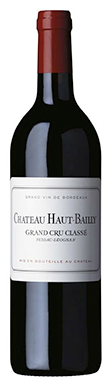

First vintage under Chris Wilmers, succeeding his father Bob. A brilliant Haut-Bailly, living up to its En Primeur promise, packed with ripe rippling black and...
2018
Château Haut-BaillyPessac-Léognan

Château Haut-Bailly, Pessac-Léognan, Cru Classé de Graves, Bordeaux, France, 2017
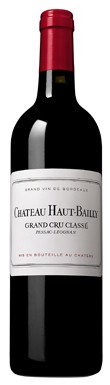
Grilled caramel notes set against sappy black fruit show classic Haut-Bailly balance, with savoury cassis and bilberry shot through with liquorice root and finely-spun tannins...
2017
Château Haut-BaillyPessac-Léognan
Château Haut-Bailly, Pessac-Léognan, Cru Classé de Graves, Bordeaux, France, 2016
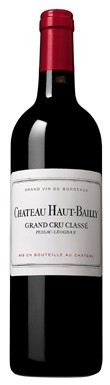
Refined, elegant, brilliant. Spring rain and a dry, sunny summer and autumn meant perfectly ripe grapes, a growing season CEO Véronique Sanders dubbed Le Bonheur...
2016
Château Haut-BaillyPessac-Léognan
Château Haut-Bailly, Pessac-Léognan, Bordeaux, France, 2015
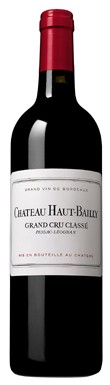
The Graves wine of the vintage (along with Haut-Brion's red). A structural, sensual, expansive wine. Dense but deft, 3.75pH, 60% Cabernet Sauvignon, 36% Merlot and...
2015
Château Haut-BaillyPessac-Léognan
Château Haut-Bailly, Pessac-Léognan, Cru Classé de Graves, Bordeaux, France, 2014
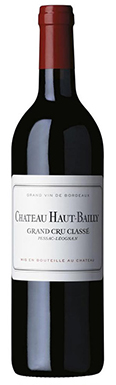
Concentrated depths to the fruit, with a silky texture that is striking. Cool blueberry and blackcurrant fruit, along with high floral aromatics, speaks to a...
2014
Château Haut-BaillyPessac-Léognan
Château Haut-Bailly, Pessac-Léognan, Cru Classé de Graves, Bordeaux, France, 2013
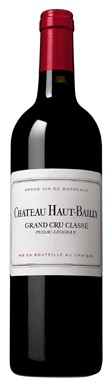
A year of contrasting weather when you had to be supremely attentive at all times - favouring estates like Haut-Bailly where there is the manpower...
2013
Château Haut-BaillyPessac-Léognan
Château Haut-Bailly, Pessac-Léognan, Cru Classé de Graves, Bordeaux, France, 2011
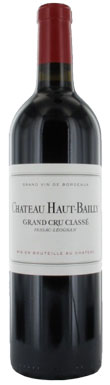
As with the 2007, this 2011 is bursting with pleasure right now. Carefully controlled and elegant while still being juicy, allowing the tannins to tiptoe...
2011
Château Haut-BaillyPessac-Léognan
Château Haut-Bailly, Pessac-Léognan, Cru Classé de Graves, Bordeaux, France, 2010
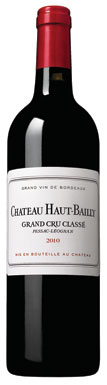
As ever when tasting the two together, the striking thing is the difference in character rather than quality between 2009 and 2010. This is tighter,...
2010
Château Haut-BaillyPessac-Léognan
Château Haut-Bailly, Pessac-Léognan, Cru Classé de Graves, Bordeaux, France, 2009
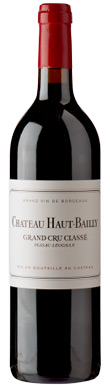
Right from the first moment you look at this wine you can see that it remains young, concentrated and full of life. Clear smoked caramel...
2009
Château Haut-BaillyPessac-Léognan
Château Haut-Bailly, Pessac-Léognan, Bordeaux, France, 2008
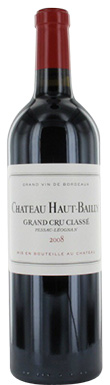
Haut-Bailly has upped the intensity a little in recent years, and although that has rightly won it plaudits, this makes me feel a little nostalgic...
2008
Château Haut-BaillyPessac-Léognan
