
Producer profile: Château Talbot
Known among claret lovers for its consistency, Château Talbot has a long history of family ownership. Yohan Castaing discovers how the current owners are combining tradition and modernity to shape its future.


With tasting notes by Jane Anson...
Château Talbot, situated smack in the middle of an ocean of vines, is one of the rare classified growths of the Médoc where the family owners reside. Nancy Bignon-Cordier likes to remind her visitors that she does not think of herself as its proprietor, rather as the custodian of a patrimony to be passed on to her children.
She has good reason to be proud of her family’s ownership of this property, located in the St-Julien appellation, as 2018 marks the 100th anniversary of its acquisition by Désiré Cordier. In anticipation of the centennial, a new high-tech winery and a monumental barrel hall, graced with branch-like pillars that recall the gobelet or bush-vine training shape, were constructed.
Scroll down for Château Talbot tasting notes from 2000 to 2017
One of the invaluable assets of such an heirloom is its long history; but the origin of the Talbot name is shrouded in mystery. It is usually traced to the English nobleman, John Talbot (c.1384-1453), First Earl of Shrewsbury, who in fact never laid claim to the property, as it was non-existent in his lifetime.
What did exist was Talbot’s fame and glory as a military commander during the Hundred Years’ War, before he lost his life in France at the Battle of Castillon. Prior to his death, he had been appointed Constable of France by the King of England, and he appears in that role as a character in Shakespeare’s play about the loss of the French territories, Henry VI Part One, in which the sabre-rattling sobriquet, ‘the terror of the French’, is applied to Talbot.Legend has it that Talbot passed through the Médoc and established a camp in St-Julien, near where the château now stands.
A map published in 1785 by Pierre de Belleyme indicates a lieu-dit or specific site named Talbot, including a house belonging to the Delage family, which in all likelihood became Château Talbot. However, Le Médoc, the authoritative book about the region written by René Pijassou in 1980, points in another direction for the origin of the name, towards a Gascon term of unknown meaning, ‘Talabot’, which transformed over time into Talbot.
Talbot at a glance
Owner Nancy Bignon-Cordier
General manager Jean-Michel Laporte
Appellation St-Julien
Vineyard area 110ha
Plantings Red grapes: 68% Cabernet Sauvignon, 28% Merlot, 4% Petit Verdot. White grapes (5.2ha): 80% Sauvignon Blanc, 20% Sémillon
Second wine Connétable Talbot
White wine Caillou Blanc
Consultants Eric Boissenot, Stéphane Derenoncourt
A family affair
Whatever its origin, the easily pronounced name of Talbot has surely played a role in the international success of the wines from this estate, which was classified as a fourth growth in 1855. Stability and tradition, as well as a corollary consistency for its wines, have also been important factors in its renown, for throughout its history it has only known four different families as owners.
After the aforementioned Delage family built the first edifice and probably put the initial vineyard in place, Jean-Jacques d’Aux de Lescout from Armagnac acquired the estate, which became known as Talbot-d’Aux. After the death of Jean-Jacques in 1813, it passed to his son Henry-Raymond (later Marquis d’Aux-Lally), who expanded both the château and the estate. It remained in the family until Henry-Raymond’s son, Arnaud, sold it to Albert Claverie in 1899, from whom the Cordier family bought it in 1918.
This was a crucial stage in the history of Château Talbot, for Désiré Cordier was a wine merchant hailing from the east of France who in 1913 had already purchased Château Lafaurie-Peyraguey in the Sauternes region and later acquired other prestigious Bordeaux estates, including Meyney in St-Estèphe and Gruaud Larose, also in St-Julien, as well as Clos des Jacobins in St-Emilion. As such, the distinctive Cordier labels became ubiquitous in international markets and a favourite on restaurant wine lists.
‘Château Talbot was lucky to belong to a family of wine merchants with pockets deep enough to maintain such a large vineyard,’ explains Jean-Paul Bignon, husband of Bignon-Cordier, who is now in charge of the domaine. Indeed, such a constant familial link has become rare in the Médoc, as more and more properties change hands because of complicated cases of inheritance.
Bignon-Cordier, her husband and their three children (Marguerite, Philippine and Gustave) continue to reside on what has always been a big property, comprising 110ha, most classified as St-Julien, but including 5.2ha of white wine grapes under the more basic Bordeaux appellation.

In the vineyard
Another factor of constancy for the past decade has been the role of Jean-Pierre Marty as general manager since 2006. Before retiring this March, Marty noted: ‘Talbot alone among the classified châteaux of St-Julien has a vineyard consisting of a single block of vines.’ To gild the lily, Talbot’s vines, most having an average age of 50 years, are located at the highest point of the commune, on Günzian gravel of the best sort and ‘with less clay than those planted closer to the Gironde estuary’. Its soil is thus well drained, a valuable attribute in the Médoc.
Sand is also present in the mix, providing finesse and elegance as well as a capacity for staying the distance. Indeed, the Talbot style has never been one of precocious pleasure, but one that comes to the fore with ageing. Its backbone is the large proportion of Cabernet Sauvignon, comprising 68% of the vineyard, with 28% Merlot and 4% Petit Verdot.
The wine produced by Château Talbot has never been subject to the phenomenon of wine speculation, and benefits from a reputation of presenting good value. Recent prices have been along the lines of €40 (£35) to €50 (£43) a bottle en primeur, and from €55 (£48) to €60 (£51) when released in bottle.
Another striking feature of Château Talbot is that it is home to one of the oldest plots of white wine grapes in the Médoc, first planted in the 1930s by Georges Cordier, Désiré’s son. He was proud of his lineage from the Alsace-Lorraine region of eastern France and loved white wine. He even cultivated Riesling for a time in what was to become at harvest time an island of white grape vines surrounded by an ocean of red grapes, the source for a wine commercialised as Caillou Blanc. Today these 5.2ha are mainly Sauvignon Blanc, with 1ha devoted to Sémillon, and they produce an aromatic wine of citrussy character that is precise and nervy.

Consistency and consultants
When asked if having a contiguous vineyard of a single block is an asset, even an incentive, for conducting organic viticulture, Bignon replies, ‘It is better to be a good practitioner of so-called conventional viticulture than a mediocre proponent of an organic approach.’ Nevertheless, he admits to experimenting with it on around 20% of the estate for the 2018 vintage, while having no immediate plans to convert the whole vineyard.
Jean-Michel Laporte, formerly director of Château La Conseillante in Pomerol, who has replaced Marty as general manager of Talbot, shares this view. ‘I’ll try to continue the work accomplished by Jean-Pierre, while bringing the fruits of what I learned at La Conseillante, a much smaller-scale estate. The wines of Talbot have clearly been getting even better in recent vintages.’ He evidently plans no substantial change to the tradition of Talbot, known for its consistency and reliability.
Respect for tradition does not equate to a closed-minded vision of the world. Talbot is advised by two of the leading Bordeaux wine consultants, both internationally renowned. Stéphane Derenoncourt supervises the viticulture, and Eric Boissenot the vinification and wine-cellaring stages. As Bignon sees it, ‘Stéphane brings us a sharper view regarding the work in the vineyard, particularly when it comes to choosing harvest dates, while Eric accompanies us during the winemaking and the blending process.’ Together they form an atypical duo in the region, bringing to the wine of Talbot in recent vintages both greater precision and plenitude.
Talbot thus embodies both the contemporary history and current trends of Bordeaux, whether as a precursor for white wine in the Médoc, as a paragon of commercial flair, a model for continuity in family ownership, or an ardent defender and promoter of its terroir. Thanks to the captivating history of the estate as well as its special mix of tradition and modernity in the elaboration of its wines – full of seductive charm once they reach their apogee – the family can continue to transmit to future generations of wine lovers the precious legacy of a fine wine named Talbot.
Château Talbot – a timeline
1453 John Talbot dies during the Battle of Castillon
1775 Jean-François Delage, owner of what was to become Château Tablot, dies and leaves the estate to his two daughters
1821-1822 Henry-Raymond d’Aux de Lescout, the Marquis d’Aux-Lally, expands the château edifice
1855 Château Talbot ranked as a fourth growth in the 1855 Bordeaux Classification
1899 Albert Claverie acquires the estate
1918 Claverie sells Château Talbot to Désiré Cordier
1930s The pioneering Georges Cordier decides to replant white grapes in the Médoc and begins to produce a wine named Caillou Blanc
1993 Jean Cordier dies and leaves the estate to his two daughters, Lorraine and Nancy
2006 Jean-Pierre Marty becomes general manager
2008 Stepháne Derenoncourt is hired as a consultant, working alongside oenologist Eric Boissenot
2011 Lorraine Cordier dies, and Nancy Bignon-Cordier takes over the management, with her husband Jean-Paul Bignon
2018 Jean-Pierre Marty retires as general manager, replaced by Jean-Michel Laporte
Château Talbot 2000 – 2017:
Vintages 2000 – 2016 were tasted in a veritcal at the château. Talbot 2017 was tasted separately for Jane Anson’s Bordeaux 2017 en primeur report.
Yohan Castaing is a DWWA judge and freelance wine writer based near Bordeaux
You may also like:
Taming Château Trotanoy: Wines from 1998 to 2018
Comparing Bordeaux’s two Château Pichon estates
Anson: Comparing St-Julien 1986 and 1988
Château Talbot, St-Julien, 4ème Cru Classé, Bordeaux, France, 2000
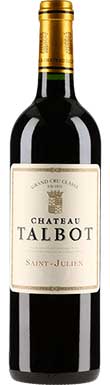

Soft, blueberry and brambled autumn fruit – a definite hedgerow feel. This has expectedly soft tannins at this stage, moving into tertiary territory. Certainly an...
2000
Château TalbotSt-Julien

Château Talbot, St-Julien, 4ème Cru Classé, Bordeaux, France, 2001
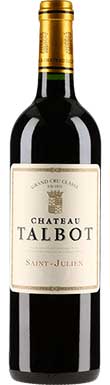
Colour-wise this wine has held itself together a little more than the 2000 vintage. The higher acidity could be down to the cooler nights in...
2001
Château TalbotSt-Julien
Château Talbot, St-Julien, 4ème Cru Classé, Bordeaux, France, 2002
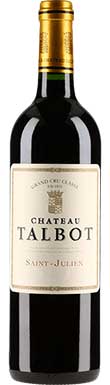
This starts off well, with a cassis fruit expression and some clear lift, however it slides through the mid-palate rather than expanding in the mouth....
2002
Château TalbotSt-Julien
Château Talbot, St-Julien, 4ème Cru Classé, Bordeaux, France, 2003
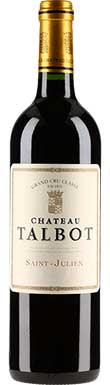
This wine has clear indications of a hot year, with some exotic dried fig notes and rich leather. Attractive in many ways, this has a...
2003
Château TalbotSt-Julien
Château Talbot, St-Julien, 4ème Cru Classé, Bordeaux, France, 2004
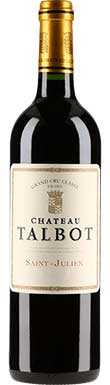
This vintage presents a clear deepening of colour, switching from tertiary to a plump and rich ruby. 2004 was not the easiest vintage in Bordeaux,...
2004
Château TalbotSt-Julien
Château Talbot, St-Julien, 4ème Cru Classé, Bordeaux, France, 2005
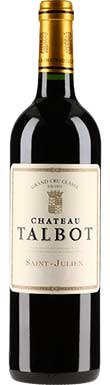
Once again the 2005 vintage works its magic, and this is a standout wine. Menthol and fresh mint leaf notes are set against liquorice and...
2005
Château TalbotSt-Julien
Château Talbot, St-Julien, 4ème Cru Classé, Bordeaux, France, 2006
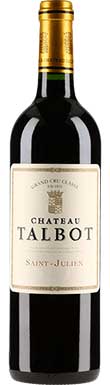
After almost two decades, the dazzling 2006 Talbot is entering its window of maturity. Gorgeous aromatics suck you in and the palate does not disappoint....
2006
Château TalbotSt-Julien
Château Talbot, St-Julien, 4ème Cru Classé, Bordeaux, France, 2007
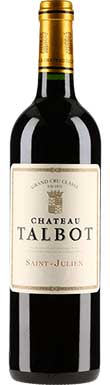
As is ever the case with these lighter vintages, the oak notes take a greater dominance than usual – here they show caramel sweetness overlaid...
2007
Château TalbotSt-Julien
Château Talbot, St-Julien, 4ème Cru Classé, Bordeaux, France, 2008
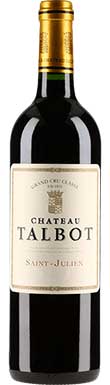
Deep in colour, just hitting that 10-year mark. It could begin to be drunk now, but equally it could also stay teetering on the brink...
2008
Château TalbotSt-Julien
Château Talbot, St-Julien, 4ème Cru Classé, Bordeaux, France, 2009
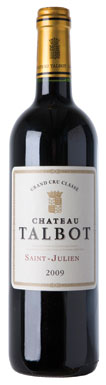
A hint of brick colour at the edge belies the youthfulness of the gorgeous 2009 Talbot. Succulent black fruit sits on a firm but suave...
2009
Château TalbotSt-Julien
Château Talbot, St-Julien, 4ème Cru Classé, Bordeaux, France, 2010
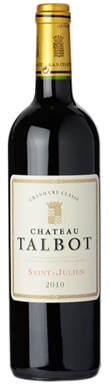
Rich, vibrant nose. Milk chocolate, cherries and soft floral scents. Bouncy and grippy. A lovely bright aspect but with quite a serious, streamlined core so...
2010
Château TalbotSt-Julien
Château Talbot, St-Julien, 4ème Cru Classé, Bordeaux, France, 2011
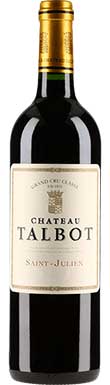
2011 was a classical vintage that was extremely dry, often overshadowed by the two previous years. But this is well balanced with clear intensity –...
2011
Château TalbotSt-Julien
Château Talbot, St-Julien, Bordeaux, France, 2012
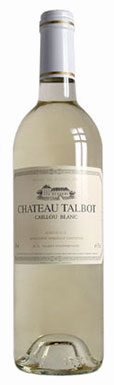
87
75% Sauvignon Blanc grown in St-Julien. Appetising citrus-mandarin aromas. Palate round and full with a pebble-sucking freshness.
2012
Château TalbotSt-Julien
Château Talbot, St-Julien, Bordeaux, France, 2013
87
Fresh colour, floral fruits, quite lifted, some charm but could have more structure and depth.
2013
Château TalbotSt-Julien
Château Talbot, St-Julien, 4ème Cru Classé, Bordeaux, France, 2014
Here the lovely cedar nose draws you in and leads to an elegant combination of dark fruit and mature, leather-like nuances. The tannins are not...
2014
Château TalbotSt-Julien
Château Talbot, St-Julien, 4ème Cru Classé, Bordeaux, France, 2015
The gentle 2015 Talbot shows the charms of claret. Not a powerhouse, it caresses the palette. Its restraint and elegance are the epitome of Talbot....
2015
Château TalbotSt-Julien
Château Talbot, St-Julien, 4ème Cru Classé, Bordeaux, France, 2016
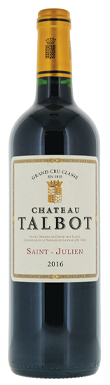
Good intensity and richness with earthy, leafy notes and integrated structure. Cumin, dark chocolate, toasted spice and black fruit provide balance, supported by soft tannins.
2016
Château TalbotSt-Julien
Château Talbot, St-Julien, 4ème Cru Classé, Bordeaux, France, 2017
Complex aromas of intense blackcurrant, dark cherries, plums and hints of chocolate, violet and leafy notes. Generous and appealing, showing tension and precision with slightly...
2017
Château TalbotSt-Julien
