
Walls: Tasting the classic 2001 Guigal La Las
Matt Walls takes a look at the 2001 vintage of the famous Côte-Rôtie trio from Rhône producer Guigal. Read his assessment below and find out whether the three 2001 La Las are ready to drink now.


Like many teenagers, I was obsessed with movies when I was growing up. When I see original posters today for films I enjoyed back then, the effect is immediate – a glance somehow conjures the story, the characters and the emotional impact all at once.
Today, wine labels can have a similar effect. And what more iconic labels are there in the Rhône than Guigal’s single vineyard Côte-Rôties?
When I see the red and gold label of La Mouline, it has the same effect as when I’m confronted with the poster for Goodfellas. Both are classics of their genre that have stood the test of time.
And after 21 years, how are the 2001 La Las holding up? I tasted all three iconic wines to see how this eminently classic vintage is looking today.
Scroll down to see tasting notes and scores for the three 2001 La Las
Vintage overview
Speaking over the phone, Philippe Guigal said 2001 ‘was a vintage that we needed to communicate to people, as they were focused on 2000 due to Bordeaux; but for me, I’ve always preferred 2001 in the Rhône.’
Looking back at his records, he said that spring saw mixed conditions, but was at least frost-free. Flowering took just 10 days across the whole of the northern Rhône, and although summer got off to a cool and cloudy start, the temperatures soon topped 33 ̊C.
There were some small rains shortly before harvest, but nothing problematic. The producers’ decision-making was hampered, however, due to that particularly French hazard: the employees of Météo-France, the national weather forecasting service, had gone on strike.
‘It started at the beginning of harvest, and went on for the whole period, so we had no idea what weather was coming!’ said Guigal.
The harvest took place between 28 September and 6 October in Côte-Rôtie, and was ‘normal-sized’ according to Guigal.
‘We considered it to be exceptional in St-Joseph and Condrieu; good to very good in Hermitage, Côte-Rôtie and Crozes-Hermitage… We thought the vintage would have good to very good cellaring potential.’
The La La cuvées: a recap
La Mouline
Vineyard location: lieu-dit Côte Blonde
Soil type: gneiss and calcareous loess
Average vine age: 75 years
Grapes: 89% Syrah, 11% Viognier
Winemaking: extraction solely by pumping over for 20 minutes twice a day. 40 months in new oak barriques. 20% stems included at the bottom of the vat to enable juice to circulate
La Turque
Vineyard location: lieu-dit Côte Brune
Soil type: Schistous clay rich in iron oxide
Average vine age: 25 years
Grapes: 93% Syrah, 7% Viognier
Winemaking: Extraction by pumping over and punching down. 40 months in new oak barriques. 20% stems included at the bottom of the vat to enable juice to circulate
La Landonne
Vineyard location: lieu-dit La Landonne
Soil type: Clay limestone rich in iron oxide
Average vine age: 35 years
Grapes: 100% Syrah
Winemaking: Extraction by continuous pumping over for 24 hours a day – an automated system powered by the carbon dioxide produced by fermentation. 40 months in new oak barriques. 100% stems included
How are the 2001 La Las tasting now?
The 2001 vintage is eminently classic. Around the same period, only 1995, 1999 and 2005 were any better.
It’s a vintage that has aged surprisingly well throughout the Rhône Valley, and these three wines are no exception.
All three of these Côte-Rôties displayed their classic personalities.
La Mouline was all about the explosive aromatic display – in this respect it’s a classic Blonde-side Côte-Rôtie. It’s light on the palate – you could easily drink this without food – and not endlessly long, but with a refreshing saltiness. Drinking beautifully now, it delivers spellbindingly complex aromatic fireworks. It will continue to age gracefully for many years to come.
La Turque was considerably deeper and darker than La Mouline; it didn’t have the same aromatic detail or finesse but it did have a more satisfying palate presence and length. It did provide pleasure, but it’s in an introspective phase at present. I expect it will open up again in a few years’ time, at which point it may well score higher. But hold it for now.
La Landonne is always the most structured of the trio, thanks to a combination of factors: there’s no Viognier in the blend; it’s made with 100% whole bunch and continuous pumping over; and it has a naturally austere terroir. It wasn’t fuller in body than La Turque, but certainly had a more robust tannic frame. It scored the same as La Mouline but for different reasons; it doesn’t currently have the captivating aromatics of La Mouline, but is altogether more imposing, grander and more satisfying on the palate. And it will continue to improve.

A long, long life
Though La Mouline is delicious now, the other 2001s really need more time. Longevity is often prized in wines, but having to wait 25 years before opening them is unusual – almost inconvenient! Their extraordinary lifespan is partly thanks to their élevage.
‘We have a vision of long élevage which is always a long-term vision, so in their early years the wines can appear quite raw (brut), often quite severely oaky… Our philosophy of winemaking and maturation is to produce wines that are ready after 15 or 20 years,’ said Guigal.
If there’s one thing that wine lovers know about these wines, it’s their peerlessly long new oak ageing regime.
For many, these wines are defined by this fact. As Guigal says, they are always strongly marked by oak in their youth, but this aromatic element does harmonise to an extent as they mature, even if it can sometimes buff out some finer details on the nose and palate in return for a deep richness.
Red carpet Côte-Rôtie
These are wines that wear their expert winemaking on their sleeve – and this sleeve is cut from the finest French fabric.
Stylistically these are unmistakably luxurious Côte-Rôties, where even casual wine drinkers would recognise that there is something special in their glass. They smell and taste expensive.
Côte-Rôtie comes in many different guises. Some are earthy and naturalistic; others poised and precise.
These are razzle-dazzle, red carpet, Hollywood Côte-Rôties, decked out in velvet and sequins. And who doesn’t like a little glamour in their lives from time to time?
See Matt Walls’ tasting notes and scores for the three 2001 La Las:
Related content:
Guigal to launch fourth ‘La La’ Côte-Rôtie
Guigal’s crown jewels: Tasting the 2015 La Las
Decanter at Home masterclass: Tasting the La Las with Philippe Guigal
E Guigal, La Landonne, Côte-Rôtie, Rhône, France, 2001
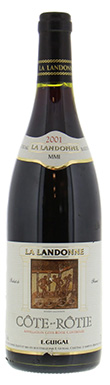

A deeper, more introspective aromatic range compared to La Mouline and La Turque 2001 on opening, more deeply herbal, with bay leaf and coal dust....
2001
E GuigalCôte-Rôtie

E Guigal, La Mouline, Côte-Rôtie, Rhône, France, 2001
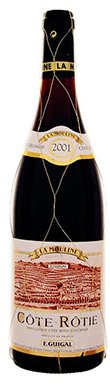
The nose is discreet but captivating on opening; it certainly speaks of Syrah and could only be Côte-Rôtie - it has that unmistakable finesse. Decidedly...
2001
E GuigalCôte-Rôtie
E Guigal, La Turque, Côte-Rôtie, Rhône, France, 2001
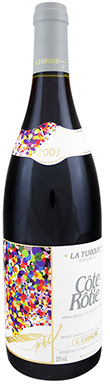
Deeper and meatier than La Mouline 2001, with plenty of black fruit on the nose. This doesn't spring from the glass, you have to approach...
2001
E GuigalCôte-Rôtie
