Master Sommelier Carlton McCoy’s rules for drinking Napa Cabernet today
Ahead of his Decanter Fine Wine Encounter New York masterclass with Heitz Cellar, Carlton McCoy shares his thoughts on aging Napa Cabernet, serving it well and why today’s wines are entering a new era of elegance.
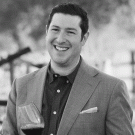


Carlton McCoy is one of the youngest Master Sommeliers, earning the title in 2013 at age 28, and is the second African American to achieve this distinction. Raised in Washington, DC, he began his career in fine dining before transitioning into wine, holding roles at The Little Nell in Aspen, Colorado, where he became Wine Director. He is now CEO of Lawrence Wine Estates, overseeing a portfolio of leading wineries in Napa Valley and Bordeaux. McCoy has been recognized as Wine Enthusiast’s 2023 Social Visionary of the Year for his work advancing diversity and inclusion in the wine industry.
At the table with Carlton McCoy MS
Carlton McCoy has spent decades immersed in the world of fine wine – from restaurant floors and cellars to overseeing some of Napa Valley and Bordeaux’s most prestigious estates.
You’ve spent your career around some of the world’s greatest Cabernet wines. If you had to rewrite the 'rules' for drinking Napa Cab today, where would you start?
It’s not so much a rule but an opportunity for people to explore their own preferences. Cabernet Sauvignon tastes very different at various stages of aging. It’s important to taste wines upon release, after a few years, and with many years of age to explore at which stage you enjoy the wines more.
Talk about the perception of Napa Cabernet as a wine to cellar. What do you think consumers get wrong? What do they get right?
From the mid-1990s on, Napa went through an era of producing wines that were honestly best within the first few years. That style has mostly phased out and the wines being made today by many (not all) will age gracefully for many decades.
What’s your ideal serving temperature for Napa Cabernet these days? And what about glassware?
The wines of Napa are best served cool. I prefer them under 60 degrees. For the more powerful styles, a Bordeaux-shaped glass works, but for the more elegant, nuanced style, a burgundy bowl will express the wine’s true character better.

'The wines of Napa are best served cool' says McCoy.
You oversee estates with serious pedigree and portfolios of age-worthy wines–how do you personally decide when a Cabernet is ready to drink versus worth waiting on?
Classically structured wines, while inspired by the great era of the 1970s are made a bit differently today. These early wines were hard and tannic in their youth. These days, our extractions are more gentle, so the wines are beautiful upon release. But a drinker will be rewarded by patience, and waiting 10 years will pay off. There is no hard rule as to when you should drink a bottle, as there are too many variables to take into consideration, such as vintage, terroir, and producer style, but 10 years will be sufficient to start to release those secondary notes that we all love.
Is there a shift happening toward Cabernets that are more approachable earlier, or is that just a consumer-driven narrative?
There is absolutely a shift. The previous school of thought was that wines had to be riper to be consumed earlier, and that has been thoroughly debunked. It’s all about freshness and elegance. This allows the wines to be more aromatic and more approachable when young. Lower alcohol is a tremendous part of this as well.
You’ve spoken about the deep relationship between food and wine – what are your favourite unexpected pairings with Napa Cabernet right now?
I recently had chicken liver pate with a more youthful Napa Cabernet Sauvignon, and it was divine. It was served with a poached fig. Absolutely fantastic!

Enjoy Cabernet slowly, over an evening, McCoy recommends.
There’s a lot of conversation about drinking less but drinking better–how does Cabernet fit into that shift?
There is no form of Cabernet Sauvignon that would be described as a quaffable beverage. It’s too structured. So drinkers and collectors can enjoy these wines slowly over an evening and watch the wines evolve in the glass for hours. This is a fantastic way to spend an evening with great company, rich conversation, and good cuisine.
Napa has this incredible legacy, but it’s also evolving quickly–how do you balance honouring classic Cabernet styles while embracing modern expressions?
This is extremely relevant to the work we do at Lawrence Wine Estates. I feel that it’s our obligation to continue evolving the region and its wines while learning from the past. There is so much that we adore about the wines of the 1960s and 1970s, but we know more now. So the journey for us is, how do we do it better? More naturally and with less intervention while still crafting timeless wines.
Do you remember a moment–or a bottle–that fundamentally changed how you think about Cabernet Sauvignon?
Absolutely! There were two very distinct moments. Ten years ago, I drank a bottle of 1968 Heitz Cellar Napa Valley Cabernet. I had never had a single wine from California that was so complex, so aromatic, yet so fresh and alive. The other was during a blending session with Jeremy Seysses for The Trailside Estate wines. The 2023 blazes a new trail for Napa Valley Cabernet. It’s a wine that is in its own lane stylistically. One of those goosebump moments.
For readers who might meet you in New York, what’s one thing you hope they take away from the Heitz Cellar tasting with you in person?
I hope they can observe the common thread between the wines Joe Heitz made and the wines Brittany Sherwood is currently making, while also noticing the unique unity in her wines. We feel so blessed to be a part of such a great lineage of wines.

'It’s our obligation to continue evolving the region and its wines while learning from the past' explains McCoy on Napa Valley.
Join Carlton McCoy for a one-of-a-kind tasting of Heitz Cellar wines, including rare library vintages dating back to 1979 at Decanter Fine Wine Encounter New York on 6 June.
Related articles

Heitz Cellar: Six decades of a Napa Valley icon

Salon’s Cristian Rimoldi: ‘Champagne is one of the easiest wines to pair with food’

Bordeaux 2025 en primeur: Everything you need to know with Decanter's expert insights
