Get our daily fine wine reviews, latest wine ratings, news and travel guides delivered straight to your inbox.
You are now subscribed
Your newsletter sign-up was successful
An account already exists for this email address, please log in.
Bo Barrett: The man at Chateau Montelena
As the 50th anniversary of the Judgement of Paris tasting approaches, Bo Barrett reflects on Chateau Montelena’s historic 1970s leap to global acclaim.
Chateau Montelena's famed, Judgement of Paris-winning 1973 Chardonnay
(Image credit: Alexander Rubin/Future)
When a small group of California wines triumphed over France’s finest at the 1976 Judgement of Paris, few could have imagined the global shockwave it would set in motion.
Staged by the late Steven Spurrier (Decanter Consultant Editor for 25 years), the tasting event was meant to be a bicentennial celebration, pitting upstart American producers against benchmark French estates.
Instead, it redefined the hierarchy of fine wine and altered the course of California’s future.
The result – Burgundy’s most esteemed whites being bested by a Napa Valley Chardonnay from Chateau Montelena (a bottle of which now sits in an exhibit in the Smithsonian in Washington, DC) – cemented not only the estate’s reputation but also the credibility of an entire region.
Half a century later, the story still reverberates.
The event remains a symbol of innovation, resilience and the restless spirit that continues to drive Napa Valley.
For Bo Barrett (current CEO and son of Jim Barrett, the late winery founder), who was just 18 when the winning 1973 Chardonnay was bottled, the tasting was a catalytic moment – one that transformed his family’s modest dream into a global legacy.
Decanter newsletter
Get our daily fine wine reviews, latest wine ratings, news and travel guides delivered straight to your inbox.
In this conversation, exclusive to Decanter, Barrett looks back on the early days of Montelena, his father Jim’s improbable leap from law to wine, and the unvarnished realities behind a victory that helped reshape the American viticultural dream.
Decanter, in conversation with Bo Barrett
From left: Decanter's Napa correspondent Jonathan Cristaldi and Bo Barrett
(Image credit: Alexander Rubin/Future)
You were only a teenager when your father bought Chateau Montelena in 1972. What do you remember about those early days?
I remember that it was all quite remarkable.
Two factors stand out in my mind that led my dad to Montelena. The Vietnam War was going really badly at the time, and top income tax rates in the US were extraordinarily high.
My dad was a real estate and tax attorney for a company that built malls around the world, and when he saw that President Nixon had introduced new incentives to revive American agriculture – which was struggling – he spotted an opportunity.
The administration had just expanded major investment tax credits and accelerated-depreciation rules for agricultural projects.
In effect, if you were a high earner, you could either hand a huge portion of your income over in taxes, or you could invest that same money into American agriculture instead.
My dad’s business partner always called Montelena ‘the tax dodge that got out of hand’.
Were you with him when he first set eyes on Montelena?
I was with him on the second trip.
My dad was a pilot, and we’d fly around together looking at pomegranate and citrus groves, cattle ranches, all these different things.
I was probably 17 when I came with him on his second trip to check out Chateau Montelena.
This lake was totally overgrown. It was a total jungle. The vineyards were completely run down.
When did you realise this wasn’t just a family project but might be your life’s work?
I didn’t know I was going to be a farmer until that first summer. I came up and started working in the vineyard and kind of just took to it.
The vineyard manager was an Italian-American named John Roll. He’d ploughed with a mule for Madame [Hélène] de Pins at Beaulieu vineyard.
He taught me how to hunt deer, collect abalone and forage for mushrooms – all this good stuff. He taught me the joy of the mason, which is the pride you take in a hard day’s work.
What do you remember about that famous 1973 Chardonnay around bottling time?
From the summer of 1973 and all the way to ’76, my whole family was here. The bottle that’s in the Smithsonian – I know I filled that bottle.
My brother Mike put the nitrogen on the bottle, and my little brother Kev put the bottles in the case. My whole family’s fingerprints are on that bottle.
Tell us about the day that Steven Spurrier visited the winery.
I remember [the winemaker] Mike Grgich being very nervous and making us get the cellar pristine, super-spiffy clean. It was a VIP tour, same as when Robert Mondavi was coming – everything had to shine.
We had to pull the magic disappearing act: all the staff go away, no one’s around. I wasn’t there watching Steven taste.
Mike probably sent me to the vineyard. Honestly, we didn’t pay that much attention until later.
What about when the results of the Paris tasting came in?
When the telegram came in, we were in the cellar working, filling barrels, and the doors were wide open.
Grgich was out in the gravel parking lot, dancing and waving this piece of paper and yelling, ‘We won! We won!’ So we turned off our pumps and walked out. We were all joining him in this little Yugoslavian victory dance.
It was a hell of a surprise. George Taber [then a Time magazine reporter and the only journalist present at the event, and subsequently author of the 2006 book on the topic] called my dad, and my dad gave him a quote. He didn’t want to insult the French: ‘Not bad for kids from the sticks.’
In what ways and how quickly did things change for Montelena after the article in Time came out?
It was immediate. Suddenly, we had distributors calling from all over the country.
The people who had said, ‘No, we don’t carry California wines’ the week before called us up and said, ‘Hey, we’d like to sell your wine.’ The phone was lighting up.
We didn’t have a general manager, but the California ‘attention’ didn’t change that much.
The first immediate change was that the rest of the country recognised that California was making good wine.
You’ve said before that the Judgement of Paris was a catalyst rather than a miracle. What do you mean by that?
All the ingredients were there: the land, the light, the people, the willingness to do the work.
If there had never been Prohibition, California would’ve buried Europe a century ago.
The most important thing is, it made quality such a driving force for everybody’s goal and mission.
So it had that drive towards improved quality, which then drove consumers to seek out a superior product. And so it became a self-perpetuating thing.
How do you see the next 50 years for Napa Valley?
It’s going to be as tough as the last 50. Work harder than anybody, pick the steep hill and keep climbing.
When you think about legacy, about Chateau Montelena’s place in history, what comes to mind?
I do think about what we’ve accomplished with just trying to do the right thing – to make something special out of a special place. The drive to express American excellence is what we’re the proudest of.
And I just hope that the people who fall in behind us in this business understand that you have to do the hard work and keep your nose to the grindstone and have the right philosophy, which is always to reward people’s faith.
They’re taking a bet on buying your product and your job is to make that bet pay off.
Three of my four grandparents were immigrants. The other was born in a covered wagon. No wine experience at all. The opportunity that was presented to us by this great country – it’s been a good thing.
We’re just quiet about it. People ask, ‘Are you going to retire?’ I say, hell no. I love what I do.
I’ve got a beautiful place, friendly people to work with and a fantastic crew. It’s a nice little ship. I don’t want to give it up.
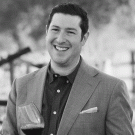
Matt Crafton on past, present and future
(Image credit: Alexander Rubin/Future)
As Chateau Montelena marks the 50th anniversary of its 1976 triumph at the Judgement of Paris, winemaker and newly named president Matt Crafton reflects on the lasting significance of that moment – and what the next half-century may hold for Napa Valley.
Jonathan CristaldiAs you reflect on the Judgement of Paris, with the 50th anniversary approaching, what strikes you most about the significance of that event today?
Matt Crafton It remains significant because it’s a story that still resonates inside each of us, from a human standpoint.
It gave us the recognition of the importance of innovation, of questioning the conventional model, and being daring enough to try something new.
That is still part of Montelena’s DNA – something very American about that. Above all, it marked an inflexion point in the industry that had been fomenting.
Jonathan CristaldiAnd how does it feel to be carrying the torch of such a legendary winery?
Matt Crafton It’s a tremendous responsibility, but not a heavy burden. I suppose if my job were to replicate the 1973 Chardonnay every year (assuming it were possible), I would look at things differently. But it’s not.
What I love about this brand is that the same daring, independent spirit that built Montelena still drives what we do.
There’s a little bit of ‘Johnny Cash’ here – cowboy, maverick, honest and confident.
Jonathan CristaldiWhat will define Montelena and Napa Valley in the next 50 years?
Matt Crafton Montelena is exceedingly independent in a sea of mimetic activity. The upside of being part of a small, tight-knit community in Napa – namely openness, collegiality and camaraderie – can also lead to deleterious outcomes, namely groupthink.
I’m grateful that Montelena supersedes those tendencies.
When one considers the goals for a vineyard with a 40- to 60-year lifespan instead of 15 to 30, the tools, decision making and perspective change.
The heart of what the Judgement of Paris signified, and how we succeeded, is still essentially here.
Napa Valley, like Montelena, needs to remain forwardlooking, free to innovate, and, as a result, aspirational.
Paraphrasing Ben Franklin, Napa is the gold standard for the wine industry, if we can keep it.
Chateau Montelena, Chardonnay, Napa Valley, California, USA 2023
My wines
Vivid, pure citrus expression with a mineral character, like the squeeze of a just-picked Meyer lemon over an oyster-shell, laced with white floral notes. Linear...
Chateau Montelena, Chardonnay, Napa Valley, California, USA 2022
My wines
A wonderfully bright through-line of fresh citrus peel and early-season apple, driven by crunchy acidity and taut, tart flavours. There’s real generosity beneath that precision,...
Chateau Montelena, Chardonnay, Napa Valley, California, USA 2021
My wines
Bright, energetic and effusive, showing excellent concentration and aromatic lift. Fragrant white flowers and citrus fruit, followed by a creamy orchard-fruit core on the mid-palate....
Chateau Montelena, Chardonnay, Napa Valley, California, USA 2020
My wines
Picked prior to the Northern California fires, this clearly reflects the warmth of the vintage. More tropical tones come through, with hints of pineapple and...
Chateau Montelena, Chardonnay, Napa Valley, California, USA 2019
My wines
Still very primary, showing crunchy citrus and orchard fruit with a slightly more voluptuous mouthfeel than the 2018. Notes of lemon cream and baking spice...
Chateau Montelena, The Montelena Estate Cabernet Sauvignon, Napa Valley, California, USA 2023
My wines
A stellar wine – polished and supremely suave. Seamless in execution, it captures the hallmarks of the 2023 vintage with an off-the-charts coolness that carries...
Chateau Montelena, The Montelena Estate Cabernet Sauvignon, Napa Valley, California, USA 2018
My wines
There’s an enticing richness here, with fragrant aromatics of spiced dark plum, black cherry and blackberry fruit, layered with loamy earth and dried violet. The...
Chateau Montelena, The Montelena Estate Cabernet Sauvignon, Napa Valley, California, USA 2017
My wines
A bit of an outlier, reflecting the 2017 vintage’s distinctive markers. Dark fruit dusted with an exotic red-spice character – cinnamon and redwood bark. An...
Jonathan Cristaldi is a wine writer and critic based in the San Francisco Bay Area. For more than a decade, his articles on wine, spirits and beer have appeared in a host of print and digital platforms, including Decanter, Food & Wine, Departures, The SOMM Journal, Tasting Panel Magazine, Liquor.com, Seven Fifty Daily, Los Angeles Magazine, Thrillist, Tasting Table and Time Out LA among others. When not writing about wine, Cristaldi works as a scriptwriter on film and documentary projects with award-winning commercial photographer and director Rachid Dahnoun.