
Why wait a decade for Côte-Rôtie? Stéphane Ogier's done it for you
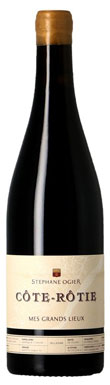
What if the best Côte-Rôtie arrived ready to drink? Stéphane Ogier’s Mes Grands Lieux – released after ten years of estate ageing – may be the answer.
For winemakers, producing long-lived styles is a double-edged sword. On the one hand, ageability confers prestige. And prestige elevates prices.
But on the other hand, long-lived wines can discourage regular purchases. Producers of, say, Port have a hard time convincing their customers to buy every year, as many clients already have some gradually maturing in the cellars – and it can last a lifetime.
Making wines such as Provence rosé can be a better business model. The average bottle price might be lower, but they’re consumed immediately; so if you like them, they’ll need to be replaced.
What about Côte-Rôtie?
When it comes to ageing, Côte-Rôtie can be enjoyed both young and old, but many of the best arrive at peak drinking between 10 and 20 years of age. It would be convenient if producers only released their wines when they reached this sweet spot, but holding wines for a decade before selling them isn’t commercially viable for most estates.
That’s why Stéphane Ogier’s new cuvée Mes Grands Lieux is so interesting. The new release is 2016, and Ogier says he will sell each subsequent vintage only after 10 year’s maturation.
Stéphane Ogier in brief
- First vintage bottled by Stéphane’s father Michel was 1983
- Stéphane joined the estate 1997
- Total size of estate: 43ha
- Surface in Côte-Rôtie: 14ha
- Individual parcels of vines in Côte-Rôtie: 35
- Lieux-dits in production in Côte-Rôtie: 22
- Mes Grands Lieux average production: 15,000 bottles
Change of range
Until now, there have been three quality levels in Ogier’s range of Côte-Rôties, following a notionally Burgundian model.
Get our daily fine wine reviews, latest wine ratings, news and travel guides delivered straight to your inbox.
To start with, there is Mon Village, a blend of vineyards that contains vineyards across the appellation, particularly his younger vines.
Skipping straight to the top, there are his single-vineyard wines, which he produces in all but the most difficult years. He typically creates between six and nine, which are sold in a mixed selection case. This includes what he considers to be his ‘grand cru’ bottlings: Côte Blonde, Lancement and La Belle Hélène.
But not all of his single-vineyard wines are bottled separately. A larger proportion is blended together to make his Côte-Rôtie Réserve, which sits between Mon Village and his single vineyards.
It is this Réserve bottling that has evolved and has now been released at 10 years of age, under the Mes Grands Lieux label.
The decision to start ageing the wines before release came after he made some tweaks to the blend.
In 2015, he started incorporating more of his structured, ‘Brune’ side parcels and started including more whole clusters. From 2016, he realised this cuvée could now take – indeed required – extended ageing as a result.
‘I didn’t know it would be 10 years to begin with – just that I wanted to keep it,’ he says. The only was to ensure that people held it for long enough was to store it himself.
That’s why there has been no Réserve released since 2016. And why, in 2026, Mes Grands Lieux 2016 now sees the light of day.
Vertical of Mes Grands Lieux
Tasting Mes Grands Lieux
The blend changes from year to year. But to generalise, since the 2016 vintage, Mes Grands Lieux is made up of around a dozen lieux-dits, all of which are fermented separately then blended after ageing for around 24 months in barriques and (increasingly) demi-muids.
Around three quarters of the lieux-dits are situated on the schistous ‘Brune’ side of the appellation, and the wine is made of 96%-98% Syrah (the rest Viognier) with close to 50% whole clusters.
Having recently tasted every vintage made so far (2007, 2010, and 2012 to 2022 inclusive) I can confirm that the jump in quality from the 2016 is noticeable and significant. Most vintages before that point are good, but they don’t reach the same heights – particularly the excellence of the 2016, 2019 and 2020.
I was surprised by the quality of some of the more difficult vintages – notably 2014 and 2021 – until Ogier explained that he made no single-vineyard bottlings these years. Everything – even his Côte-Blonde, Lancement and Belle Hélène – went into Mes Grands Lieux.
My only quibble is this: 10 years is not always quite enough. The 2016, 2017, 2019, 2020 and 2022 will all improve even more with further time in bottle. So don’t assume Mes Grands Lieux guarantees a wine at peak drinking (though the 2018 and 2021 should be drinking well on release, as is everything pre-2016).
But this is a minor criticism. By ageing these wines in perfect conditions until they’re ready to drink, Ogier deserves our praise.
Crucially, they’re past that awkward teenage stage at around seven to eight years when many Côte-Rôties can show poorly. Any further ageing is optional, and down to us.
This is great for wine lovers – it provides access to Côte-Rôtie that’s been stored under optimum conditions either at peak drinking or not far off. And it’s a smart move for Ogier. Côte-Rôtie might be a long-lived wine, but these wines won’t hang around for long in people’s cellars. And they’ll likely be swiftly replaced with more.
Matt's tasting notes for Ogier's Côte-Rôtie Mes Grands Lieux: 2007 to 2022
Wines are listed in order of oldest to youngest
Related articles
Château la Borie: The wizard of Suze
Château-Grillet: The legendary Rhône white steps into a new era
It's a rock thing: Meeting Georges Truc, the Rhône’s wine geologist
Stéphane Ogier, Mes Grands Lieux, Côte-Rôtie, Rhône, France 2007
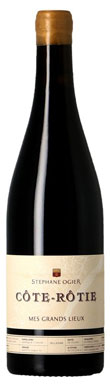
Smelling this for the first time actually made me laugh out loud - so intense, so aromatic, so classically Côte-Rôtie and so utterly wonderful. It's...
2007
RhôneFrance
Stéphane OgierCôte-Rôtie
Stéphane Ogier, Mes Grands Lieux, Côte-Rôtie, Rhône, France 2010
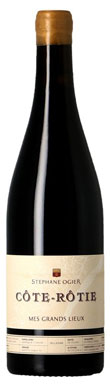
This vintage was quite closed on opening; it feels like it's in something of a hole or dumb phase currently. After an hour's decant, it...
2010
RhôneFrance
Stéphane OgierCôte-Rôtie
Stéphane Ogier, Mes Grands Lieux, Côte-Rôtie, Rhône, France 2012
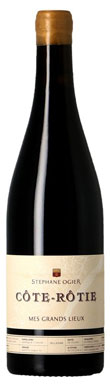
Dark chocolate, coffee bean and rosemary, some wood smoke. It's medium-bodied, not hugely concentrated, but has a lovely sense of freshness, ending on a saline...
2012
RhôneFrance
Stéphane OgierCôte-Rôtie
Stéphane Ogier, Mes Grands Lieux, Côte-Rôtie, Rhône, France 2013
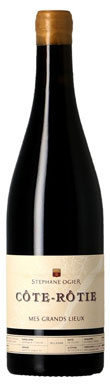
Tightly wound, with mouthwatering acidity; still young and tight. Has some intensity and concentration, but acidity plays a more leading part here than in a...
2013
RhôneFrance
Stéphane OgierCôte-Rôtie
Stéphane Ogier, Mes Grands Lieux, Côte-Rôtie, Rhône, France 2014
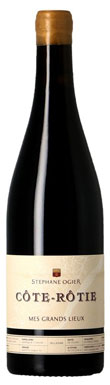
Lovely spiciness on the nose - struck flint, paprika. Light-bodied, very fluid and fresh. A precise style of Côte-Rôtie, with bright, focussed acidity running through...
2014
RhôneFrance
Stéphane OgierCôte-Rôtie
Stéphane Ogier, Mes Grands Lieux, Côte-Rôtie, Rhône, France 2015
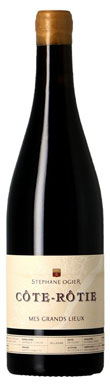
This begins with plentiful dark fruit and Syrah spice, then there's a barnyard note too on the nose here that's not evident on other vintage...
2015
RhôneFrance
Stéphane OgierCôte-Rôtie
Stéphane Ogier, Mes Grands Lieux, Côte-Rôtie, Rhône, France 2016
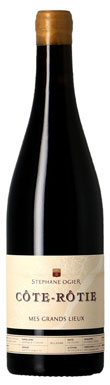
This is a big step-up from all previous vintages (except the legendary 2007); it has freshness, purity, precision and finesse. It has a lovely ethereal...
2016
RhôneFrance
Stéphane OgierCôte-Rôtie
Stéphane Ogier, Mes Grands Lieux, Côte-Rôtie, Rhône, France 2017
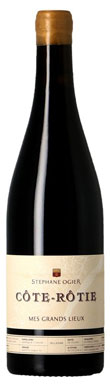
The nose has real intensity, led by fresh black fruits. The tannins are intense, really grippy. It has good freshness, but it feels like it...
2017
RhôneFrance
Stéphane OgierCôte-Rôtie
Stéphane Ogier, Mes Grands Lieux, Côte-Rôtie, Rhône, France 2018
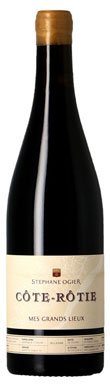
Gently perfumed, a touch of dark chocolate and vanilla. Silky, generous, fairly full and juicy style; good acidity however. It has good impact and intensity...
2018
RhôneFrance
Stéphane OgierCôte-Rôtie
Stéphane Ogier, Mes Grands Lieux, Côte-Rôtie, Rhône, France 2019
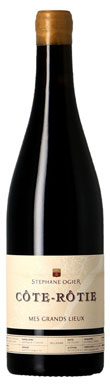
Immediately, the vintage makes itself known, it has 2019's intensity and ripeness, along with a sticky, spicy complexity. It's full-bodied, concentrated - this is a...
2019
RhôneFrance
Stéphane OgierCôte-Rôtie
Stéphane Ogier, Mes Grands Lieux, Côte-Rôtie, Rhône, France 2020
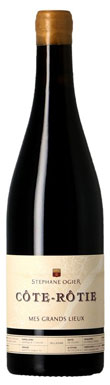
All the elements are here on the nose: the flowers, the fruits, the herbs, the spices. It's more classically Côte-Rôtie in aroma than the thunderous...
2020
RhôneFrance
Stéphane OgierCôte-Rôtie
Stéphane Ogier, Mes Grands Lieux, Côte-Rôtie, Rhône, France 2021
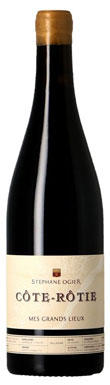
Prettily perfumed violets and tart berry fruits, some fresh herbal inflections. Light-bodied, as you'd expect for the cool 2021 vintage, and it has the acidity...
2021
RhôneFrance
Stéphane OgierCôte-Rôtie
Stéphane Ogier, Mes Grands Lieux, Côte-Rôtie, Rhône, France 2022
This has serious weight and depth; great resonance and power. Huge length. The tannins are firm, bold, muscular - the most overtly tannic vintage of...
2022
RhôneFrance
Stéphane OgierCôte-Rôtie

Matt Walls is an award-winning freelance wine writer and consultant, contributing regular articles to various print and online titles including Decanter, where he is a contributing editor. He has particular interest in the Rhône Valley; he is chair of the Rhône panel at the Decanter World Wine Awards and is the owner of travel and events company www.rhoneroots.com.