
Castello Banfi’s Poggio all’Oro: vertical tasting
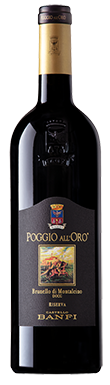
Poggio all’Oro is Banfi’s historic flagship, a Brunello di Montalcino Riserva which has been produced since 1985. Michaela Morris enjoys a vertical of the wine at the Banfi estate.


‘Poggio all’Oro is the vineyard from which our marriage with Sangiovese started,’ declares Enrico Viglierchio, Banfi’s General Manager of over 20 years. He hosted me at Castello Banfi for a vertical tasting during Montalcino’s most recent Benvenuto Brunello event in November 2021.
Scroll down to see tasting notes and scores from the Poggio all’Oro vertical tasting
In the region’s southwest corner, the 800-hectare estate surrounds the medieval Poggio alle Mura castle. It was purchased in 1978 by Italo-American brothers John and Harry Mariani. They arrived with a certain bravado but were instrumental in the success of Brunello in the US market.
Today the company is led by John’s youngest daughter Cristina Mariani-May who has honed Banfi’s environmental and research initiatives.
The most prolific producer and largest landowner in Montalcino, Banfi boasts 173.5 hectares designated for Brunello. The vineyards spread out from Camigliano to Tavernelle down to Sant’Angelo Scalo. Of the 10 million bottles Banfi produces annually in Tuscany, 500,000 are Brunello.
These are divided between five labels. One of two Riservas, Poggio all’Oro is Banfi’s historic flagship. At 20,000 to 30,000 bottles per year, it is comparable in quantity to the estate’s other Riserva – Poggio alle Mura. The latter is made every vintage from a selection of choice grapes throughout Castello Banfi’s extensive Brunello vineyards, whereas Poggio all’Oro hails from a single vineyard and is crafted only in top years.
While single vineyard Brunellos are now prevalent in Montalcino, Banfi can be considered an early adopter as Poggio all’Oro has been produced since 1985. Given Banfi’s vastness, it is a single vineyard on a macro, California-esque scale. Totalling 24 hectares, Poggio all’Oro is much larger than the entire surface area of many other Montalcino estates. Upon its inception, it also diverged from the classic interpretation of a Riserva which was usually selected from an estate’s old vines as espoused by Biondi Santi.
Translated as the ‘golden knoll’, Poggio all’Oro sits at the highest elevation of the estate’s gently rolling hills. Essentially a plateau, it rises gradually from 229 to 255 metres above sea level. With a southwest exposure, it is bathed in sun by mid-morning through to early evening. The soil is predominantly brown clay with lots of small alluvial stones that help drainage.

A massal selection from the vineyards surrounding it, Poggio all’Oro was planted between 1978 to 1981. The low density (2,100 vines per hectare) and high cordon spur training system reflected the prevailing customs of that era. In 2016, Banfi began replanting the vineyard, renewing all but five hectares by 2020. Density has been increased and ‘albarello’ or small bush vines were also partially introduced. Cuttings were taken from old vines to preserve the concept of a massal selection. This contrasts with the rest of the estate’s vineyards which have been replanted with specific clones selected on the property – the result of extensive studies that started in 1982.
In the winery, Poggio all’Oro has seen a slow evolution. Vinification in temperature controlled stainless steel tanks remained the standard from 1985 to 2006. During this period, aging was predominantly in Banfi’s signature 350-litre barriques. At the turn of the century, Banfi started to rein in the wood influence by gradually decreasing toast levels.
Nevertheless, the greatest changes began in 2006 when Banfi’s new vinification facility was completed. It was outfitted with the estate’s patented Horizon tanks invented in collaboration with the esteemed Gamba cooperage. A hybrid of stainless steel and wood, they combine the cleanliness of the former with the benefits of slight oxygen ingress of the latter, describes winemaker Gabriele Pazzaglia. ‘Bringing greater precision to the winemaking through smaller batch vinification, the tanks allow for gravity pressing, délestage, pumping over and long macerations if desired,’ he says. The 24 lightly toasted vats are used exclusively for the estate’s Brunello and Sangiovese-based Super Tuscan wines.
At the same time, Banfi began reducing aging in barriques in favour of large casks of 40 hectolitres or more for all its Brunello bottlings. This transition is most pronounced in Poggio all’Oro where the soon-to be-released 2016 sees just 20% barriques. Viglierchio points to years of experimentation in tandem with the changing climate and trying to balance ripeness. ‘These factors led us to research the most suitable aging in wood,’ he says. ‘All aimed at a quest for greater elegance and respect of the vineyard.’
The tasting
Charting this evolution, we tasted nine of the 15 vintages produced starting with the inaugural 1985. ‘There were large jumps between certain years,’ explains Banfi Communication Manager, Lorella Carresi. ‘For example, between 1999 and 2004, the 2001 was not made as spring frost decimated the vines.’
Just four of the 15 vintages were not rated five stars by the Brunello consortium – 1986, 1993, 1999 and 2013. We tasted all these except for 1986. The vertical included hotter than average, more extreme vintages like 1985, 1993 and 2006 as well as cooler, more balanced years like 2004, 2010 and 2013. The wines demonstrated varying vintages and changes in winemaking, but above all the sturdy, foursquare character of Poggio all’Oro pervaded.
Tasting the 1985 vintage was a rare treat, even for the team at Banfi. While it won’t improve, it is not on precipice. The same can be said of 1999 and 1993, though I would open these within the near-term for maximum balance of fruit and structure. The latter was the least charming of the vertical, a throwback to a bygone era. Though 2004 showed better oak integration, the evolution of fruit was not quite in step with the unhurried structure.
Conversely, 2006 was still quite immovable. It definitely has Poggio all’Oro’s signature austerity and linearity but fascinatingly so. I would continue to hang onto it – along with the 2010, 2015 and 2016. Of these, I’d hedge my bets on 2015 coming around first. It shows the warmth of the vintage and may not be as long-lived. As for 2013, it was the most elegant – which is not a characteristic I typically associate with Poggio all’Oro. The most approachable of the wines since 2010, it can be opened now.
Ending on a high note, the 2016 is a testament to the work at Banfi. It suggests that all the fine tuning will have a positive impact on the fruit to tannin ratio and allow the wines to express and age with greater harmony.
Poggio all’Oro vertical: tasting notes & scores
Related content:
Under-the-radar Brunello producers in 2022
Top 10 best-value Brunello di Montalcino 2017 wines
Barolo and Brunello vintages to drink now
Castello Banfi, Poggio all'Oro, Brunello di Montalcino, Tuscany, Italy, 2016
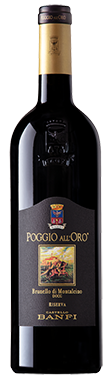

Banfi was rewarded for waiting out the 100 millimetres of rain that fell mid-September, harvesting ripe, healthy grapes at the end of the month. With...
2016
Castello BanfiBrunello di Montalcino

Castello Banfi, Poggio all'Oro, Brunello di Montalcino, Tuscany, Italy, 2015
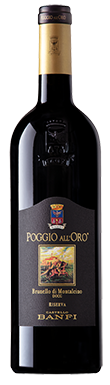
With the switch to predominantly large casks, ageing in wood was increased from 30 months to 42 for 2015. This vintage also saw a prolonged...
2015
Castello BanfiBrunello di Montalcino
Castello Banfi, Poggio all'Oro, Brunello di Montalcino, Tuscany, Italy, 2013
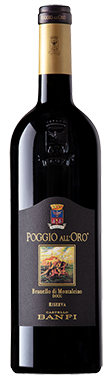
2013 was described as fresh with rain in September destabilizing the zone somewhat. According to Enrico Viglierchio, it was a good year for those who...
2013
Castello BanfiBrunello di Montalcino
Castello Banfi, Poggio all'Oro, Brunello di Montalcino, Tuscany, Italy, 2010
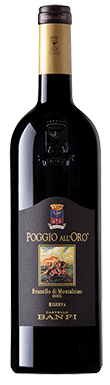
After a late and rainy start, 2010 progressed cool yet dry giving a long, slow ripening period. Fermented in Banfi’s new cone casks – a...
2010
Castello BanfiBrunello di Montalcino
Castello Banfi, Poggio all'Oro, Brunello di Montalcino, Tuscany, Italy, 2006
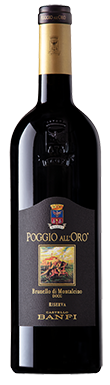
Enrico Viglierchio explains that late budding delayed everything, including harvest. At the same time, the hot summer resulted in high sugar levels and very concentrated...
2006
Castello BanfiBrunello di Montalcino
Castello Banfi, Poggio all'Oro, Brunello di Montalcino, Tuscany, Italy, 2004
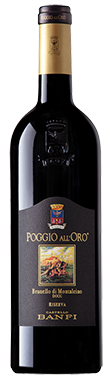
The 2004 vintage is prized for delivering elegant wines. Weather conditions were balanced throughout with sufficient rain at the right times, plenty of sunshine and...
2004
Castello BanfiBrunello di Montalcino
Castello Banfi, Poggio all'Oro, Brunello di Montalcino, Tuscany, Italy, 1999
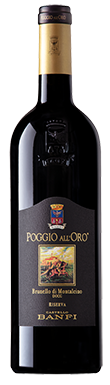
A hot but not torrid summer with occasional light rainfall and significant diurnal temperature swings led to a relatively late harvest mid-October. This still exudes...
1999
Castello BanfiBrunello di Montalcino
Castello Banfi, Poggio all'Oro, Brunello di Montalcino, Tuscany, Italy, 1993
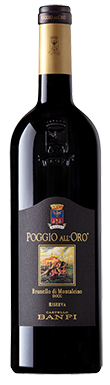
Between 1985 and 1993, Banfi bottled Poggio all’Oro Riserva in 86, 88 and 90. By 1993, it was being aged in a greater percentage of...
1993
Castello BanfiBrunello di Montalcino
Castello Banfi, Poggio all'Oro, Brunello di Montalcino, Tuscany, Italy, 1985
Grapes were harvested on 3-4 October after a dry, hot year with little rain. This first vintage of Poggio all’Oro corresponds with Banfi’s experiments with...
1985
Castello BanfiBrunello di Montalcino
