
Bonfils: Producer profile and 10 wines tasted
With 17 estates and 1,600ha of vines, the Bonfils family is one of the largest vineyard owners in France, its business having spanned six generations and grown substantially since the early 1990s. Today the group is converting its estates to organic viticulture, focusing on regionality and looking towards luxury wine tourism. Elizabeth Gabay MW tastes 10 wines across four of the group's estates...


Though Vignobles Bonfils are familiar overseas, its wines also are well known throughout French supermarkets and as house wines in restaurants.
In 1870, the Bonfils family left Alsace for Oran in Algeria, where they planted a 139ha estate of vines and oranges. Upon Algerian independence in 1962, the family returned to France. Starting at Domaine de Lirou in the Languedoc, Jean-Michel Bonfils produced bulk wine and grew the business.
Scroll down for tasting notes and scores of 10 Bonfils wines tasted
Buying into the ideas of Robert Skalli and Jacques Gravegeal—who, with their vision of varietal wines, were creating what would become the IGP Pays d’Oc—Jean-Michel bought the Domaine de Cibadiès in 1978. Much to his father’s horror, he planted Chardonnay and Pinot Noir vines, both then unfamiliar in the region.
He chose to focus on hillside sites which provided each grape variety with adequate sunshine. Further changes came in 1990, when the fifth generation, Laurent, Jérôme and Olivier, joined the business and Vignobles Bonfils began bottling its wines, moving them upmarket.
Growth and acquisitions
Further estates were purchased, extending the range of styles and appellations supplied: Domaine d’Aubaret (34ha) in 1992, Château de Cantaussels (116ha) in 1995, Domaine Vaugelas (Corbières, 144ha) in 2000 and Château de Millegrand (Minervois, 235ha) in 2003.
In 2007 Bonfils began developing their exports, buying Domaine Demeure in 2008 and acquiring the negociant business of Maurel Vedeau to expand their international business.
An eye for nineteenth century châteaux is clearly evident. These grand properties reflect the wealth and prestige of the Languedoc’s then landowners, who supplied food and wine throughout France until phylloxera and two world wars reduced their wealth.
The Bonfils family purchased Château Les Carrasses (63ha) and Château Capitoul (La Clape, 92ha) in 2011, and Château l‘Esparrou (Roussillon, 92ha) in 2012. They stopped working as negociants in 2013 and bought two more estates in 2014: Château St-Pierre de Serjac (100ha) and Château Villerambert Julien (159ha).
Building on the growth in wine tourism, the group has transformed Château Les Carasses, Château Saint-Pierre de Serjac and Château Capitoul into luxury hotels and residential villages, hoping to make them wine destinations.
Consolidation and regional focus
The family recently consolidated their range of 400 labels down to 200, seeking to be better known and aiming to reach a more premium market. To reflect environmental excellence, they achieved certification of all their estates at the highest level of sustainability, High Environmental Value 3 (HVE), in 2019 and expect organic certification by the end of 2021.
Laurent’s passion for local wildlife is evident when he talks about the flora and fauna and his reintroduction of the small lapin de Garenne.
An increased emphasis on regional styles and single vineyard wines is increasing diversity of the estate’s offering. Harvests span over two months depending on location and varieties.
Laurent feels the name of a château has greater selling power than its appellation, ‘Everyone knows Corbières, but it struggles to command a higher price’.
The boost given by wine tourism is leading to a greater focus on regionality, further enhanced by using locally-trained winemakers and the encyclopedic knowledge of long-term employee and estate manager, Christian Mignard, who knows the vineyards inside out.
In an attempt to enhance regional styles, the wines of Château Capitoul are often fermented in cement, while those of Château St Pierre de Serjac in tank.
With rosé (especially the Provence style) and white wines increasing in importance, recent experiments away from obvious commercial trends include an oak-aged rosé, Rive (created by Laurent’s son Thomas); a Bourboulenc made in Stockinger barrels to experiment with different weight and texture; and an orange wine.
Most notable is the atmosphere of a close family, working together and energised to develop their business, with dynamic innovation on the horizon and a range of wines seeking greater presence overseas.
See tasting notes and scores for 10 Bonfils wines:
Wines are shown in score order
Related content:
Mas de Daumas Gassac: producer profile
Domaine Gayda: Behind the labels plus 10 wines tasted
Domaine de Baronarques: inside the Rothschild’s Languedoc estate
Château Capitoul, Les Oubliées, Pays d'Oc, Languedoc-Roussillon, France, 2003
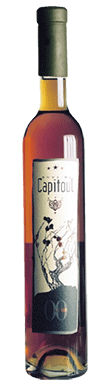

A complete surprise here with a late-harvested Viognier with 18 years in barrel! Harvested by the previous owner on the 15th September 2003 as a...
2003
Château CapitoulPays d'Oc

Château l'Esparrou, Ambré, Rivesaltes, Languedoc-Roussillon, France, 2009
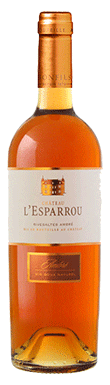
Aromas of salty twiglets suggest this might be a restrained, dry wine - quickly disproved by the amazingly rich and complex fruit on the palate....
2009
Château l'EsparrouRivesaltes
Château Capitoul, Oros Cayenne, La Clape, Languedoc-Roussillon, France, 2018
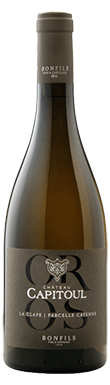
Golden in colour, the aromas are richly honeyed with floral, honeysuckle notes. On the palate the oak supports the round weightiness of ripe white peaches...
2018
Château CapitoulLa Clape
Château Capitoul, Oros Les Portes, La Clape, Languedoc-Roussillon, France, 2019
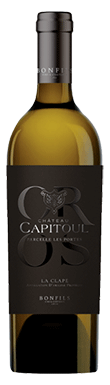
The nose is restrained and delicately perfumed with notes of white flowers and freshly-gathered hay. On the palate the wine is full-bodied with round, ripe...
2019
Château CapitoulLa Clape
Château Capitoul, Rocaille, La Clape, Languedoc-Roussillon, France, 2020
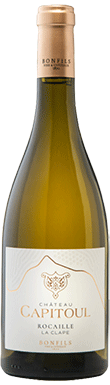
With gentle pressing and tank fermentation, this wine has good purity of fruit and freshness. Its honeyed aromas suggest softness, but the wine is in...
2020
Château CapitoulLa Clape
Château l'Esparrou, Les Alysses, Côtes du Roussillon, Languedoc-Roussillon, France, 2020
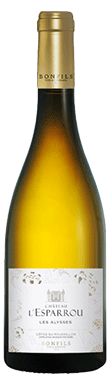
Restrained chalky, saline notes with a touch of the seaside give way to charming fruit on the palate. Bruised summer pears, white peaches, rich sweet...
2020
Château l'EsparrouCôtes du Roussillon
Château Capitoul, Maëlma, La Clape, Languedoc-Roussillon, France, 2018
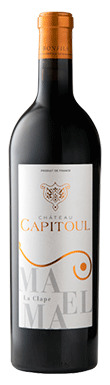
A wine that is only made in good vintages, the blend is predominantly Syrah, with Grenache and Carignan alongside, and spends 15 months in barrel....
2018
Château CapitoulLa Clape
Château Villerambert Julien, Cuvée Excellence, Minervois, Languedoc-Roussillon, France, 2018
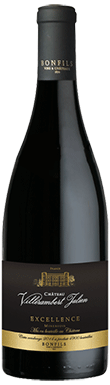
A classic GSM blend showing lots of fruit in a savoury style. Aromas of ripe blackberries with hints of garrigue and leather continue on to...
2018
Château Villerambert JulienMinervois
Château Capitoul, Rive, Languedoc, Languedoc-Roussillon, France, 2019
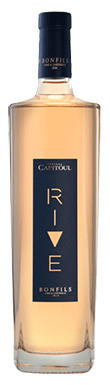
Available only in limited quantities, this is the first vintage bottled of this barrel-aged rosé. Pronounced oak aromas lead to a palate where the oak...
2019
Château CapitoulLanguedoc
Château Vaugelas, Cuvée Excellence, Corbieres, Languedoc-Roussillon, France, 2018
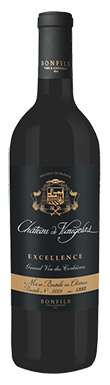
The profile of this wine is dominated by Syrah and Mourvèdre, with opulently ripe mulberries and spice aromas developing into smooth, supple black fruit. Dark...
2018
Château VaugelasCorbieres
