
Closerie Saint Roc: A new cult wine in Bordeaux?
Jane Anson reports on the latest project from the owner of Le Puy in Bordeaux, and offers in-depth tasting notes on the 2015 and 2016 vintages.


There are a few wines that work like a smile and a nod. They include Domaine de Villaine from Bouzeron, L’Hêtre in Côtes de Castillon, Château Rocheyron in St-Emilion and Domaine de Fontbonau in the Rhône.
All are owned by names connected to legendary wine estates, but reserved only for those who know the story beyond the labels.
Hoping to find a new name to add to this list, I headed out last week to the border of Francs Côtes de Bordeaux and Puisseguin St-Emilion to an estate called Closerie Saint Roc.
Wine from this now-16ha estate will next year be making its way to market in a serious way, after three years of small releases from just 3ha of vines. Back in 2012, Closerie Saint Roc was called Château Cantegrive and caused barely a ripple.
But it was bought – first just a slice, then the whole estate – by the Amoreau family of Château Le Puy, and you can be pretty sure that its profile is set to rise. There are only a handful of true cult wines in Bordeaux, but Le Puy is undoubtedly one of them, cementing its status even more from the 2017 vintage by dropping the Château part of the name. Just like, well, Petrus.
It also dropped the Francs Côtes de Bordeaux appellation in favour of being a simple Vin de France, at least until the country’s national appellation body, INAO, decides on whether it deserves its own appellation. It’s an ongoing process that will reach the French Conseil d’Etat in 2020.
Le Puy has long been a place that writes its own rules, from its circle of prehistoric standing stones to its 400-year history with one family. The team use biodynamic farming methods with natural yeasts, no added sulphur and ageing in decades-old oak barrels before bottling unfiltered and unfined.
And it’s an approach that we can expect to see followed at Closerie Saint Roc, something that was underlined as soon as I stepped into the winery.
It’s sleek and spacious with a rotunda-type, glass-domed tasting area overlooking a courtyard, set to one side from the polished concrete floor, brushed concrete walls, contemporary oak paneling across the ceiling, large oak vats lined up next to a couple of clay amphorae.
‘The previous owners were from Champagne,’ said estate director Harold Langlais, with an embarrassed shrug, as if that entirely explained the presence of such a gleaming winery.
‘We prefer a more simple approach, but it is nice to have the extra space’.
If you know Le Puy, you’ll be able to picture the scene. It is, after all, a Château where owner Pierre Amoreau refused to capitalise on the biggest marketing coup he had ever received back in 2010.
His 2003 Château le Puy was named as one of the 12 Drops of God wines in the television adaptation of blockbuster Japanese manga cartoon Kami no Shizuku.
Instead of taking advantage of the buzz, Amoreau took all the wine off the market so that price wouldn’t jump too high. He said he was trying to avoid driving speculation and wanted instead to keep stock back for his usual customers.
So it’s no surprise to learn that, despite his new property being only a few hundred meters apart from Le Puy, the two are to be kept entirely separate.
‘It would be easy to use these vines in our main wine, as we are Vin de France now with both estates, and we are rarely able to meet the demand for Le Puy,’ said Langlais.
‘But that is not what we are looking for. It’s a different terroir, different expression, different style of wine’.
Farming is entirely biodynamic at Closerie Saint Roc today; nothing was bottled until 2015, when it received its organic certification.
But the team knows that it will take some time for the soils to recover from being treated traditionally under previous owners Doyard-Jacquart, who were in place since 1990.
There are also efforts to bolster the biodiversity that is so key at Le Puy, where there are 56ha of vines and 46ha of orchards, ponds, woods, fields, bee hives and wild open spaces.
‘The only way to do this is through hard work, and through time,’ Pascal Amoreau, Jean-Pierre’s son, told me as he joined tasting the concentrated, floral-focused 2018 from cask.
‘At Le Puy we have one person working full-time in the cellar, and 24 in the vines, because that is where we put all of our emphasis.’
The need to be able to easily walk the two vineyards is key – they even sold 4ha of Closerie Saint Roc that was located a little further away in Côtes de Castillon.
And the plan is to bottle wines from the four different soil types at Saint Roc separately, so following the Burgundian model of climats; although to date this has not happened. The 2018 vintage was the first year with an expanded footprint of vines.
‘We couldn’t do terroir-bottling under Bordeaux rules, but are freed up by Vin de France,’ said Amoreau. ‘We are looking at this estate as our research centre, trying out some rare grape varieties, leaving the soil in permaculture, adding agro-forestry, and a few other projects that we are working on right now.
‘It turns out when looking through archives that our 19th century ancestors farmed here, on a plot that dates back to the Middle Ages when it was used as a vegetable garden to feed English soldiers.’
I smile when I hear this, knowing that while it may well be true, the Amoreaus have always grasped something that not enough people in Bordeaux understand.
Stories and heart sell wine. And it’s clear that a new story is being written here.
Jane Anson’s tasting notes for Closerie Saint Roc wines
See also:
Tasting Figeac wines from 1985 to 2016
Tasting one hundred years of Le Puy
Closerie Saint Roc, Vin de France, Bordeaux, France, 2016
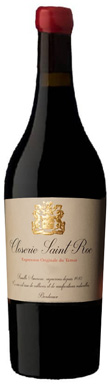

Pulsing with dark fruit, lashings of cassis and blackberry. The lift of Cabernet Franc is clear, although it has less violet notes than the 2018...
2016
Closerie Saint RocVin de France

Closerie Saint Roc, Vin de France, Bordeaux, France, 2015
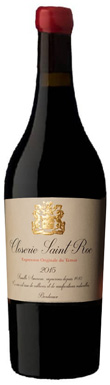
<p>A lovely wine with a clearer touch of minerality and juice than the more concentrated 2016 vintage. A sense of quiet power is obvious here,...
2015
Closerie Saint RocVin de France
