
Domaine de Baronarques: inside the Rothschild’s Languedoc estate
James Lawther MW profiles the Languedoc estate owned by the Château Mouton branch of the Rothschild family and rates a dozen recent and older vintages.


Domaine de Baronarques in the Limoux region of the Languedoc is owned by the Mouton branch of the Rothschild family.
An uncharacteristic purchase given their penchant for Cabernet Sauvignon, the 110-hectare estate, previously known as Domaine de Lambert, was acquired by Baroness Philippine de Rothschild and her children in 1998 and renamed Baron’Arques (Baronarques from 2015).
Scroll down to see tasting notes and scores for James Lawther’s top 12 Domaine de Baronarques wines
It was, in effect, an impulse buy, the Baroness enchanted by this out-of-the-way area of the Aude valley in the shadow of the Pyrenees. But there was also a serious goal, to make a great red wine in the Languedoc.
Twenty-odd years on and after much replanting and investment, the Rothschilds are nearing their objective. Since the first vintage in 2003, Domaine de Baronarques has gained in depth and precision and more recently in quality of tannin – the 2018 I tasted at the estate was the most complete vintage yet.
It has also demonstrated a capacity to age, at least over a span of 15 to 20 years, a quality requisite of any grand vin.
Where it still has to reassure fans of the region is that it truly is a Languedoc wine, its atypical profile the result of a blend of Bordeaux and Mediterranean grape varieties cultivated on the local clay-limestone soils.
Why this particular blend of grape varieties?
Limoux is situated in the far western reaches of the Languedoc. It experiences a Mediterranean climate but one tempered by local sea breezes and rain-bearing westerly winds.
It also has the influence of altitude, the vineyards located at anything from 100 to 450 metres above sea level. These conditions, with modified heat, cool night-time temperatures and an even distribution of rain throughout the year, have always favoured the cultivation of white grape varieties and indeed Limoux is best known for its sparkling Crémant and Blanquette made from Chardonnay, Mauzac and Chenin Blanc.
However, red wine has always been made in the region even acquiring something of a reputation in the 19th century.
Produced from Mediterranean varieties like Carignan and Ribeyrenc at this epoque, the Bordeaux varieties were introduced later in the 1970s, a fall from grace for the likes of Carignan and the realisation Merlot and Cabernet suited Limoux’s particular climate the contributing factors.
Initially used in vins de pays, they were officially authorised in the newly created AC Limoux red in 2004 (2003 the first vintage). Hence, the Rothschilds have followed the appellation guideline which stipulates (for a blend): 45 to 70 per cent Merlot, a minimum 20 per cent Malbec, Syrah and/or Grenache and up to 35 per cent Cabernet Franc and/or Cabernet Sauvignon.
What is the winemaking philosophy?
‘We’re not trying to make a Bordeaux wine but plainly there’s an imprint particularly when it comes to structure, balance and the ability to age,’ explains Augustin Deschamps, managing director of Domaine de Baronarques.
Winemaking techniques are clearly Bordelais and since inception Mouton’s former (now retired) executive director, Philippe Dhalluin, and technical director, Erick Tourbier, have been involved in the process.
Blending is done traditionally in January following the harvest and the wine aged for 12 months in 225 litre Bordeaux barrels (and some 300 litre), 25 to 33 per cent of which are new.
Domaine de Baronarques: the facts
Date founded: 1998 (but exists since 1650)
Owner: Baron Philippe de Rothschild SA
Area under vine: 43ha (32ha red, 11ha white)
Grape varieties: (red) Merlot, Syrah, Cabernet Franc, Malbec, Cabernet Sauvignon; (white) Chardonnay
Annual production: Baronarques red 60,000-80,000 bottles; La Capitelle (second wine) 30,000-40,000 bottles ; Baronarques white 20,000-30,000 bottles
If the structure provides a nod towards Bordeaux, the fruit evokes warmer climes. There’s a sweetness to it that has a southern feel and aromatic notes of spice, garrigue and truffle (with age) that evoke the Mediterranean.
The winemaking team are bound by the appellation rules to use a minimum 45 per cent Merlot in the blend but have an increasing admiration for Cabernet Franc and Syrah in the region.
Grenache was only of significance in the first two vintages (2003, 2004) and was thereafter steadily abandoned as it never seemed to obtain sufficient maturity.
Freshness seems innate, a consequence of the local terroir, the sum of everything provided by a wine that has a foot in two camps.
How has Baronarques evolved?
When the Baroness purchased the property, she started with a blank page.
About 20 hectares were planted but much of the vineyard was either disease-ridden or planted with the wrong grape variety or rootstock so had to be grubbed up.
A little Merlot and Malbec dating from 1974 still exists today otherwise the rest of the 43ha vineyard is relatively young. The parcels are located at anything from 250 to 350 metres so gradually there has been a move towards more precise zonal management and vinification.
A thorough analysis of the soils is presently underway (there’s greater variety than thought with sand, galets roulées, sandstone and marl as well) and this will have a bearing on future management and planting decisions.
The original, semi-sunken, 19th century cuvier was retained but the old wooden foudres replaced by temperature controlled, stainless steel and concrete tanks corresponding in size to the needs of the various parcels.
The hand-harvested grapes (on average the harvest lasts from 25th September until 20th October) are destemmed and vinified separately.
A second wine, La Capitelle, was introduced in 2008 to improve selection and in 2016 a new barrel cellar constructed to increase the capacity for maturation of the red wine and for the vinification and ageing of the white.
And what about the Chardonnay?
There were no initial plans to make a dry, white Limoux but when the decision was taken to abandon Grenache it was steadily grafted over to Chardonnay.
The first vintage released was 2009 and since then there has been some steady fine-tuning.
The wine is fermented and then aged in 225 litre Bordeaux barrels for eight months. Fifty per cent new oak was used in the first vintage but that has since been reduced to 33 percent with a preference given to oak from the Vosges.
As with the 2018 red, I found the white 2018 to be of the most interest to date but the 2019, to be released later this year, apparently has a dash of Chenin Blanc to give greater length.
Clearly, it’s still a work in process.
James Lawther’s top Domaine de Baronarques wines
You may also like
Louis Jadot: producer profile
Ramonet: behind the acclaimed Burgundy estate plus 30 wines tasted
Domaine Gayda: Behind the labels plus 10 wines tasted
Domaine de Baronarques, Limoux, Languedoc-Roussillon, France, 2018
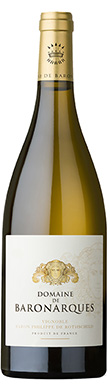

There's a riper character than previous vintages with pear and citrus the dominant aromas. Generous fruit sweeps across the palate balanced by refreshing acidity. The...
2018
Domaine de BaronarquesLimoux

Domaine de Baronarques, Limoux, Languedoc-Roussillon, France, 2016
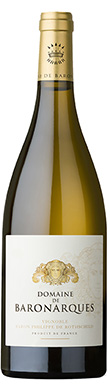
Pale gold colour. The wine is juicy and refreshing with an attractive depth of fruit. The nose and palate have floral and white fruit aromas...
2016
Domaine de BaronarquesLimoux
Domaine de Baronarques, Limoux, Languedoc-Roussillon, France, 2015
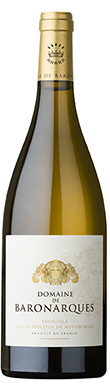
The wine is round and fruity but has less intensity than 2016 or 2018. Citrus provides the dominant aroma and flavour with the oak again...
2015
Domaine de BaronarquesLimoux
Domaine de Baronarques, La Capitelle, Limoux, Languedoc-Roussillon, France, 2015
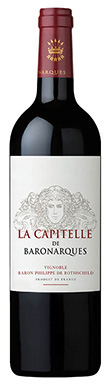
Garnet hue. The nose is open and aromatic, the spice of the Syrah and Malbec coming through. The palate is fresh and lifted, despite the...
2015
Domaine de BaronarquesLimoux
Domaine de Baronarques, Limoux, Languedoc-Roussillon, France, 2018
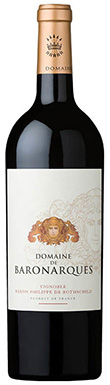
Deep colour to the rim. Youthful, berry-fruit notes dominate the nose at present with a touch of Syrah spice. The palate is round and gourmand...
2018
Domaine de BaronarquesLimoux
Domaine de Baronarques, Limoux, Languedoc-Roussillon, France, 2017
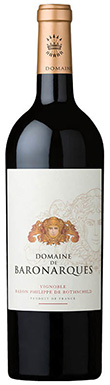
The nose is beginning to open to dark fruit notes, blackberry to the fore. The fruit is attractive but there's not quite the density of...
2017
Domaine de BaronarquesLimoux
Domaine de Baronarques, Limoux, Languedoc-Roussillon, France, 2015
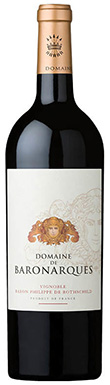
Deep, dark, youthful colour. The nose is still a little reticent but dark fruit, spice and a slightly ferrous note appear with aeration. The palate...
2015
Domaine de BaronarquesLimoux
Domaine de Baron'Arques, Limoux, Languedoc-Roussillon, France, 2013
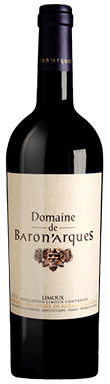
Still a youthful, dark garnet hue. Dark and red pastille fruit nose with a subtle hint of spice as it opens. The palate is again...
2013
Domaine de Baron'ArquesLimoux
Domaine de Baron'Arques, Limoux, Languedoc-Roussillon, France, 2011
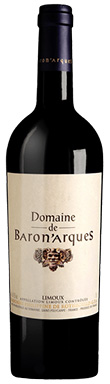
Deep colour with a touch of brick at the rim. Definitely has a more Mediterranean feel with tapenade, dark fruit and menthol notes on the...
2011
Domaine de Baron'ArquesLimoux
Domaine de Baron'Arques, Limoux, Languedoc-Roussillon, France, 2008
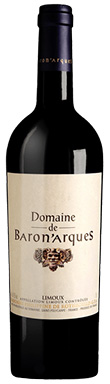
Brick at the rim but dark inner core. The nose is open and expressive with initially plum and leather notes then spice and garrigue and...
2008
Domaine de Baron'ArquesLimoux
Domaine de Baron'Arques, Limoux, Languedoc-Roussillon, France, 2004
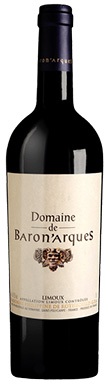
Red to brick-red hue. Clearly evolved but less so than the 2003 tasted at the same time and with better balance. Leafy, forest floor, garrigue...
2004
Domaine de Baron'ArquesLimoux
Domaine de Baron'Arques, Limoux, Languedoc-Roussillon, France, 2003
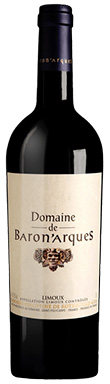
This was the first vintage of Baron'Arques (now Baronarques). Mahogany colour. On opening, the nose is initially a little oxidised but this then fades to...
2003
Domaine de Baron'ArquesLimoux
