
First Taste: Charles Heidsieck’s Champagne Charlie
Champagne Charlie is back in town. Celebrating 200 years since the birth of its founder, Charles Heidsieck relaunches the much-loved luxury cuvée. Yohan Castaing is impressed and recounts the Champagne Charlie backstory here.


In 1851, 29-year-old Charles-Camille Heidsieck (1822-1893), a member of the highly respected family already known for its Champagne production, decided to create a Champagne house bearing his own name.
Scroll down for Yohan Castaing’s tasting note and score for Champagne Charlie
Champagne’s big break in the USA
He had the brilliant intuition to focus on new markets, notably the United States, into which he made his first foray as early as 1852. Immediately understanding the strategic importance of a burgeoning market waiting to be conquered, he made the sometimes-perilous journey to the USA numerous times.
His rapid success, as well as the local press attention he garnered for both his wine and his dynamic personality, was such that he soon became known by the nickname Champagne Charlie. A name which went on to inspire songs, books, films, and even a 1987 Canadian television series starring a young Hugh Grant (still available to watch on Youtube).

From riches to rags to riches
When the American Civil War broke out in 1861, the successful Champagne market that Charles-Camille was riding the wave of began to collapse. Rushing back to the USA from France, Charles-Camille made the dangerous journey to New Orleans in an attempt to recoup some outstanding payments.
He was arrested and accused of being a spy for the French government and the Confederate army. Imprisoned in terrible conditions, he eventually returned to France in bad health and financial ruin.
Thankfully, a windfall of money allowed him to rebuild his company and by 1867, he had acquired 47 crayères, those distinctive caves carved out of chalk that lie beneath Reims and the surrounding area, and which provide perfect conditions for storing and ageing wine.
Now resettled permanently in his native region, Charles-Camille set about consolidating the house style of his Champagnes, the two pillars of which became time and complexity.
The final blend contained 50% of reserve wines, which were composed of 150 different still wines aged on lees, some from vintages going back 20 years, a practice that was quite rare at the time. The Charles Heidsieck style was thus born again and back in business.
The first Champagne Charlie cuvée is born
Fast forward to the end of the 1970s, Daniel Thibault, cellar master of the house – the last to work with the descendants of Charles-Camille – was in charge of maintaining the distinctive Charles Heidsieck style.
At the time, the house was headed-up by Joseph Henriot, whose ancestor Ernest Henriot had been a partner when Charles-Camille founded his house.
Thibault was asked to come up with a special new bottling to celebrate the founder, with the same sense of freedom, innovation and excellence that had always guided Charles-Camille. The result was the prestige cuvée named fittingly Champagne Charlie. It was released just five times, bearing the mention of the 1979, 1981, 1982, 1983 and 1985 vintages.
Champagne Charlie – Relaunching a classic
To mark the bicentenary of Charles-Camille’s birth in 1822, the current owner of the Charles Heidsieck house, EPI group, asked its cellar master, Cyril Brun, to relaunch this landmark cuvée, more than three decades after its last appearance with the 1985 vintage.
Brun set about it by respecting the philosophy and method of its initial creator, the talented Thibault. In the past Champagne Charlie was released with a specific vintage on the label, however surprisingly, it ‘contained a significant portion of reserve wines, which was the essential leitmotif for providing a consistent stylistic identity,’ Brun explained to Decanter.
Having tasted some of the past vintages of the emblematic cuvée that still remained in the Charles Heidsieck cellars, Brun decided to maintain a very high proportion of reserve wines in this new iteration.
Bottled in 2017, this new version of the Champagne Charlie cuvée was created with nearly 80% reserve wines and just 20% of wines from the 2016 harvest.
Brun also drew inspiration from another of Thibault’s practices from the initial series: using nearly equal portions of Chardonnay and Pinot Noir – although there is no fixed recipe.
In this instance, there is 52% Chardonnay and 48% Pinot Noir sourced from the grand cru village of Aÿ.
Yohan Castaing’s tasting note and score for Champagne Charlie:
Related content:
First Taste: Champagne Palmer & Co’s Grands Terroirs 2015 and 2012
Krug Grande Cuvée: new 170th edition and vertical tasting
Investing in Champagne: Sales boom continues
Clos de Tart: 1947-2019 vertical tasting
10 reasons to drink English sparkling wine
Charles Heidsieck, Champagne Charlie, Champagne, France
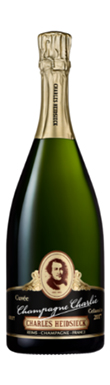

The blend for the second edition of Charles Heidsieck's unusual prestige cuvée, reborn under previous cellar master Cyril Brun, contains 55% of the house's rich...
Charles Heidsieck

