
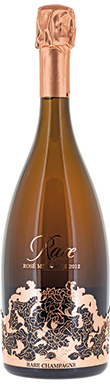
First taste: Rare Champagne Rosé 2012
Yohan Castaing tastes and rates the latest release of Rare Champagne's rosé, only the third vintage of this cuvée to be produced.


Hot on the heels of the release of the 2008, the sister house of Piper-Heidsieck has declared a new vintage rosé cuvée, ‘the third of a series that started with the 2007 vintage,’ announced Maud Rabin, Global Director of Rare Champagne, during our video tasting.
Although Piper-Heidsieck and Rare Champagne share the same cellar master, ‘since 2008, Rare Champagne has evolved to become a separate entity with its own production,’ stressed Rabin.
The 2012 is paler in colour than the 2008 iteration, and Emilien Boutillat, chef de cave for Rare Champagne since the recent retirement of Régis Camus, whose stellar reputation and award-winning track record can be rather intimidating, confirms that this is the style they want for Rare Champagne. It has a tenser and more crystalline style than the 2007 rosé, the first opus of this cuvée.
Scroll down see the Rare Champagne Rosé 2012 tasting note and score

This third opus of Rare Rosé is composed of 60% Chardonnay and 40% Pinot Noir from 12 crus, of which eight are classified as premier and grand cru. The Chardonnay grapes were sourced from Villers-Marmery, Vertus, Le Mesnil-sur-Oger, Oger, Chouilly and Avize, and the Pinot Noir from Verzy, Aÿ, Verzenay, Ville-Dommange and Ambonnay.
The Pinot Noir part of the blend includes 8% vinified as red wine, whose grapes came from Les Riceys, in the Aube department, instead of Bouzy, in the Marne, which was the case for the previous vintage (2008). ‘Les Riceys grapes have more acidity, and with a vintage like 2012, which is dense and powerful, they are more suitable,’ says Boutillat.
Broadly speaking, the 2012 vintage started badly but ended well. ‘Fortunately, the end of the season was hot and sunny,’ says Boutillat. This allowed the grapes to reach ideal ripeness.
For me, the Rare Rosé has a singular style: smoky and concentrated, with an endless finish.
There is a distinctive aromatic signature, showing notes of pastry, nuts, smoke and guava that really sets it apart from the classic white Rare Champagne. They share, however, the house’s fidelity to full malolactic fermentation, which imparts a deep, fleshy texture that will offer greater ageing capacity and will gratify consumers who enjoy Champagnes with bottle age.
Art de vivre
This Champagne house is a keen promoter of the arts, and in 2022 commissioned the artist William Amor to create a label for the six-litre Methuselah format of this newly released cuvée.
Amor’s idea for the design draws on the house’s recent B Corp certification, which recognises those making strides towards an inclusive, equitable and regenerative economy. Amor states: ‘Everything is beautiful. Nothing is discarded, everything can be transformed. Each of us has to work on bringing beauty to it.’
Only 5,000 bottles of this Champagne are to be released. It was disgorged in 2021, with a dosage of 7g/L (the lowest in the short history of Rare Champagne rosé).
Yohan Castaing’s Rare Champagne Rosé 2012 tasting note and score:
Related content
First taste: Champagne Alfred Gratien’s 2022 releases
First taste: Champagne Ayala’s 2022 releases
Champagne Day: 96+ point wines to try
Rare, Rosé Brut, Champagne, France, 2012

Delicate and coy, the 2012 concedes notes of rose, cherry blossom and orange blossom, and the fruit comes through much later. There's still an opulence...
2012
Rare

