
Fuligni Brunello di Montalcino Riserva: vertical tasting
Fuligni is a founding member of the Brunello di Montalcino consorzio. Michaela Morris tastes a vertical of the estate’s Riserva, going back to 1983.


A founding member of the Brunello di Montalcino consorzio in 1967, Fuligni was also one of the first names I encountered when I cut my teeth on this iconic wine. So it was without hesitation that I accepted an invitation to taste a vertical of the estate’s Riserva.
Scroll down to see tasting notes and scores from the Fuligni Brunello di Montalcino Riserva vertical tasting
Of Venetian origin, the Fuligni clan moved to England in the 14th century. When Luigi Fuligni returned to his ancestral land in 1770, he settled in Tuscany and was granted land for cultivation in the Maremma region.
Several generations later, agronomist Giovanni Maria Fuligni relocated to Montalcino. He established the Fuligni estate in 1923 after purchasing the property from the Biondi-Santi family.
One of six children, Giovanni’s daughter Maria Flora worked alongside him for many years. She took the reins when he died in 1971. Now 86 years old, she continues to have a strong presence at the winery. ‘Particularly at harvest – she checks on the grapes, tasting the berries,’ says cellar master Daniele Zefferini. ‘She is a highly capable, active woman.’
The reputation of the estate is due to her hands-on management and unflagging commitment to quality. For the last 15 years, business economics graduate Dr Daniela Perino has been her right hand, and as of this year became Fuligni’s CEO.
Approximately three kilometres to the west, the town of Montalcino looms over the the 100-hectare estate. Essentially a contiguous property, it encompasses olive groves and hundreds of rose bushes along with 14 hectares of vineyards divided into three blocks. Predominantly east facing on stony Galestro marl, these rise from 380 to 450 metres above sea level. ‘The estate isn’t organic in the legal sense, but in the cultivation of the Brunello vineyards only sulphur and copper are used,’ asserts Perino.
Along with Brunello, Fuligni’s annual production of 50,000 to 60,000 bottles includes a Rosso di Montalcino, an IGT blend of Merlot and Sangiovese and a rosato. In years when it is crafted, the Riserva represents 12,000 to 13,000 bottles.
Produced since 1970, it has always hailed from the vineyards surrounding the historic heart of the Cottimelli estate – a 16th century ex-convent. Vigna San Giovanni, Vigna del Piano and Vigna Vignaccia boast vines that are at least 20 years old though some plants are upwards of 60.
Exceptional years
The concept of Fuligni’s Riserva is to express the characteristics of the year at its best. According to Maria Flora, this is only possible in the greatest vintages. Grapes must demonstrate ‘perfect polyphenolic ripeness of anthocyanins and tannins combined with substantial acid component that guarantees longevity,’ explains Perino. While the annata is crafted to be approachable in its youth, the Riserva can be austere upon release becoming more obviously gracious with time.
In terms of winemaking, little has changed over the years. Even the consulting oenology team has been consistent. Fuligni has collaborated with the Vagaggini family for 80 years spanning three generations.

At the beginning of the ’90s, the estate started working with French Allier oak tonneaux of 500 litres. These, however, are only used for the Brunello annata, with approximately 15% used to help fix the colour. Conversely, the Riserva matures exclusively in Slavonian oak casks of 20 to 30 hectolitres. ‘Given its greater structure, extract and polyphenols, we prefer that the Riserva goes through a long and traditional ageing in large botte,’ continues Perino.
Beyond this, there is little difference in vinification of the two. The wines are fermented with selected yeasts in stainless steel tanks that were introduced in the 70s. Maceration lasts approximately three weeks with frequent pump overs. ‘Fuligni doesn’t have a lot of technology,’ says Zefferini. ‘This is a disadvantage because the work is more demanding, but it also allows us to have a more artisanal approach.’
Tasting the Riserva
It is Zefferini, cellar master since 2010, who presents the vertical. He tastes studiously alongside me as we work our way from 2015 to 1983.
Within this 30-plus year period, there is an inevitable rise in alcohol levels due to the warming climate, but no change in style. Instead, the wines are time capsules that capture the uniqueness of each vintage. Zefferini opens wines from extremely warm vintages like 2015, 2012 and 2007 as well as cooler years like 2013 and 2010. ‘The great fortune of Fuligni and the northern zone of Montalcino is the significant difference between day and nighttime temperatures even in hot vintages,’ he says.
Each wine is on its own trajectory. I continue to be impressed with the commanding structure yet balance of the relatively recent 2015 release. I look forward to checking back with it in a few years. On the other hand, the generous and outgoing 2012 can be opened now. I was particularly charmed by the elegant 2013. While I don’t expect it to be a long ager, it could do with another year in bottle. A powerful force, 2010 is a surly teenager yet with obvious potential so best to wait.
The juxtaposition of 2006 and 2007 made for a fascinating comparison with the perspective of time. Both were rated five stars, but the latter was more highly touted upon release. Approximately a decade on, however, it is the 2006 – at least at Fuligni – that shines in terms of aging potential. It was my top pick of the vertical. I am inclined to hang onto it a bit longer while enjoying the 2007 in the near term.
Of the two oldest vintages, 1990 had reached its peak – though here I suspect some bottles might be better than others. Simply a pleasure to taste, the 1983 was in excellent shape with plenty of life left.
Tasting through the wines, I was reminded of a visit to the estate earlier in 2021. On that occasion, Maria Flora’s nephew and co-owner of the estate, Roberto Guerrini Fuligni hosted me. A keen music aficionado, he put on Glenn Gould playing Bach’s Goldberg variations. Fuligni’s young Riservas are much like Gould’s 1955 recording with a vigour and energy that sweeps you away sometimes leaving you too breathless to fully appreciate the complexities. The older vintages are akin to the more ponderous, slightly decelerated 1981 rendering. They allow you to contemplate their intricacies.
Young or old though, Fuligni’s Riserva is a demonstration of mastery, precision and class – a true classic of Montalcino that has stood the test of time.
Fuligni Brunello di Montalcino Riserva vertical: tasting notes & scores
Related content:
Under-the-radar Brunello producers in 2022
Top 10 best-value Brunello di Montalcino 2017 wines
Barolo and Brunello vintages to drink now
Fuligni, Brunello di Montalcino, Tuscany, Italy, 2015

Cellar master Daniele Zefferini calls the 2015 ‘a bit unnatural’ in that the extreme ripeness of grapes rarely corresponds to the high level of acidity....
2015
FuligniBrunello di Montalcino

Fuligni, Brunello di Montalcino, Tuscany, Italy, 2013
Linear and svelte, the 2013 doesn't have anywhere to hide - but it isn't trying to. It takes time to reveal its full range of...
2013
FuligniBrunello di Montalcino
Fuligni, Brunello di Montalcino, Tuscany, Italy, 2012
The extremely warm summer was capped by significant diurnal temperature differences in September. Grapes were small with thick skins giving lots of aromas and structure....
2012
FuligniBrunello di Montalcino
Fuligni, Brunello di Montalcino, Tuscany, Italy, 2010
This is intense throughout – minty and meaty with exotic spice, saffron and tobacco. Tannins are upfront and powdery in this decidedly linear and imposing...
2010
FuligniBrunello di Montalcino
Fuligni, Brunello di Montalcino, Tuscany, Italy, 2007
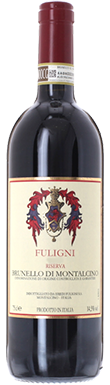
Fuligni’s 2007 wears the hot vintage on its sleeve with ample ripe fleshy fruit and vigorous, muscular tannins to match. At the same time, it...
2007
FuligniBrunello di Montalcino
Fuligni, Brunello di Montalcino, Tuscany, Italy, 2006
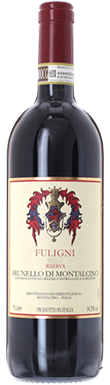
At 15 years old, this has reached that magical tipping point between youth and evolution. It has shed any teenage sullenness but is in no...
2006
FuligniBrunello di Montalcino
Fuligni, Brunello di Montalcino, Tuscany, Italy, 1990
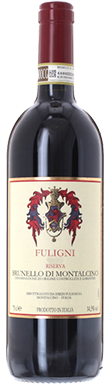
Brunellos from this vintage have typically held up well. Here, aromas are fully evolved exhibiting a savoury mix of moss, celery and bouillon. The palate...
1990
FuligniBrunello di Montalcino
Fuligni, Brunello di Montalcino, Tuscany, Italy, 1983
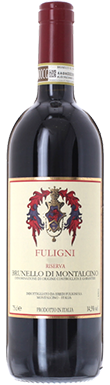
This shows typical evolved notes of Sangiovese – tea, tobacco and mossy undergrowth, yet there is a remarkable vibrancy to the aromas. The palate is...
1983
FuligniBrunello di Montalcino
