
Gaja’s Ca’ Marcanda: Celebrating 20 vintages
A deep-dive into the Piedmontese family's Bolgheri estate, which is celebrating its 20th vintage this year.


It was the beginning of the new millennium and Angelo Gaja was busy making the first vintage at the family’s latest acquisition in Bolgheri; Ca’ Marcanda. Meaning ‘house of endless negotiations’ in Gaja’s Piedmontese dialect, the estate’s name is a reflection of the endless rounds of talks with the owners required to finalise the purchase of the property, which finally went through in 1996 – two years after the acquisition of the Pieve Santa Restituta estate in Montalcino.
Scroll down to see tasting notes and scores for eight Ca’Marcanda wines
Angelo, looking to expand his horizons beyond his historical Barbaresco estate, clearly had his finger on the pulse; Bolgheri was not the internationally renowned region then that it is today but nevertheless the family went full steam ahead and planted most of their current 120 hectares of vines between 1996 and 2002, using a variety of clones of mostly international varieties: predominantly the two Cabernets and Merlot, with some Syrah, Sangiovese, Petit Verdot, and later Viognier, Vermentino and Fiano.
The estate’s vineyards are composed of two different soil types: the ‘terre brune’ is a dark soil made up of lime and clay, while the ‘terre bianche’ is stonier and features limestone and clay.
The construction of a new winery was initiated in 1998, built out of – and within – the earth; the walls constructed from excavated stone, while mature olive trees and grass today conceal much of its subterranean structure.
Given that Bolgheri DOC’s area under vine is 1,190ha, divided between 65 wineries, Ca’ Marcanda represents a sizeable chunk of vineyard. The DOC stretches 7km from the coast to the Metalliferous Hills inland. The Viale dei Cipressi covers almost all this distance, its 4.7km straight road leading from the early 18th century Oratorio San Guido into the centre of Bolgheri town itself. The labels of the estate’s wines pay homage to this famous and picturesque boulevard, showing an abstract image of the cypress trees merging on the horizon.
20 vintages
In April 2022, to celebrate 20 vintages under the family’s belt at Ca’ Marcanda Angelo’s daughter, Gaia Gaja visited London to host a tasting of the range. ‘It’s a rarity that we devote an entire tasting to Ca’ Marcanda,’ she proclaimed at the start. ‘Today is special because I can open some of the few older bottles.’
Since the mid-2010s, the Gaja family has introduced some big changes at Ca’ Marcanda which have helped the estate to keep pace with the effects of climate change – namely, introducing more elegance and freshness into the wines.
Vine training is one way that the estate is making a difference. The move from cordon to Guyot training (currently in progress and around 50/50) is significant for producing grapes with less concentration and more freshness. Gaia noted that while Guyot training was traditionally used for mass-produced wines, climate change has enabled the estate to produce quality grapes using the system.
Guyot training is also useful for fighting disease: the looser bunches allow air to better circulate, minimising the risk of fungal infection, while the single cane reduces the amount of wood available for the devastating esca grapevine trunk disease to attack.
In the winery, the amount of new oak has gradually been reduced during the maturation process, although oak and concrete vessels are now used for fermentation in addition to stainless steel. The reduction in new oak allows the newfound elegance of the wines to shine through, while the mixed fermentation vessels get the best from each variety and arguably add texture and complexity.
Ca’ Marcanda: The wines
‘There is a perfume from the mountains in the air…your shoulders go down and you relax,’ described Gaia. ‘I think we find this character in the wines, too.’
Vistamare
In 2009, almost a decade after the first wines were produced at the property, Ca’ Marcanda released its first vintage of Vistamare, the estate’s first and only white wine made initially from a blend of Viognier and Vermentino, before Fiano was added more recently. The Viognier is fermented in 500l tonneaux and small casks; the Vermentino in stainless steel and concrete; and the Fiano in stainless steel and 500l tonneaux.
Approximately 60,000 bottles produced.
Promis
From the estate’s ‘terre brune’ – darker soils of lime and clay in Bolgheri and Bibbona – Promis is a blend of Merlot, Syrah and Sangiovese, matured for 12 months in used barriques.
Approximately 240,000 bottles produced.
Magari
‘We don’t have the right soils for Merlot,’ admitted Gaia, explaining that the Merlot added too much ‘heaviness’ to the early vintages of Magari. Over time, the variety has been completely eliminated from the blend. Magari is today 60% Cabernet Franc, 30% Cabernet Sauvignon and 10% Petit Verdot from a combination of dark clayey soils and white limestone soils. The constituent parts are aged for 12 months in oak before blending.
Approximately 80,000 bottles produced.
Carmacanda
The flagship wine of the estate, from the best ‘terre bianche’ plots on stony clay and limestone soils, is made up of 80% Cabernet Sauvignon and 20% Cabernet Franc. Individually fermented and matured – firstly for 12 months in oak barrels then six months in concrete – the wines are then blended and aged in the bottle for several months before release.
Approximately 25,000 bottles produced.
Biodiversity
Although Ca’Marcanda is certified organic, it’s not mentioned in the marketing or on the label. Biodiversity in the vineyards is encouraged, with flowers and grasses allowed to grow among the rows, attracting pollinators and shading the soil from the sun. Fava beans are grown among some of the rows, adding nitrogen to soil without the need for fertilisers. Compost is also used to add bacteria and other organic matter to the soil. ‘We buy really nice cow shit!’ jokes Gaia.
Attention to detail is everything for the family. The inter-row growth is rolled down in early summer to prevent the grass and flowers from taking up valuable water, while at the same time preserving a thermal layer over the soil to keep it cool. The tops of the vines are twisted rather than cut to avoid the subsequent vigour of the vine cutting causes. As a result, the leaves last a long time and as they get older, their ability to photosynthesise reduces. The result, says Gaia, is ‘ripe tannins but not an accumulation of sugar.’
There is also a full-time picking team, ready to harvest at a moment’s notice. ‘The harvest window is becoming much more narrow,’ says Gaia on the impact of climate change here.
Tasting Ca’Marcanda:
Related content
Gaja: A family portrait
Tasting IDDA wines from Angelo Gaja and Alberto Graci’s Etna project
Bolgheri 2018 vintage report: Graceful wines suitable for the long haul
Gaja, Ca' Marcanda Vistamare, Toscana, Tuscany, Italy, 2020
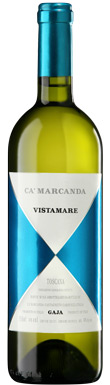

The introduction of 20% Fiano really lifts this wine, bringing in nutty and floral elements that weren't evident in the 2013. Toasted fenugreek seeds are...
2020
GajaToscana

Gaja, Ca' Marcanda Vistamare, Toscana, Tuscany, Italy, 2013
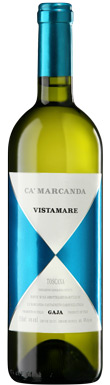
This early vintage of Vistamare (first vintage 2009) is composed of around 60% Viognier and 40% Vermentino, giving it a different character to later vintages...
2013
GajaToscana
Gaja, Ca' Marcanda Promis, Toscana, Tuscany, Italy, 2019
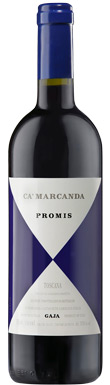
Described by Gaia as 'a classic vintage of Bolgheri,' this 2019 displays balsamic freshness, ripe, creamy red and black berries, a stony mid-palate tightness, then...
2019
GajaToscana
Gaja, Ca' Marcanda Promis, Toscana, Tuscany, Italy, 2003
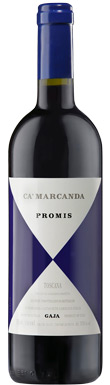
2003 was a severely hot year throughout most of Europe but this Promis 2003 shows little sign of the summer drought and intense heat. Of...
2003
GajaToscana
Gaja, Ca' Marcanda Magari, Bolgheri, Tuscany, Italy, 2019
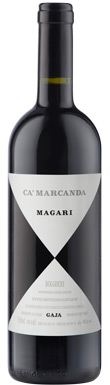
In contrast to the 2004, the 2019 Magari has no Merlot; instead it's composed of 60% Cabernet Franc, 30% Cabernet Sauvignon and 10% Petit Verdot....
2019
GajaBolgheri
Gaja, Ca' Marcanda Magari, Bolgheri, Tuscany, Italy, 2004
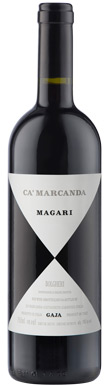
The early vintages of Magari were dominated by Merlot before the variety was eliminated from the blend. This 2004 is 50% Merlot, 40% Cabernet Franc...
2004
GajaBolgheri
Gaja, Ca' Marcanda Camarcanda, Bolgheri, Tuscany, Italy, 2018
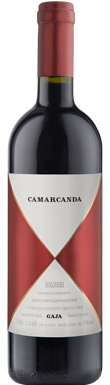
Intense, vibrant and juicy, the 2018 Camarcanda features bright red and black fruits, wood and balsamic notes all wrapped up in some soft creaminess. Tight...
2018
GajaBolgheri
Gaja, Ca' Marcanda Camarcanda, Bolgheri, Tuscany, Italy, 2000
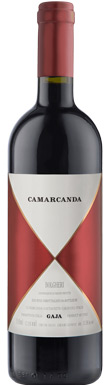
The first year that Angelo made wines at Ca'Marcanda - 2000 - was a very hot vintage, yet even after 22 years this flagship bottling...
2000
GajaBolgheri
