
Luczy: Why it’s time to revisit California Chardonnay
We might be past the ABC years, but Chardonnay still sparks debate. Matthew Luczy questions why, even though the style of California Chardonnay has evolved, many perceptions of the wines have not.

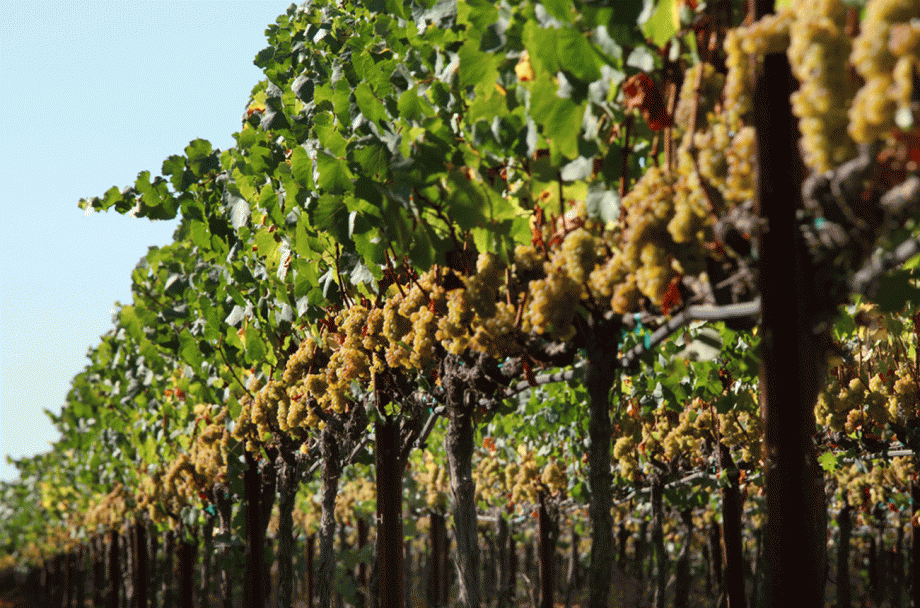
Among grape varieties that cause knee-jerk reactions, Chardonnay is a contender for the top slot. California Chardonnay nearly guarantees a divisive response.
But many of the greatest and most influential dry white wines are Chardonnays, Californian among them. Looking into the subject more reveals deeper themes of consumer preferences.
Scroll down for Matthew Luczy’s California Chardonnay tasting notes
The Golden State’s relationship with Chardonnay dates to the 1880s when Charles Wetmore planted ‘suitcase cuttings’ from the Côte d’Or east of San Francisco’s Bay Area. In the years following Prohibition and two World Wars, Napa’s Stony Hill, Mount Eden in the Santa Cruz Mountains and Sonoma’s Hanzell would establish now-seminal Chardonnay vineyards.
Chateau Montelena‘s victory at the 1976 Judgment of Paris fuelled already-growing interest in Chardonnay. Pioneering winemakers such as John Kongsaard, Fred McCrea and Mike Chelini of Stony Hill, Brad Webb of Hanzell and Jim Clendenen of Au Bon Climat took lessons learned from European cellars back to California, combining them with their own innovations.
There was a lot of plonk in the mix as well. ‘California Chablis’ (jug wine not even necessarily made from Chardonnay) latched its identity to a famous region crippled by World War II. The backlash from this would eventually lead to an increase of varietally labelled California wine – a rare practice up to this point.
Bombastic butterbombs
In 1982, an accident of sorts would forever change California Chardonnay. At Kendall Jackson, a stuck fermentation left the wine with some residual sugar. When combined with fermentation in new oak as well as malolactic fermentation, a blockbuster was born. This runaway success resulted in a chain reaction of financially rewarding emulation across the state.
Along with many of California’s wines, particularly Cabernet Sauvignon and Pinot Noir, Chardonnay became bombastic in the late 1990s and early 2000s. While there were still pockets of traditional and expressive examples, many wineries followed the vogue of ripeness and low acidity.
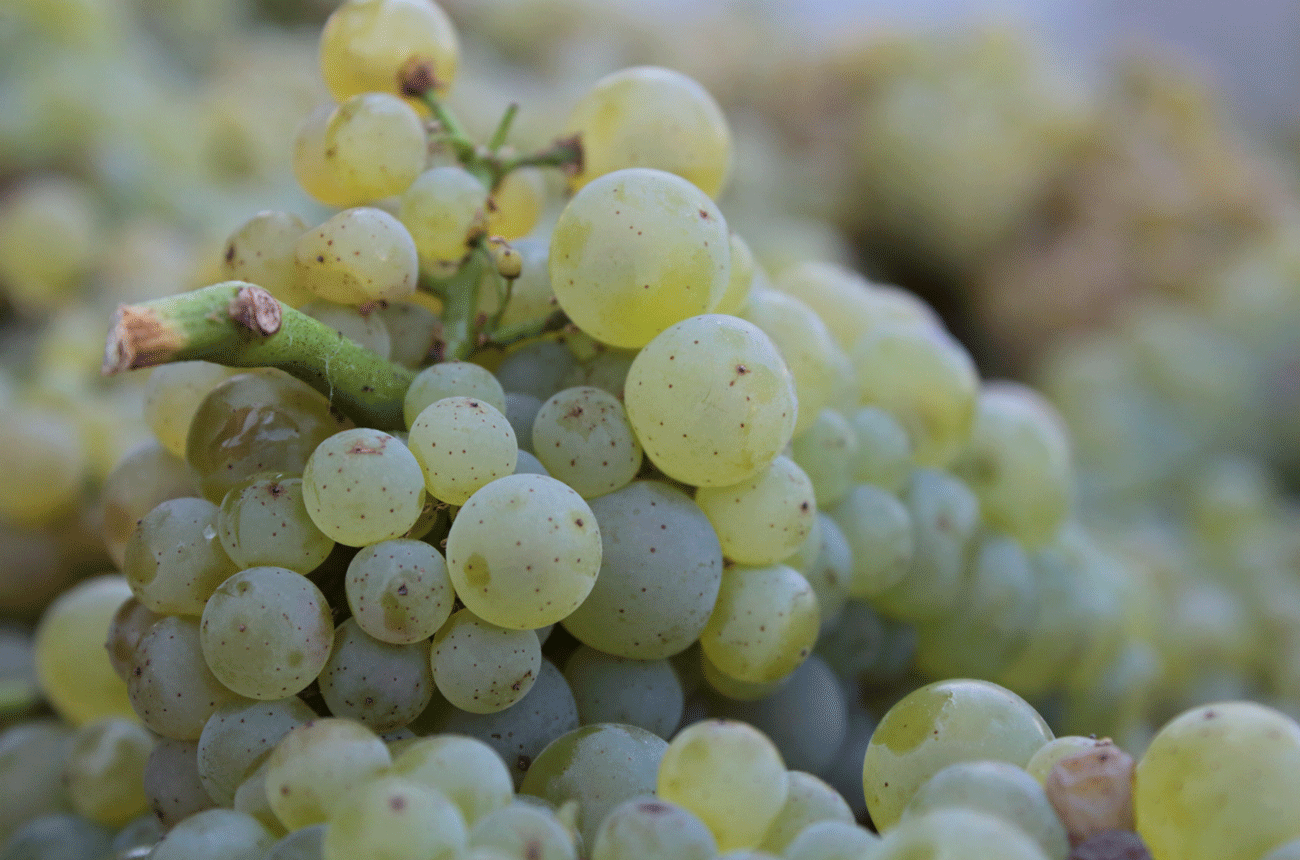
Starting in the early 2010s, though, things settled into a sensible middle ground. This is still the case – and not only at artisanal wineries dedicated to expressing terroir, but also among bigger, more commercial producers once defined by their ‘butterbomb’ styles.
This rollercoaster of trends only confirms that stylistic fads have nothing to do with Chardonnay itself. The grape can be likened to tofu: it has little intrinsic varietal character but melds with the flavours surrounding it, both in the vineyard and cellar. Chardonnay is always playing heads up poker; its cards face-up on the table for all to see. There is nowhere to hide with Chardonnay, making it one of the ultimate terroir-expression grape varieties.
Oak use and malolactic fermentation
One elephant in the room is oak use, with the perception that oaked wines will necessarily taste ‘oaky’ further confusing matters. Look no further than the grands crus of the Côte de Beaune for impeccable examples of Chardonnay matured in 100% new oak. Wood is a porous, breathing membrane, and judicious use of new vessels can enhance the flavours and textures of the wine inside.
I find an analogy with salt useful. The most memorable meals of most of our lives almost certainly contained more salt than we were aware of. When seasoned correctly, you would never call a dish ‘salty’. But if you could retaste the food without the addition of salt, its absence – and the blandness of the food – would be immediately obvious.
An initial overcorrection by Chardonnay producers was to eliminate oak and use stainless steel throughout the winemaking process. This approach achieves varying levels of success, as steel’s inert nature can produce wines lacking depth, complexity and dimension.
A hybrid technique (unofficially known as the ‘Roulot method’, after legendary Meursault producer Jean-Marc Roulot) has gained popularity. Winemakers age the wine on its lees in barrel for about 12 months and then rack it into a stainless tank for another six months or so. This practice lets richness and brightness intertwine, bringing out aromas of struck match and flint that entice many Chardonnay lovers.
Malolactic fermentation is another hot topic. Largely a pragmatic decision by the winemaker, stellar Chardonnays are produced both with and without it. Most of the now-legendary California Chardonnays of the 1970s were made by blocking malo, while the majority of benchmark white Burgundies undergo it fully. Among forward-thinking producers looking to buck prior reputations by making acid-driven wines, malolactic fermentation can be a necessity to avoid shrill flavours.
Quality, complexity and variety
Chardonnay is easily marred due to its neutrality, making it a useful tool for insight into consumer inclinations and perceptions. If you’re not a fan of big, rich wines, it doesn’t necessarily follow that you don’t like oak or malolactic fermentation. Bad Chardonnay is usually the result of grapes that have neither the stuffing nor the structure to stand up to and integrate with their treatment in the cellar.
As with other varieties across the state, Chardonnay is shedding its former reputation as an overly rich, sweet, oaky blockbuster style of wine. The level of structure, tension and complexity of California Chardonnay today – across a broad spectrum of styles and prices – is miles ahead of where it was 20 years ago.
Below are some excellent examples of the quality on offer. Some are laser-like and austere, others combine richness with precision and energy. Something for every palate – even those who say they don’t like Chardonnay!
California Chardonnay: time for a rethink
You might also like…
Matthew Luczy: introductions and reflections
Hirsch Vineyards: producer profile and seven 2018 Pinot Noirs
Napa Valley Cabernet 2018: Top 10 producers and 10 wineries to watch
Bien Nacido Vineyards, Estate Chardonnay, Santa Barbara County, Santa Maria Valley, California, USA, 2018
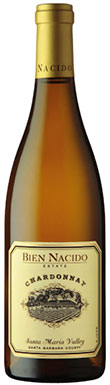

A mineral, flashy and bright showing of Santa Maria Valley. Herbal and floral aromas combine with cleansing and radiant yellow fruits. Beautifully tropical and snappy...
2018
Bien Nacido VineyardsSanta Barbara County

Newton, Beckstoffer Carneros Lake Vineyard Chardonnay, Napa Valley, Los Carneros, California, USA, 2018
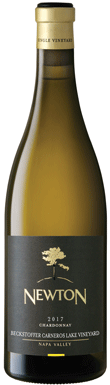
A fantastically complex nose of nougat, lemon zest, red apples and savoury Comté rind. The palate is perfectly balanced between richness, tension and lift, wth...
2018
NewtonNapa Valley
Hirsch Vineyards, Chardonnay, Sonoma County, Fort Ross-Seaview, California, USA, 2018
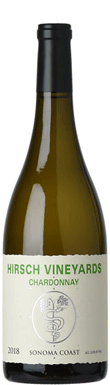
Pure aromas of orchard fruit and white blossoms plus a subtle hint of nougat. Flavours of fresh baguette and honey balance out shimmering citrus fruit,...
2018
Hirsch VineyardsSonoma County
Mayacamas, Chardonnay, Napa Valley, Mt Veeder, California, USA, 2019
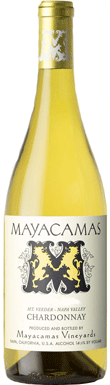
Fresh and exotic aromas of passion fruit, lychee, coconut flakes and seabreeze. The tropical perfume carries through the texturally taught, medium-bodied frame with its zippy...
2019
MayacamasNapa Valley
Stony Hill, Chardonnay, Napa Valley, Spring Mountain, California, USA, 2018
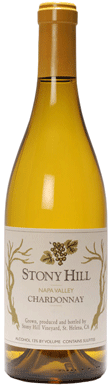
Aromas of wheat crackers, almond skin and peach stones. Racy, tense and electric on the palate, with flavours of lemon zest, lime peel and crushed...
2018
Stony HillNapa Valley
Donnachadh, Estate Chardonnay, Santa Barbara County, Sta Rita Hills, California, USA, 2017
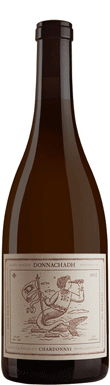
Apricot, yellow apple and river rocks on the nose. The palate is texturally rich and broad but has a spine of nervy acidity. An impressive...
2017
DonnachadhSanta Barbara County
Hudson Vineyards, Chardonnay, Napa Valley, Los Carneros, California, USA, 2018
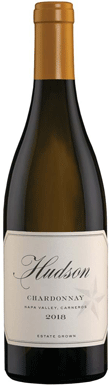
A toasty nose of fresh pastries, buttered toast and toffee, then flavours of apple skin, white peach and honeydew melon. A well-made expression of Carneros...
2018
Hudson VineyardsNapa Valley
The Hilt, Estate Chardonnay, Santa Barbara County, Sta Rita Hills, California, USA, 2018
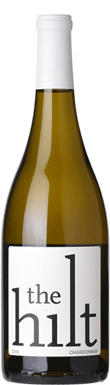
Lime pith, lemon curd and oyster shell aromas. The palate is dominated by refreshing yet sturdy citrus fruit flavours, providing great energy and tension. The...
2018
The HiltSanta Barbara County
Ram's Gate, El Diablo Vineyard Chardonnay, Sonoma County, Russian River Valley, California, USA, 2018
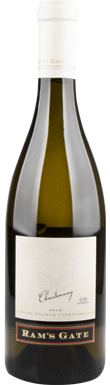
Aromas of caramel, crème fraîche, mushrooms and Golden Delicious apples. The mouthfeel is luscious and layered, showing flavours of ripe citrus fruit. This richness is...
2018
Ram's GateSonoma County
