Peter Michael masterclass: DFWE NYC 2024
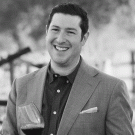
Peter Michael Winery's Robert Fiore and Decanter’s Napa Valley Correspondent Jonathan Cristaldi presented three vintages of the estate's L’Après-Midi white blend, and five vintages of the Bordeaux-style flagship red Les Pavots during a masterclass at the recent Decanter Fine Wine Encounter in New York City.

A lot of people often make the mistake of thinking the Peter Michael Winery is located in Napa. The last bastions of vineyards within the northern Napa Valley AVA are on the fringes of the town of Calistoga.
But 10 minutes north of the town’s bustling main drag of tasting rooms, restaurants, and gift shops, a green and white sign emerges along Highway 128, marking the Sonoma County line.
Another three miles north of the county line is the Peter Michael Winery – very much in Sonoma.
From Great Britain to Sonoma
Established in 1982 by Sir Peter Michael, an engineer by trade and a tech entrepreneur (knighted in 1989 by the late Queen Elizabeth), and his wife Margaret, who raises South Devon cattle and farms a 405-hectare estate in the southern English county of Berkshire.
Their California estate is a serene setting, comfortably settled and well-established, a far cry from when it was an old neglected cattle ranch.
Today, Sir Peter and Lady Michael’s son and daughter-in-law, Paul and Emily, carry forth the vision of Peter Michael Winery as a family-owned estate.
In my opening remarks for the master class at Manhattan in downtown New York City, I mused that Peter Michael Winery is often confused as an icon of Napa Valley. This isn’t surprising, given its proximity to Calistoga and the fact that the winery produces wines from vineyards in Napa’s Oakville appellation.
However, the 304-hectare ranch that encompasses Peter Michael Winery’s tasting room, offices, cellar, vineyards, and family retreat falls explicitly within the Knights Valley AVA, a sub-appellation of Sonoma County.
It is aptly referred to as the ‘Knights Valley Estate’, most of which is a wildlife preserve home to bobcats, bears, raptors, eagles, and falcons. The other two vineyard estates are Seaview Estate in West Sonoma County and Oakville Estate in Napa Valley.
As of March 2020, Robert Fiore began producing the wines. Fiore is a soft-spoken, genial man who harbours an obsession for rocks. He first trained as a geophysicist, and his global travels as an earth scientist inevitably led to a fascination with wine.
Equipped with a Master of Science degree in Viticulture and Enology from UC Davis, Fiore’s bio includes stints at Continuum with Tim Mondavi, Arietta with Andy Erickson, Spring Mountain Vineyard, and experience in Burgundy as a Confrèrie des Chevaliers du Tastevin Fellowship Laureate.
Fire and brimstone
The seminar room at Manhatta, with its floor-to-ceiling views of the New York City skyline, filled up with new and familiar faces. For the next hour and a quarter, winemaker Robert Fiore and I engaged in an enthusiastic, dynamic journey.
First, Fiore helped frame a picture of the Knights Valley estate. ‘We’re on the western slopes of Mount Saint Helena’, he explained, ‘which is what remains from early volcanic explosions. The vineyards are underlain with rhyolite which is a volcanic rock high in silica content. We have both rhyolitic tuff which is lithified ash and rhyolitic lava flows which range from white to grey and brown in colour.’
Fiore continued: ‘These varying pockets of tuff and rhyolite on steep hillsides lead to variations in blocks, whereas some hillside vines produce structure and present tannins, and others deliver more flesh and silky tannins’.
It is clear, therefore, that for Fiore, in the winery, these differences comprise just some of the building blocks for Peter Michael’s remarkably structured and age-worthy wines.
After a bit of history and soil talk, we delved into the tasting with three vintages of the estate-grown Sauvignon Blanc-Sémillon white blend L’Après-Midi (The Afternoon), followed by five vintages of the flagship Bordeaux blend, Les Pavots (The Poppies).

The wines of Peter Michael’s Knights Valley Estate
Peter Michael, L’Après-Midi, Knights Valley, Sonoma County, California 2010
Peter Michael, L’Après-Midi, Knights Valley, Sonoma County, California 2016
Peter Michael, L’Après-Midi, Knights Valley, Sonoma County, California 2021
Peter Michael, Les Pavots, Knights Valley, Sonoma County, California 2006
Peter Michael, Les Pavots, Knights Valley, Sonoma County, California 2009
Peter Michael, Les Pavots, Knights Valley, Sonoma County, California 2012
Peter Michael, Les Pavots, Knights Valley, Sonoma County, California 2016
Peter Michael, Les Pavots, Knights Valley, Sonoma County, California 2021
The wines
2010 L’Après-Midi
86% Sauvignon Blanc, 14% Sémillon, 100% barrel-fermented, aged sur lies 8 months, biweekly bâtonnage, 15.2%
I asked Robert how far back he’d tasted the L’Après-Midi whites. ‘Back to the mid-1990s vintages’, he said, ‘and they hold up incredibly well.’ 2010 was one of the coolest years in a decade, beginning with a wet and cold winter, but heat came in the end, and ripening was sufficient.
Shatter impacted the Sauvignon Blanc crop this vintage, so there was more Sémillon in the 2010 blend than is typical. We compared the colour to the 2021 vintage. The 2010 was darker and straw-flecked with gold hues. Incredibly fresh, rich with fruit weight, and deep concentration on the mid-palate, it harboured notes of salted Meyer lemon peel, honey, oyster shell, and parmesan rind. What was most striking was its freshness.
2016 L’Après-Midi
88% Sauvignon Blanc, 12% Sémillon, 100% barrel-fermented, aged sur lies 8 months, biweekly bâtonnage, 14.5%
‘The growing season was warm and dry, a continuation of the previous drought year with low winter rains from 2015 into 2016,’ I offered, then asked Robert how the crop turned out. ‘At the time of flowering, we had beautiful, perfect conditions and great fruit set’, he said. ‘In this vintage, more thinning was done in the vineyard.’
There was quite a leap in freshness between 2010 and this 2016, which exhibited bright salinity and floral notes, with citrus, orchard, and stone fruits resonating around an incredibly focused and balanced medium-bodied white with vivid acidity. Fiore explained that: ‘Luc Morlet had decided to plant the Sémillon in the early 2000s as a blending component with the Sauvignon Blanc’.
2021 L’Après-Midi
93% Sauvignon Blanc, 7% Sémillon, native yeast, 100% barrel-fermented, aged sur lies 8 months, biweekly bâtonnage, 15.1%
‘Coming off the heat-stricken 2020 growing season, there were minimal winter rains, which resulted in a very low-yielding year for Sauvignon Blanc (and Cabernet Sauvignon, as we will discover later in the tasting’, I began. ‘The months of June and July brought a good amount of heat, but then things tempered, and the season was even-keeled.’
The smaller amount of Sémillon ‘was more typical’, Fiore said. This gorgeous wine captivated the attendees. Its pale colour belied the power and integrity of this super fragrant and floral-driven white, with all the same flavours and round, rich textures as the 2010 and 2016, only young, subtle, compact – apricot cream instead of dried apricots and honeysuckle instead of honeycomb.
2006 Les Pavots
77% Cabernet Sauvignon, 13% Cabernet Franc, 8% Merlot, and 2% Petit Verdot, aged 18 months in 100% French Oak, 15.5%
As we transitioned to the Les Pavots reds, I reminded everyone that our focus was strictly on the Knights Valley Estate in Sonoma – the source of all the grapes harvested for Les Pavots. For those who have collected Peter Michael wines, I asked Fiore to briefly remind us of the difference between Les Pavots and the winery’s other Bordeaux-style reds.
‘Au Paradis is a powerhouse red from our Oakville Estate in Napa Valley, and L’Esprit des Pavots is a blend from the Knights Valley estate and our Oakville estate, so a true California blend, made for early enjoyment’. L’Esprit des Pavots is French for ‘The Spirit of the Poppies’, a flower which grows among the vines.
2006 was a wet year, with hail and snow during the springtime. Frost damage impacted some hillside blocks. The coolness delayed flowering and a moderate growing season led to a later harvest in October. Absolutely riveting, this wine was full-bodied, complex, layered, and so inviting with its rich black truffle and earth notes interlaced with currant fruit and beautifully refined, almost powdery tannins perfectly integrated. A dusty, mineral quality nearly had some in the room fooled that we’d poured a Left Bank Bordeaux red.
2009 Les Pavots
66% Cabernet Sauvignon, 22% Cabernet Franc, 10% Merlot, and 2% Petit Verdot, aged 17 months in 100% French Oak, 15%
A slow and steady growing season with just a couple of heat spikes. The berries were in prime condition, harvested between 6 and 14 October. Both the 2009 and the 2006 are just instant classics by California standards. There’s a cooling quality to this full-bodied wine, a coolness in the fruit and wild herb aromatics, with ripe, present and integrated tannins that are soft and mellow, supporting still-ripe red and black fruits in the 2009. Tobacco and earth fill out the finish.
I wondered if the wines were unfined and unfiltered, and Robert explained that indeed they are, which, he said, ‘helps with long-term ageing to maintain structure and freshness.’
2012 Les Pavots
64% Cabernet Sauvignon, 20% Cabernet Franc, 11% Merlot, and 5% Petit Verdot, aged 18 months in 100% French Oak, 15.8%
We nosed the 2012, and I explained that ‘this was an extraordinary year, following the cold and rainy 2011 vintage. The great 2013 vintage often overshadows this vintage, but both years are accessible now, especially this 2012, having shed its youthfully intense tannins, and it has a long way to go, plenty of structure, weight, and prettiness in its cigar box, currant fruits, full-bodied appeal and tremendous length underscored by good acidity.
2016 Les Pavots
62% Cabernet Sauvignon, 18% Cabernet Franc, 13% Merlot, and 7% Petit Verdot, aged 18 months in 100% French Oak, 15.6%
I urged the attendees to compare 2012 to 2016 because ‘the blends are remarkably close, and the growing seasons have a lot in common – good winter and spring rain followed by moderate weather and later harvests.
‘The presence of oak is still quite powerful in the 2016, whereas it has softened with 2012’, I noticed, and added: ‘A watershed in the life of the wine, wherein you can see the trajectory of oak and its eventual integration after a decade of bottle ageing.’
I then asked Robert if there had been any major shifts in the barrel ageing regimen over the years. ‘No, it’s been consistent since the beginning,’ he replied, ‘which is a huge win for collectors. They get to experience vintage variation through the same lens of winemaking’. The 2016 showed ample dark fruit and spices, wild herbs, pixelated tannins and an excellent baseline of acidity.
2021 Les Pavots
62% Cabernet Sauvignon, 25% Cabernet Franc, 7% Merlot, and 6% Petit Verdot, aged 18 months in 100% French Oak, 15.8%
As discussed with the 2021 L’Après-Midi, the 2021 vintage ushered in extremely low yields, with vines producing very few clusters and very concentrated berries. ‘It’s similar in my mind to 2001, which is a year that produced very dark, very tannic wines with considerable structure,’ said Fiore.
The 2021 was just dynamite, showing its youthful exuberance in dark purple-black colour, heady primary, blue and black fruit aromatics, violet pastille, and sweet cedar.
Full-bodied and compact, with fine-grained tannins and refreshing acidity. I pressed the room to observe the opulence of the wine and then to revisit the 2006 vintage as a bookend to our journey with Peter Michael and a sneak peek into the future of these drop-dead gorgeous wines – a promising future for anyone fortunate enough to have bottles in their cellar.
Related articles
- Photo highlights: Decanter Fine Wine Encounter NYC 2024
- The Peter Michael Winery retrospective tasting
- Sonoma County’s best kept secret: Moon Mountain District
