
Producer profile: Franck Bonville
Yohan Castaing introduces a dynamic, terroir-passionate family estate that straddles the divide between small grower and Champagne house, and deserves to be far better known.


The emergence of a new generation of grower-producers in the Champagne region has brought about a veritable Copernican revolution – in the sense of a paradigmatic shift – affecting the production of the world’s most prestigious sparkler.
These small-sized producers belong to the category of récoltant-manipulant in which the same pair of hands that grows the grapes also handcrafts and sells the Champagne directly to consumers.
Savvy Champagne consumers even tend to fall into two opposing camps today. On the one hand, there are those who prefer the small growers while on the other, there are those who remain attached to the house styles of the big brands.
Scroll down to see tasting notes and scores for six Franck Bonville wines
Blurred lines
On closer inspection, the reality is much more complex, as it is increasingly difficult to discern a real difference between ‘house’ and ‘grower-producer’ in these times of climate disruption. Both are now practising an haute couture approach to viticulture, and this is one of the critical and certainly positive factors making a welcome impact on Champagne styles today.
Franck Bonville is an emblematic producer of this dynamic dichotomy. While this family enterprise belongs to the category of a Champagne house, it also qualifies as a ‘grower-producer’ as all of its production is made with its own grapes. The dynamics of such a double status is becoming a motor of change for the whole region.

Early days
The origins of Franck Bonville as a Champagne house go back to the purchase of vineyards in 1900 by Alfred Bonville, based in Oger but working for Veuve Clicquot. Bonville took advantage of lower prices for buying vineyards in the region, one of the consequences of the outbreak of the dreaded phylloxera.
Starting in 1945, Alfred’s son, Franck Bonville, began to take advantage of the post-World War II context to adopt more mechanised forms of grape growing and wine production – including the use of a tractor – and this gave him the means to market a few vintages of Champagne under his name. Another important milestone for this small family house came in the 1970s after Franck’s son Gilles and his wife Ingrid took charge and made the decision to replace the large wooden casks with stainless steel vats in order to have a more efficient and precise way of working.
New generation
In 1996, their son Olivier Bonville, representing the fourth generation, came on board after getting his diploma in oenology and beginning his career working for the Comité Champagne, the trade association representing the interests of both the independent Champagne producers and the Champagne houses. In time, Olivier took the helm of this family enterprise.
Olivier’s arrival proved to be game-changing, as he was keen to focus on the technical aspect of Champagne production. Even today, he freely admits that he prefers to ‘spend more of his time in the cellar than making the commercial rounds to sell bottles.’
Terroir-focused cuvées
He is also passionate about viticulture, and is deeply attached to the terroirs of the Côte de Blancs, where he is based, and the stylistic differences of Champagnes coming from this prized sub-region. This is evident in his decision to add to his line-up – beginning with the 2012 vintage – a trio of cuvées that are more terroir-focused and so more closely identified with their village origins.
The Bonville vineyard holdings amount to 15ha spread over three areas in the Côte des Blancs that are attached to villages having grand cru ranking: 8ha in Avize, 5.5ha in Oger, and 1.5ha in Mesnil-sur-Oger. Olivier Bonville’s idea is to offer cuvées that reflect his interpretation of each separate terroir but also their ‘purest expression’.

Since the 2012 vintage – but followed by the 2014 – he has vinified grapes from these three villages separately before releasing them with eloquent label designations: Pur Avize, Pur Oger and Pur Mesnil. His declared ambition is to highlight not only their freshness and finesse but also the distinctive style and especially the mouthfeel of each one.
Stylistic differences
The Champagnes from Le Mesnil, where the grapes ripen later, tend to be tight and lively, and infused with the sort of tactile tension that many associate with the notion of minerality in a wine. In Oger, the chalk soils are two to three metres deep, resulting in fruit-driven wines that can be almost exuberant. As for Avize, the chalk is shallower with visible outcroppings of it, and the wines produced from here stand out for their floral scents and crystalline textures.
‘The Bonville style is based on freshness, racy acidity and compelling vivacity,’ says Olivier. ‘I want to make Champagnes in a style that I personally like, in which the wines express what I like to describe as a “shimmering harmony” on the palate.’
By adopting a philosophy and a practice that are more closely associated with so-called Champagnes de Vignerons, Olivier Bonville has guided this family-owned house toward a very different vision of Champagne production and transformed it into one of the more vibrant players of the region.
For the moment, Franck Bonville is still a hidden gem of the appellation, but surely not for long, given the impressive quality of the wines.
Franck Bonville Champagnes are distributed in the UK by Charles Mitchell Wines Ltd (wines available by the 12-bottle case), and in the US by Total Wine & More.
See Yohan Casting’s tasting notes and scores for six Franck Bonville wines:
Related content:
Producer profile: Château-Grillet
Village profile: Cramant, Champagne
Yohan Castaing: My top 10 Champagnes of 2021
Franck Bonville, Les Belles Voyes, Champagne, France, 2013
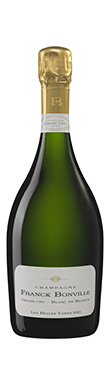

This mid-slope parcel covering less than one hectare was planted in 1960 in Oger. It produces wines that are full and generous, as evidenced by...
2013
Franck Bonville

Franck Bonville, Pur Mesnil, Champagne, France, 2014
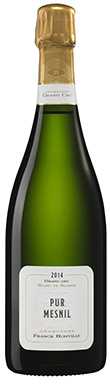
Fresh and juicy white fruit but also candied citrus along with notes of menthol dominate the bouquet. After airing, chalky overtones come to the fore....
2014
Franck Bonville
Franck Bonville, Pur Oger, Champagne, France, 2014
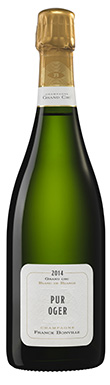
Very distinctive bouquet with notes of white fruit, candied lemon and citrus blossom. Its floral scents are enhanced by aeration. This is a structured Champagne...
2014
Franck Bonville
Franck Bonville, Pur Avize, Champagne, France, 2014
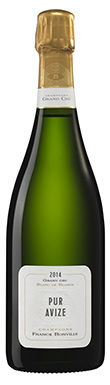
Remarkable freshness and focus but also complexity on the nose, composed of scents of spring flowers and pears along with flinty notes. There is chiselled...
2014
Franck Bonville
Franck Bonville, Blanc de Blancs Grand Cru, Champagne, France, 2014
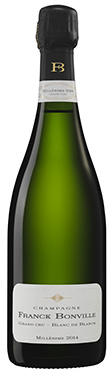
The first scents are floral in character, accompanied by a touch of liquorice, but aeration reveals pastry and citrus notes. The palate is perfectly balanced...
2014
Franck Bonville
Franck Bonville, Blanc de Blancs Grand Cru Extra Brut, Champagne, France, 2013
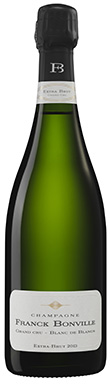
This extra-brut interpretation of the Blanc de Blancs Grand Cru is a tremendous success. It offers riper aromas than the Blanc de Blancs Grand Cru...
2013
Franck Bonville
