
Poderi Aldo Conterno – Profile and wine reviews


Made in limited quantities, the Barolos of Aldo Conterno are highly sought-after, with his sons continuing the winemaking philosophy of their father. Stephen Brook explores the history of this perfectionist estate.
Family splits have been unusually common in Barolo, with fathers and sons at odds, and brothers no longer on speaking terms. This happened to the Conterno family too, when in 1969 Aldo Conterno and his brother Giovanni decided to divide their domaine.
Scroll down to see Stephen’s tasting notes
Because Giovanni was the staunchest of traditionalists, it was supposed that the brothers fell out over the style of Barolo each favoured.
The truth was less dramatic. Both men favoured long ageing in large casks for their Barolos, although Aldo did use barriques for some of his other wines, a practice continued by his three sons. The truth is that the brothers went their separate ways because they found it hard to work together, although towards the end of their lives there was a degree of reconciliation.
No one familiar with Barolo is likely to question that both domaines made outstanding wines, and continue to do so. Both brothers were fortunate in that their heirs and successors respected and perpetuated their vision, and had the technical skill to maintain the highest standards.
I knew Aldo, who was born in 1931, in middle age, when he was of stocky build and greying hair, with a relaxed, urbane manner. What I did not know until recently is that in the 1950s he travelled to California, where a rich uncle who lived there asked him to scout for vineyards in Sonoma with a view to creating a winery. But Aldo was drafted into the American army to complete his Italian military service. Poor timing, as the Korean War was raging at the time. He survived, but his uncle died, and the project with him. Following a period of doing odd jobs to earn a living in Berkeley, Aldo returned to Monforte.
After successfully building up his own estate, Aldo died in 2012, and was succeeded by his three sons, who had been working with him since the end of the 1980s. Franco and Stefano are both trained oenologists. Stefano makes the wines, while Franco travels extensively to promote them. The youngest son, Giacomo, studied accountancy but also looks after the vineyards. The brothers have changed little at the winery, unwilling to tinker with a philosophy and a range of wines that had always attracted a loyal following. However, they did make one change of great importance, as will become clear later.
Poderi Aldo Conterno at a glance
- Vineyards 25ha, all in Bussia on its three highest hills
- Production 80,000 bottles
- The brothers Franco (b 1965), studied oenology in Alba. Stefano (b 1968), also studied oenology in Alba. Giacomo (b 1973), studied accountancy
The Barolos
Bussia is a prime zone within Monforte, and Aldo produced four Barolos from his vineyards. Three were single-vineyard wines, the other a blend called Granbussia that is given exceptionally long ageing in top vintages only. The wine from Colonnello, explains Giacomo, ‘is the most floral of the three, and in style and weight is more like a La Morra. Cicala is higher and steeper, with limestone and iron in the soil that gives a stronger wine with ageing potential that reminds some people of Serralunga. It’s more leathery and exhibits darker fruits than Colonnello.’
The third, and arguably greatest, site is Romirasco, which Aldo leased until 1980, when he was able to buy the 3.8ha vineyard outright. Its slopes overlook the winery, and the cru was already celebrated over a century ago, when the grapes were sold for high prices. It receives a longer maceration of around four weeks and shows a good deal of spice.
Granbussia is a riserva, first made in 1970. Since 1980 it has been composed mainly of grapes from the Romirasco vineyard, with 15% each from Colonnello and Cicala. Since 2001 the grapes have been co-fermented, with a maceration period that can be as long as 60 days. After ageing for three years in large casks, the wine remains in steel tanks and bottles for many years. The 2009 will be released in 2018.
In the 1970s and 1980s, it was common for Barolo to receive a very long maceration period, often at high temperatures. The idea was to extract the maximum amount of tannin, as it was considered important for Barolo to be structured and long-lived.
Unfortunately, this technique tended to impart bitterness and volatility to the wines, and few stayed the course. Aldo always got the balance right: fermenting at warm but not hot temperatures, without using the then-prevalent ‘submerged cap’ maceration so as to avoid excessive extraction. But he never went in for the short vinifications in rotofermenters favoured by the so-called modernists.
He and his sons also opt for a long ageing period that ranges from 27 months in casks for the basic Barolo to 32 months for the Romirasco. Aldo never liked barrique-ageing because, he said, Barolo was already rich in perfume and tannins and didn’t need any additional elements added by small barrels. The wines are neither fined nor filtered.
With the estate’s reputation for Barolo so elevated, it can be easy to forget that it also makes other wines of high quality. The Barbera, Conca Tre Pile, is named after the Bussia site from which most of the grapes are sourced.
Giacomo argues: ‘Barbera is all about acidity, not tannic structure,’ so the ageing in new oak can add more dimension and grip to the wine.
The Langhe Nebbiolo, Il Favot, is primarily made from vines under 20 years of age, and this too is aged in new barriques.
There used to be two Chardonnays, but the brothers eliminated the simpler of the two so as to focus on Bussiador, which is grown in the east side of Romirasco from vines planted in the 1970s.
Giacomo recalls that his father originally wanted to plant Arneis to produce a white wine and pulled out the existing Grignolino and Dolcetto. ‘But Arneis thrives on sand, so we have the wrong soil for it.’ The Chardonnay spends 13 months in new oak, and a further eight months in steel.
Aldo Conterno – a timeline
- 1961 Brothers Giovanni and Aldo Conterno inherit the domaine from their father Giacomo
- 1969 Aldo founded his estate after he and his brother Giovanni split the domaine. Aldo had 14 ha in Bussia
- 1970 First vintage of the Granbussia blend
- 1980 Aldo bought the Romirasco site, which he had formerly leased. He began producing Granbussia from 70% Romirasco grapes
- 1989 Aldo’s three sons entered the winery
- 1991 The first Chardonnays bottled, after earlier vintages had been sold in bulk
- 1999 The bothers decided to cut production after years of deliberation. Volumes cut from 200,000 to around 80,000
- 2001 First vintage with reduced production
- 2012 Aldo Conterno dies
No compromise
The great change, mentioned earlier, has been the reduction in quantity. ‘Until the mid- 1990s,’ says Giacomo, ‘we were producing 200,000 bottles per year, and had the winery capacity to produce many more. It was tempting to expand. Vineyards were available to buy, and the exchange rate made export easy. But we decided to move in the other direction so as to focus on the identity of our wines without compromise. So we reduced production to 80,000 bottles. We wanted our wines to have such typicity that Barolo lovers could always recognise them. We were less concerned about whether they liked them, but we wanted them to have a clear identity.’
The first vintage reflecting the far stricter selection was 2001. ‘Previously we made about 16,000 bottles of Chardonnay each year. We reduced it to 7,000, and dropped the simpler bottling. We were prepared to take risks by picking as late as possible, as acidity is never an issue in the Langhe,’ continues Giacomo.
‘With Barbera we cut the bottoms of the bunches, which are slower to ripen. Of course that halved production, but we had riper wines,’ he adds. ‘So our primary selection is in the vineyard, by removing any fruit that’s not of exceptional quality. But we can also select in the winery. We justify our rigid focus on quality as a kind of freedom, not being beholden to any entities outside the winery. That freedom also means we are in no rush to release our wines, especially since they sell out quickly anyway.’ This dedication to the highest quality explains the success of the estate’s wines in 2014, a wet and difficult vintage.
‘Our goal is to do our best,’ insists Giacomo. ‘We’re not saying ours is the best Barolo, but we want to show the very best of which our terroir is capable. There’s no question that quality in our region is far more consistent than in the past. When my brothers are I were growing up, my father liked to organise blind tastings. There were always some great wines, some acceptable wines, and quite a few awful wines, unclear and tainted by brett. You’re so much less likely to find the awful wines now. Even cheaper Barolos can be excellent, though they may lack identity.’
Reduced production has inevitably led to rising prices, and the Conterno wines were never cheap. Giacomo is unrepentant. ‘Those prices are fixed by the secondary market, which we can’t control. Price has to be based on fame, marketing and scarcity. Scarcity needs to be based on a reality, not on trying to manipulate the market. Think about Montrachet. The French have always been proud of their greatest terroirs, and that’s a model we admire.’
The Conternos have little patience with the modernist vs traditional ‘debate’. Giacomo sagely remarks: ‘It’s more important, surely, to talk about our terroir and raw materials than the capacity of our barrels. Barrels are a tool that help the wines to breathe and avoid reduction.
‘We use barrels of various sizes for Barolo, depending on the wine, but no new oak. There’s no single right approach to winemaking in the Langhe. Angelo Gaja and Mauro Mascarello have opposed ideas but both fight for what they believe in and speak widely about it. They’re not competitors as they both produce great wines.’
It takes guts to halve production when your winery has the capacity to do the opposite. The Conternos have confidence in their terroir and the skill, learned from their father, to transform its fruit into great wine. A perfectionist approach allows them to discard bunches and wines that don’t meet their exacting standards.
It also means that their customers, who are mostly patrons of fine restaurants, can have complete trust in the label.
Stephen’s pick of Aldo Conterno wines:
You may also like:
Introducing Damilano’s Raviole cru: A new Barolo
Barolo 2015: Vintage report and 89 wines rated
Barolo Riserva 2013: ‘Some first-rate wines’
Aldo Conterno, Bussiador Chardonnay, Langhe, Langhe, Piedmont, Italy, 2015
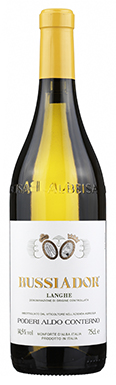

Old-fashioned in the best sense. The appley nose is gently smoky, with a good deal of spice from the oak. Rich and creamy, with a...
2015
Aldo ConternoLanghe

Aldo Conterno, Granbussia, Barolo, Monforte d’Alba, Piedmont, Italy, 2009
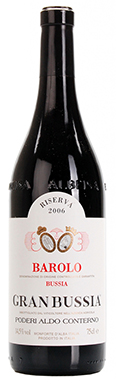
Opulent but far from jammy, with aromas of leather and cherries. It’s velvety, with lovely depth of flavour and luxurious tannins, a harmonious wine with...
2009
Aldo ConternoBarolo
Aldo Conterno, Bussia Romirasco, Barolo, Monforte d’Alba, Piedmont, Italy, 2013
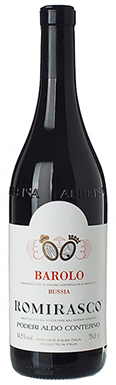
Sumptuous aromas of raspberries and cherries, with a touch of mocha despite the lack of new oak. It’s bold and forthright, very compact, with tannins...
2013
Aldo ConternoBarolo
Aldo Conterno, Bussia Cicala, Barolo, Monforte d’Alba, Piedmont, Italy, 2013
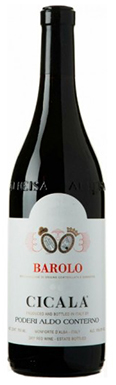
Sour-cherry and red-fruit aromas are less perfumed than Colonnello but more assertive. Very concentrated with structure and vibrancy, and more texture and grip than Colonnello....
2013
Aldo ConternoBarolo
Aldo Conterno, Bussia Colonnello, Barolo, Monforte d’Alba, Piedmont, Italy, 2013
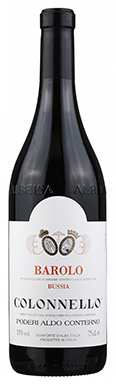
The red-fruited nose is brisk, charming and floral, with lift and purity. The attack is discreet but tannins soon kick in, while the sweet core...
2013
Aldo ConternoBarolo
Aldo Conterno, Conca Tre Pile, Barbera d'Alba, Langhe, Piedmont, Italy, 2015
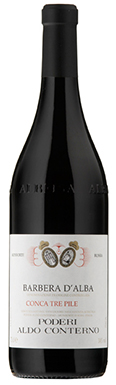
Sweet, ripe, dashing nose of red fruits and discreet oak. Rich but lively, its ripeness is cut by the fine acidity that also gives persistence....
2015
Aldo ConternoBarbera d'Alba
Aldo Conterno, Bussia, Barolo, Monforte d’Alba, Piedmont, Italy, 2013
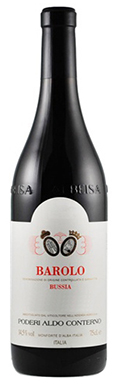
Fragrant and elegant cherry and raspberry. While not super-concentrated, it shows intensity and spice. It's relatively forward, with appealing acidity, and a hint of mint...
2013
Aldo ConternoBarolo
Aldo Conterno, Il Favot Nebbiolo, Langhe, Langhe, Piedmont, Italy, 2015
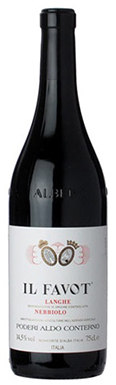
Charming raspberry nose. Sleek yet concentrated too, showing freshness and flair. Quite approachable, yet has depth and bite. Long.
2015
Aldo ConternoLanghe
