
Spanish Icons: CVNE, Imperial Gran Reserva
For decades, there were just a few wines regarded as Spain’s most revered. Recently, these have been joined by a growing cast of modern-day powerhouses that have risen rapidly to win the hearts of critics and collectors alike.


It’s impossible to will, or proclaim, the creation of an icon. Any Hollywood talent agent worth their salt will tell you as much. And yet, when achieved, icon status is undisputable.
So what does the process of becoming an icon entail? What makes the 10 Spanish wines we’ve chosen worthy of the description? The answer is never straightforward. Producers themselves acknowledge that there is, despite their recognised efforts and focus on quality, an element of serendipity made of fortunate encounters and of the sometimes baffling flux of history.
These allow them to remain firmly above fleeting fashions, standing out not just as benchmark examples of their regions but also as symbols of rigour, professionalism and strength of character.
They are faithful to their time and place but, above all, to themselves.
Scroll down for a great modern vintage of CVNE Imperial Gran Reserva
Most importantly, however, these are incredible tasting experiences that demonstrate Spain’s increasing strength as a source of fine wine – of icons old and new. Some of them command exorbitant prices – but it’s worth pooling with a group of friends to try a bottle at least once. You won’t regret it.
The robustness of this list, and the fact that other names – such as Dominio del Aguila’s Canta la Perdiz from Ribera del Duero or Terroir Al Límit’s Les Manyes Priorat – would have been included, space allowing, shows how the last 150 years have been punctuated by chapters of outstanding evolution in the narrative of Spanish winemaking.
Perhaps inevitably heavy on Rioja ‘first growths’, this line-up nevertheless reflects evolution and change. The emergence of Priorat in the 1990s and the rediscovery of Gredos (and Garnacha) in the 2010s have questioned the attributes of modern classics – and it’s this self-questioning that makes Spain such an enduring source of wine discovery and fascination.
Spanish Icons: CVNE, Imperial Gran Reserva, Rioja
First vintage: 1917

I don’t know if Imperial is our best wine, but it represents our soul,’ says Víctor Urrutia Ybarra, CEO of CVNE.
‘It was the first “great wine” of Rioja. Until Imperial came around, Rioja estates – including ourselves – mostly produced one wine, with a focus on quantity. In my opinion, Imperial was the first wine produced with excellence in mind, capturing the essence of Rioja Alta.’
More than 100 years after its first vintage, Imperial endures as a symbol of classical modern Rioja – and of the prestige of CVNE, founded in 1879 in Haro by brothers Eusebio and Raimundo Real de Asúa, of whom Urrutia is a direct descendant.
The fruit used to produce Imperial – in selected vintages only – hails from 42ha of estate-owned plots in the villages of Villalba, Briones and Torremontalbo planted with Tempranillo, Graciano, Mazuelo (Cariñena) and Garnacha.
Vinification takes place in a dedicated winery within CVNE’s compound in Haro, with each plot fermented separately in French oak foudres. Barrel ageing takes place in the atmospheric Eiffel cellar, designed by the French engineer and built in 1909.
When discussing the wine’s evolution, Urrutia says: ‘Imperial hasn’t changed much. The only significant adjustment might be the use of oak: we now use exclusively French oak, while 100 years ago we used American oak. But overall, we don’t seek changes.’
Having staged multiple extensive vertical tastings, Urritia says that, for him, the best examples of Imperial are from the 1940s and ’50s. ‘Our goal is to produce a [Imperial] wine like the 1947, ’52 or ’59… with incredible acidity and a lot of structure,’ he says. ‘Our future is in our past.’
The wine to try before you die
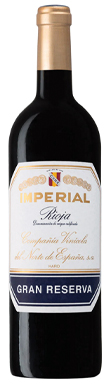
CVNE, Imperial Gran Reserva, Rioja 2017 – 96pts
£40 (ib)-£65 Burnett & Herbert, Cuchet & Co, Davy’s, Falcon Vintners, Farr Vintners, Honest Grapes, Primitus, The Wine Society, VinQuinn, Vintage Cellars US$90-$106 Binny’s, Gillette Ridge, Station Plaza, Total Wine & More, W&J Wine, Yiannis
85% Tempranillo, 10% Graciano and 5% Mazuelo, fermented in small oak vats with malolactic in concrete, then aged in new and second-use oak barrels, 70% French plus American. A bit coiled upon opening, this opens slowly in the glass, revealing beautiful nuance, fragrant herbal details and savoury complexity underneath the brooding restraint.
Top notes of vanilla, charred oak, camphor and preserved cherry. Fresh and exact on the palate, with dark chocolate and coffee beans lining the muscular tannins. Very long finish, supported by a firm acid backbone.
Drink: 2025-2045 Alcohol: 14%
Spanish Icons: CVNE, Imperial Gran Reserva
Related articles
CVNE, Imperial Gran Reserva, Rioja, Alta, Northern Spain, Spain, 2017

A bit coiled upon opening, this opens slowly in the glass, revealing beautiful nuance, fragrant herbal details and savoury complexity underneath the broody restraint. Top...
2017
CVNERioja

