Vietti: Producer profile
Michaela Morris profiles the respected Barolo producer, Vietti...


‘When I was young, I wanted to be an archeologist or forest ranger,’ recounts Luca Currado. Instead, this self-deprecating storyteller became Vietti’s fifth-generation winemaker.
Founded in the late 1800s in the Barolo township of Castiglione Falletto, Vietti’s headquarters sit atop a maze of tunnels that serve as an underground cellar. The Vietti name comes from Currado’s maternal side. His mother, Luciana Vietti inherited the property when her father died. ‘She didn’t want to pay for a winemaker so she married my father Alfredo,’ Currado jokes.
Alfredo was a trailblazer. An early champion of the Arneis grape, he crafted a monovarietal in 1967, helping to save it from extinction. He also started bottling individual sites contrary to the prevailing practice in Barolo of blending grapes from different areas. ‘My father was in love with Burgundy and believed that there were some zones in Barolo that were better than others,’ explains Currado. Vietti’s 1961 Rocche (di Castiglione) was among the first ‘cru’ Barolos.
After stints in Bordeaux at Château Mouton-Rothschild, and in California at Opus One, Currado returned to Barolo in 1991 working with his father until Alfredo retired in 2000. ‘He taught me to respect terroir,’ Currado states.
Vietti Vineyards
With vineyards in all 11 communes, Vietti owns some of the most prestigious terroir in Barolo. The estate also boasts sites in Barbaresco, Roero, Asti and Colli Tortonese. In total, Vietti’s holdings (owned and rented) add up to approximately 40 hectares, from which it makes 30,000 to 35,000 cases per year.
As of the 2019 vintage, the entire production will be certified organic. Currado has also adopted various biodynamic principles but calls his approach pragmatic. He believes in following lunar cycles and planting diverse cover crops – but burying cow manure in the beast’s horn? ‘That’s too esoteric,’ he declares.
Currado’s wife, Elena Penna runs the property alongside him. While her responsibilities include sales and winery visits, the two taste from barrel and make all blending decisions together.
In the spectrum of traditional to modern, Vietti leans more towards the former. The estate’s Nebbiolos see classic long maceration times with a submerged cap fermentation. ‘We have never been extreme,’ states Currado. He strives for clean wines and is as intolerant of Brettanomyces as he is of excessive oak. While he did introduce barriques into the cellar, their imprint is minimal. When utilised, they serve as vessels for alcoholic and malolactic fermentations before extended ageing in large oak casks, and are used for at least 10 years before being replaced.
Currado is quick to explain that there is no strict recipe in the cellar. ‘Every year is different and the crus are diverse. It’s like different cuts of meat, you don’t cook them in the same manner.’
While each parcel is vinified separately, only a handful of crus has traditionally been bottled on their own: Rocche di Castiglione, Ravera, Brunate and Lazzarito. However, even these are vintage dependent – there was no Brunate in 2014 as much of this plot was decimated by hail, for example. Crafted in limited quantities, Vietti’s single crus capture the distinct personality of each site, particularly in the outstanding 2016 vintage.
In exceptional years, Vietti produces a Barolo Riserva from the prized Villero cru. The 2012 vintage is the most recent release and 2013 will follow at the end of this year. Every vintage is labelled with an original work by a different artist. An art buff, Alfredo Currado established the tradition in 1974 with Claudio Bonichi producing a xylograph for the 1971 Masseria Barbaresco. Since the 1982 vintage, the art label is created exclusively for the Villero Riserva and the artist is usually given 12 bottles in exchange. In years which Villero is not made, such as 2014 and 2015, the grapes go into Vietti’s Castiglione Barolo, which blends parcels from throughout the region.
Beyond Nebbiolo, the family has great affection for Barbera. This is due in large part to their centenarian plot located in the prime Barolo cru of Scarrone. Rather than ripping out these vines, they actually sacrificed some Nebbiolo to plant more Barbera in 1989. The two parcels are bottled separately under the Barbera d’Alba denomination. Barbera production was further increased with the purchase of 7ha in Asti. The single-vineyard La Crena label is a selection of the oldest vines there.
In terms of whites, Vietti continues Alfredo’s legacy with a fresh and fruity Arneis. More recently, they invested in the Colli Tortonesi area and have just released their first vintage of Timorasso.
In 2016, Vietti was sold to American business mogul Kyle Krause. The news sent shockwaves through the wine world and the family was subjected to much criticism. ‘It was a painful decision,’ says Currado, explaining that it involved other family members who were no longer interested in the business.
However, four years on, Luca and Elena remain the faces and force of the winery. ‘We have a very clear agreement that allows us to have full management,’ asserts Currado. It has also given them the resources to purchase additional coveted sites, such as Roncaglie and Rabajà in Barbaresco and Cerequio and Monvigliero in Barolo.
While the long-term succession plan at Vietti remains to be seen, the near-term forecast looks bright – with the added prospect of some new cru bottlings.
Tasting Vietti’s wines:
You may also like:
Barolo and Piedmont are hot property in 2020
Tasting Ceretto’s 2016s
1996 Piedmont: A retrospective
Top Super Tuscan wines
Vietti, Rocche di Castiglione, Barolo, Castiglione Falletto, Piedmont, Italy, 2016
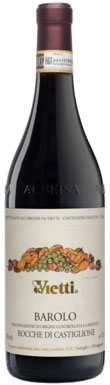

Rocche di Castiglione is prized for its pure white, limestone rich soil which gives wines of extraordinary finesse and fragrance. It is epitomised here in Vietti's graceful and refined 2016. It's evocatively scented with wild forest berries, savoury spice and heady, almost truffle-like nuances. The buoyant, vigorous palate is mineral-driven and generous in red currant and raspberry flavours on a silky texture of fine tannins. As immediately captivating as this is, it has the bones for a solid couple of decades.
2016
ViettiBarolo

Vietti, Brunate, Barolo, La Morra, Piedmont, Italy, 2016
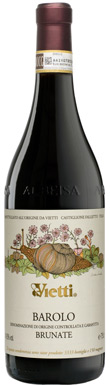
Vietti's Brunate plots sit on the La Morra side of this cru. Fermented in stainless steel then transferred directly to large oak casks for ageing, it offers engaging and penetrating aromas of cedar, red cherry, blood orange, sage blossom and rose. The palate demonstrates the austere personality of Brunate and will require a few years in bottle to unfurl. Dense and layered with profound depth, chewy tannins and persistent red berries, this is a fantastically complete wine.
2016
ViettiBarolo
Vietti, Masseria, Barbaresco, Piedmont, Italy, 2016
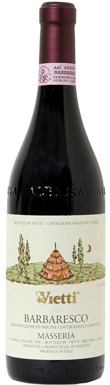
Produced since 1967, Masseria brings together fruit from Pora, Faset, Paje' and Montaribaldi in the township of Barbaresco, as well as Giacone in Treiso. Like Vietti's Barolos, it spends a lengthy 30 months in large casks. Pristine, precise and pure, the 2016 rings out with pronounced mint, white pepper and rose. Still tightly wound, this is tactile and chalky but above all elegant. Long, luscious tannins are seamlessly integrated and the finish bursts with lovely red currants and pomegranate.
2016
ViettiBarbaresco
Vietti, Castiglione, Barolo, Piedmont, Italy, 2016
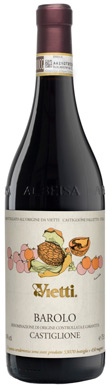
While the exact blend of parcels varies from year to year, the backbone of Castiglione always comes from the Ravera cru of Novello. It has a dark and brooding character and takes time to open up. Winter mint, cedar and an intriguing earthiness offset nuances of red cherry and violets as they slowly emerge. Firm, vertical tannins shore up the palate but remain effortlessly sophisticated in this powerful and dense Barolo.
2016
ViettiBarolo
Vietti, Vigna Vecchia Scarrone, Barbera d'Alba, Piedmont, Italy, 2017
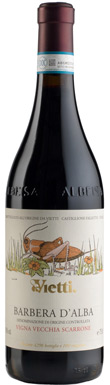
Planted in 1918, Vietti's oldest plot of Barbera is located in the Scarrone cru, overlooking its underground cellars in Castiglione Falletto. The vines naturally yield a low 1kg per plant. Remarkably concentrated, fleshy fruit is enveloped in soft, luxurious tannins. Juicy through the core with hints of fennel and peppermint, it offers black currants, black cherry and plum flavours. This could do with an additional year in bottle but will hold brilliantly for another decade.
2017
ViettiBarbera d'Alba
Vietti, Perbacco Nebbiolo, Langhe, Piedmont, Italy, 2017
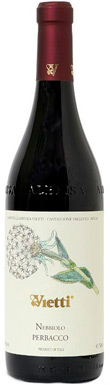
While Perbacco used to be crafted exclusively from Barolo lots that didn't make it into Vietti's Castiglione label, Perbacco now includes declassified parcels from Barbaresco as well. Hints of rosehip, anise and sweet earth are immediately attractive. On the palate, the tannins have the slight astringent edge of the hot vintage but are countered by succulent raspberry and strawberry flavours which linger on the tangy, bright finish. Needs some braised meat.
2017
ViettiLanghe
