
Vigorello: Tasting 50 years of a Tuscan wine pioneer
Vigorello has existed in different guises since its inception in the 1960s and is a veritable piece of Tuscany wine history, says Aldo Fiordelli, who tastes vintages back to 1969 - including top years like 1985 and 2001.


Vigorello was originally a gamble first made in 1968, the wine’s name inspired by the Vigorelli cycling track in Milan – the owners’ native city.
Today, this SuperTuscan is one of the region’s historic labels, produced by Agricola San Felice, which is owned by the Allianz group.
Scroll down to see scores and tasting notes for 12 Vigorello wines
San Felice is a pristine corner of Tuscany, between Castelnuovo Berardenga and Gaiole in Chianti, overlooked since the 1970s when the draw of industrialisation caused a mass movement of young people to the surrounding cities.
At that time this borgo was just a country hamlet populated by retirees who met there, seated in front of the old café, passing time chatting, playing cards and drinking cheap red wine bottled in fiasco.
Chianti Classico was already weaving its path to success, increasing its popularity in the export market as an everyday, easy drinking wine mostly sold in the typical 1.5-litre bottles wrapped in straw.
The rules of the DOC at the time still allowed for the inclusion of white grapes blended with red. Baron Bettino Ricasoli invented his historical recipe by introducing Malvasia and Trebbiano to soften Sangiovese in the blend of Gallo Nero. The climate was different decades ago, too; namely colder and wetter.
In the vineyards, viticulture was geared towards quantity over quality. Vines produced almost three kilos of fruit each, compared to today’s average of one to 1.5kg.

Sangiovese’s aggressive acidity was too high to achieve balanced reds. Moreover, destemming was not practiced, the must was fermented and aged in big chestnut vessels and so the wine needed a lot of time to become drinkable.
In 1968, the farmer Enzo Morganti, father of the well-known natural wine producer Giovanna Morganti (Podere Le Bonce), proposed a 100% Sangiovese.
He came from the Lilliano estate and worked with talented winemaker Giulio Gambelli, a legend behind celebrated labels such as Montevertine, Soldera, Poggio di Sotto and others.
Morganti’s goal was to demonstrate the potential for quality across the various Chianti Classico villages. ‘That’s why Cabernet Sauvignon and Merlot arrived,’ says Leonardo Bellaccini, winemaker and production manager of Agricola San Felice.
Evolution of the Vigorello wines
Whether one considers the original gamble won or lost, there are 50 vintages that demonstrate the results of the venture.
For the first 10 years, Vigorello was made with 100% Sangiovese. Since 1979, 10% of Cabernet Sauvignon was blended with Sangiovese and the first oak barrels were introduced.

In 1982, while opening the new winery, the destemming machine and 60 new French oak barrels came into operation. In 1984, the barrel numbers increased to 120 and from 1990 the ageing process was carried out completely in barrels – with 50% new oak in the best vintages, getting away from the big casks of the wine’s first decade.
In 1997, the percentage of Cabernet Sauvignon rose to 40% and in 2001 15% of Merlot was introduced, at the expense of Sangiovese, alongside shorter macerations.
In effect, this trend towards a Bordeaux blend continued and in the 2006 vintage Vigorello had Cabernet Sauvignon and Merlot in almost equal proportions, alongside a splash of Petit Verdot.
Use of international grape varieties peaked at around this point and in 2011 the estate decided ‘to give back to the wine its Tuscan blood’, notes Leonardo Bellaccini.
Agricola San Felice had previously launched an experimental vitiarium, where hundreds of grape varieties native to Tuscany have been cultivated and studied for more than 30 years – partly to determine what contribution they can make to the estate, and partly to prevent them from fading into oblivion.
The project was accompanied by a scientific study of indigenous varietals in partnership with the universities of Florence and Pisa. Among the results was the rediscovery of Pugnitello, a late-maturing red grape with thick skin that is rich in colour, medium in size and with ripe tannins even when young and achieving low yields.

‘It produces 50q/ha when abundant,’ says Bellaccini. Pugnitello has been the ‘Tuscan blood’ of the Vigorello blend since 2011. As for Sangiovese, ‘we have been faithful to Chianti Classico appellation and so our top Sangiovese is used to produce Riserva’, adds Bellaccini.
Poggio Rosso Chianti Classico remains the top wine of the San Felice estate, slightly overshadowing the price and reputation of Vigorello. So, commercially speaking, one might argue that the original bet was not wholly won.
But in terms of quality, across these 50 vintages of Vitorello, extraordinary wines like 1969, 1985, 1990 and 2001 prove the great insight of San Felice.
The 1969 vintage is an emotional bottle, not only because its longevity demonstrates Sangiovese’s ability to age in the Chianti Classico region but also because it’s an outstanding old wine.
The 1985, one of the best vintages ever in Tuscany, was the greatest wine of this tasting flight. The 1990, the first vintage of Bellaccini, is another gem of stunning modernism.
The 2001, the last including Sangiovese in this vertical tasting, is still young and I would keep it longer.
Regardless of the original gamble, if there is one wine that fiercely represents the evolution of winemaking in Italy – from the excess of experimentation to the full understanding of territorial expression – then it is this SuperTuscan.
Scroll down to see scores and tasting notes for 12 Vigorello wines
Related content
Tasting IDDA wines from Angelo Gaja and Alberto Graci’s Etna project
Bolgheri 2018 vintage report: Graceful wines for the long haul
Tasting September releases via the Place de Bordeaux
San Felice, Vigorello, Toscana, Tuscany, Italy, 1969
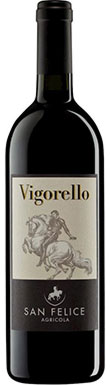

The evolution of this 1969 is complete. Cherry jam, boiled chestnut, wild fennel and tobacco than dried prune aromas and flavours plus rust draw the...
1969
San FeliceToscana

San Felice, Vigorello, Toscana, Tuscany, Italy, 1975
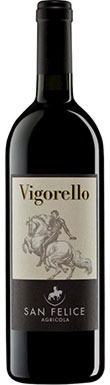
This bottle never left the cellar at San Felice and the conservation has been perfect. Despite the lack of technology, destemming machine and small barrels,...
1975
San FeliceToscana
San Felice, Vigorello, Toscana, Tuscany, Italy, 1985
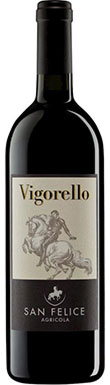
In Tuscany the celebrated 1985 vintage was extremely cold during the winter as well as hot (for that time) during the summer. The new winery...
1985
San FeliceToscana
San Felice, Vigorello, Toscana, Tuscany, Italy, 1988
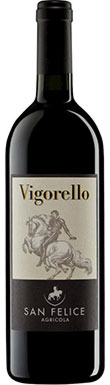
Compared to 1990 this 1988 is considerably leaner, but not less enjoyable for those who love old wines. The nose is evolved and multifaceted with...
1988
San FeliceToscana
San Felice, Vigorello, Toscana, Tuscany, Italy, 1990
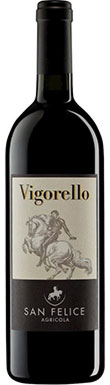
The 1990 was the first vintage made by Leonardo Bellaccini, winemaker at San Felice who began at the estate in 1984. Chapeau! Bright garnet in...
1990
San FeliceToscana
San Felice, Vigorello, Toscana, Tuscany, Italy, 1997
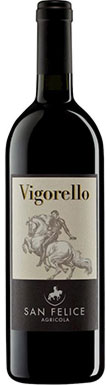
The celebrated 1997 vintage was overestimated in Chianti Classico however this Vigorello shines with integrity and complexity. It was one of the first warm vintages...
1997
San FeliceToscana
San Felice, Vigorello, Toscana, Tuscany, Italy, 2001
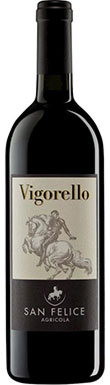
The 2001 vintage was the last (in this flight) with Sangiovese in the blend (45%). The 15% of Merlot was harvested from six-year-old vineyards. The...
2001
San FeliceToscana
San Felice, Vigorello, Toscana, Tuscany, Italy, 2007
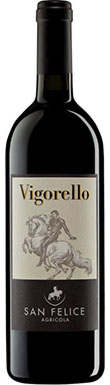
In the warm vintages such as 2007 international grape varieties such as Cabernet Sauvignon, Merlot and Petit Verdot help in the blend, even if indigenous...
2007
San FeliceToscana
San Felice, Vigorello, Toscana, Tuscany, Italy, 2010
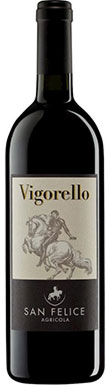
The 2010 vintage was regular, with rainfall at the right time and an ideal ripening period, according to Leonardo Bellaccini, winemaker at San Felice since...
2010
San FeliceToscana
San Felice, Vigorello, Toscana, Tuscany, Italy, 2015
Another warm vintage but here the Cabernet Sauvignon from sandy soils is remarkable. The grape should be very ripe to produce a Vigorello more elegant...
2015
San FeliceToscana
San Felice, Vigorello, Toscana, Tuscany, Italy, 2017
The patchwork of San Felice soils, within the Castelnuovo Berardenga municipality, usually allows the estate to achieve consistent wines even in difficult vintages. This part...
2017
San FeliceToscana
San Felice, Vigorello, Toscana, Tuscany, Italy, 2018
The 35% of Pugnitello - a thick-skinned grape planted in Alberese chalky soil - gives this vintage a bracing character, while Cabernet Sauvignon and Merlot...
2018
San FeliceToscana
