Walls: A vertical of a great Cornas cuvée
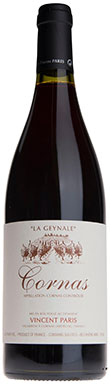
La Geynale by Vincent Paris is one of the great cuvées of Cornas says Matt Walls, who recently assessed a small vertical of recent vintages.


A tasting note is a written record of an encounter with a wine. Sometimes the meeting is brief; you shake hands and move on.
But occasionally you become embroiled. Words spread across the page and spill down it, there is so much to say. Even before you’ve had time to draw any conclusions, you know you’re in the presence of something special.
Vincent Paris’ La Geynale from the hillside of Cornas, is reliably one such wine.
Scroll down to see notes and scores for Vincent Paris’ La Geynale
When young, it’s a roaring black hole, massive, dense, drawing you in. A wine so assertive it seems to taste you as much as you taste it.
I visited Vincent Paris one grey spring morning to taste nine early vintages to see how they are developing – and whether any vintages of this famously long-lived wine are ready to drink yet.
A Cornas grand cru
Like dogs and their owners, sometimes wines embody the winemaker. But not here. Paris cuts a lean figure, he’s reserved, and doesn’t waste words.
He doesn’t seek the limelight – he’s happy to let the place do the talking. And what a place it is.
The granite slopes of the Northern Rhône can be steep and jagged, but Cornas is particularly chaotic.
Though the heart of the appellation is essentially east-facing, thanks to the streams that cut down from the plateau above, there are some south-facing vineyards.
Reynard – the greatest lieu-dit of them all – is one of them. Paris says La Geynale isn’t technically a lieu-dit itself – it’s just the name given to the eastern flank of Reynard.
‘It’s the hottest terroir in Cornas,’ says Paris, and very dry with it. His cuvée La Geynale comes principally from a 1ha parcel from this side of the hill, hence the name – but it also contains 0.3ha of Reynard.
Generational transition
When Paris’ great-grandfather replanted the site in 1910 after phylloxera, he included a few white vines.
But when the appellation was officially ratified in 1938, it was agreed that Cornas must be 100% Syrah.
‘You still find a few white grapes to eat during harvest,’ notes Paris.
It was his uncle, the great Robert Michel, who tended the site for 40 years before Paris. Michel trained some of Cornas leading winemakers, including Guillaume Gilles, Thierry Allemand, and Paris himself.
Paris’ parents weren’t winemakers, so establishing his own estate was a struggle. Thankfully his grandfather bequeathed him a hectare of Cornas vines in 1997, which gave him a crucial foothold.
After Michel’s last vintage in 2006, he decided to sell his vineyards, and he gave Paris first refusal on his parcel of La Geynale. Naturally Paris was keen – but the price of land had risen to €500,000 per hectare.
‘The bank said no to begin with,’ says Paris, so he reached out to investors – mostly other wine professionals. Having successfully reached his target, his first vintage of La Geynale was 2007.
Sticking to tradition
Paris says he’s tasted 30-year-old bottles of Michel’s La Geynale that were still in great shape, and this has convinced him to keep to similar methods.
‘I wanted to keep my uncle’s ways, so it’s still whole bunch,’ he says. ‘With climate change it’s much better, because when you ferment with the stalks it reduces alcohol by around 0.5%. And the vegetal side brings freshness and a menthol note.’
He continues to use indigenous yeasts, ferments in concrete tanks, and matures the wines in three to eight-year-old barriques and demi-muids for a year or more.
He makes two other Cornas cuvées – Granit 30 and Granit 60, the numbers referring to the steepness of the slopes where the grapes are grown.
But La Geynale is his top cuvée, amounting to just 5,000 bottles a year on average.
The tasting
Paris generously opened bottles of all the vintages of La Geynale he had in his cellar – there was no more stock of the earlier-drinking 2008, 2014 and 2016.
Despite their concentration and intensity, three of them are already good to go – including the oldest (2007) and – more surprisingly – the youngest (2018).
He didn’t add any sulfites in 2007 and 2008, and the 2007 certainly stands out for its wild side.
The bottle we tasted was a touch volatile and had an animal aroma that later vintages didn’t share. It also had more marked acidity and drier tannins, which is likely down to the vintage.
It nonetheless offered complexity and enjoyment, but the 2009 and 2010 were a big step up, even if neither were ready to drink.
These are both great vintages in Cornas, and the 2010 in particular is a phenomenal wine. It displayed the classic markers of the greatest Cornas: aromatically, it brimmed with smoke, slate and menthol.
Texturally it was bristling with the angular, pointed tannins that make Cornas such a physical experience.
One of the great cuvées
Another great vintage was 2015, which will be no great shock – an exceptional vintage in the Northern Rhône.
What might be more surprising is the quality of the 2013 – not usually considered a brilliant vintage, but Paris made an involving wine with freshness and finesse.
Cornas usually takes many years for its tannins to soften, but the exception is 2018 – these are delicious young, even from traditional estates such as Paris and Clape.
A couple of vintages (2011, 2017) showed a gamey side that some wine lovers might find off-putting, but in neither case did it dominate the wine.
But for this reason, I would consider drinking these two sooner rather than later.
This tasting confirmed what I’ve long felt about Vincent Paris’ La Geynale: it is one of the great Cornas cuvées, classically styled, with awesome longevity in good vintages.
And while some other estates’ top wines have become stratospherically expensive, La Geynale remains relatively affordable.
It reminded me that a great wine can tell you a lot – about a place, its history, a family, tradition, ideas of beauty and the passing of time. It’s the kind of encounter you don’t forget in a hurry.
Vincent Paris, Cornas, La Geynale vertical
Related articles
- Walls: Chasing freshness in Ventoux
- Walls: M Chapoutier Hermitage Monier de la Sizeranne vertical
- Walls: M Chapoutier Sélections Parcellaires 2023 tasting
Domaine Vincent Paris, La Geynale, Cornas, Rhône, France, 2010
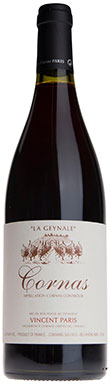

Plentiful menthol and camphor notes emerge with air, along with hot slate and graphite. Very powerful palate, full-bodied, rich in fruit, very pure, still so vibrant and expressive. A great upswell of ripe, powerful, slightly angular tannins, surging acidity, ripe blackberry fruit that still tastes so youthful. Quite closed on the nose still in 2024, like so many 2010s. This is exceptionally young still. It's highly impressive to taste now, and certainly delivers pleasure and a feeling of awe, but this has so much more to give. So fresh, so mineral. Hundred-year-old vines. No destemming. Five-day cold maceration, then fermented with wild yeasts. Twice daily remontage, no punching down, then aged for 12-16 months in two- to 8-year-old barriques. Grown on the granite slopes of lieu-dit La Geynale, one of the finest of the appellation.
2010
Domaine Vincent ParisCornas

Domaine Vincent Paris, La Geynale, Cornas, Rhône, France, 2015
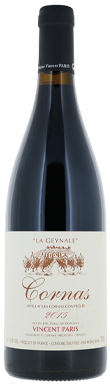
Still very darkly coloured, quite closed, the aromas descend again after swirling. Intense graphite, petrichor and blackcurrant. Full-bodied, with lovely sweet fruit, very elegant tannins, so concentrated but so light on its feet. The acidity isn't high, but it's well balanced, everything here is in place. Definitely a vintage to buy, then to keep, until at least 2029, then to drink over the decades. 'A hot year. But the vines didn't suffer, there were no blockages,' says Vincent Paris. Hundred-year-old vines. No destemming. Five-day cold maceration, then fermented with wild yeasts. Twice daily remontage, no punching down, then aged for 12-16 months in two- to 8-year-old barriques. Grown on the granite slopes of lieu-dit La Geynale, one of the finest of the appellation.
2015
Domaine Vincent ParisCornas
Domaine Vincent Paris, La Geynale, Cornas, Rhône, France, 2013
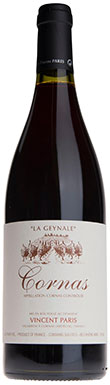
Graphite, fine balsamic touches, sticky plum sauce – moving out of fruit into something else. Full-bodied, this has impressive density. Great tannic swell on the finish however, and stone-licking dry tannic freshness on the tongue. Surprisingly fine tannins for the vintage, and finishes with menthol and smoke. Still in a slightly truculent phase aromatically – not quite out of its chrysalis yet – this is a great Geynale in the making, but still needs time to express itself. A very involving wine with great character. Hundred-year-old vines. No destemming. Five-day cold maceration, then fermented with wild yeasts. Twice daily remontage, no punching down, then aged for 12-16 months in two- to 8-year-old barriques. Grown on the granite slopes of lieu-dit La Geynale, one of the finest of the appellation.
2013
Domaine Vincent ParisCornas
Domaine Vincent Paris, La Geynale, Cornas, Rhône, France, 2012
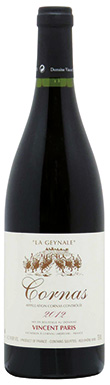
Very easy to drink and like, a wine with lovely freshness and good fruit still – raspberry and blackberry inlaid with menthol and some spicy peppery hints. Very elegant, succulent tannins, harmonious, with good length. A particularly friendly and approachable Geynale, but still a genuine, authentic Cornas with freshness, impact, and those characteristic slightly angular, cleansing tannins. Fruitiness into the finish. Hundred-year-old vines. No destemming. Five-day cold maceration, then fermented with wild yeasts. Twice daily remontage, no punching down, then aged for 12-16 months in two- to 8-year-old barriques. Grown on the granite slopes of lieu-dit La Geynale, one of the finest of the appellation.
2012
Domaine Vincent ParisCornas
Domaine Vincent Paris, La Geynale, Cornas, Rhône, France, 2018
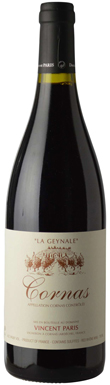
Deeply coloured. Fresh, fruity, vibrant and open, with blackberry coulis and violets. Little touch of balsamic too on the nose that makes you salivate. Herbal elements and any oak very much in the background – surprisingly ready. Not overly full-bodied, it's rich in fruit, ripe, with elegant tannins and good acidity. Good length. Has some Cornas salinity, and the tannins are surprisingly soft and approachable. Drinkable now, but will improve into the medium term. But why wait! Hundred-year-old vines. No destemming. Five-day cold maceration, then fermented with wild yeasts. Twice daily remontage, no punching down, then aged for 12-16 months in two- to 8-year-old barriques. Grown on the granite slopes of lieu-dit La Geynale, one of the finest of the appellation.
2018
Domaine Vincent ParisCornas
Domaine Vincent Paris, La Geynale, Cornas, Rhône, France, 2017
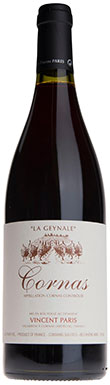
Surprisingly open aromatically, with some vibrant rosemary scents, animal notes as well. Fairly full-bodied, it has a good sense of density on the palate, with a firm tannic base. Really quite meaty, there's possibly a touch of brett hiding here, so perhaps don't wait too long. But it has freshness, intensity – and great length. Big tannic presence, not as elegant as some vintages though it was, 'not a terribly hot summer', according to Vincent Paris. Hundred-year-old vines. No destemming. Five-day cold maceration, then fermented with wild yeasts. Twice daily remontage, no punching down, then aged for 12-16 months in two- to 8-year-old barriques. Grown on the granite slopes of lieu-dit La Geynale, one of the finest of the appellation.
2017
Domaine Vincent ParisCornas
Domaine Vincent Paris, La Geynale, Cornas, Rhône, France, 2011
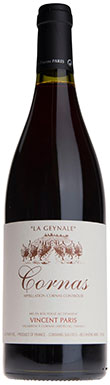
Dark in the glass still but not opaque. Doesn't quite have the clarity of expression of other recent vintages, aromatically it's not quite so defined, but has an enjoyably bloody balsamic note, and a gamey, animal side. Full-bodied, earthy, gamey, a bit horsey perhaps. Certainly interesting and complex, with robust but not excessive tannins, but the gaminess might be off-putting to some. 'It's a nice vintage, no problems with the climate, but it was put in the shadow a bit by 2010,' says Vincent Paris. Hundred-year-old vines. No destemming. Five-day cold maceration, then fermented with wild yeasts. Twice daily remontage, no punching down, then aged for 12-16 months in two- to 8-year-old barriques. Grown on the granite slopes of lieu-dit La Geynale, one of the finest of the appellation.
2011
Domaine Vincent ParisCornas
Domaine Vincent Paris, La Geynale, Cornas, Rhône, France, 2009
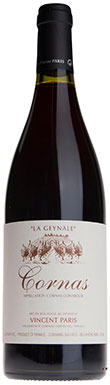
Very closed and backward still. Very powerful, very dense. Really slow-moving on the palate, the acidity is there, and tannins are tough, chewy, dense, thick – they will need a very long time to soften. Fortunately the fruit is still fresh, it has energy and vitality. It's not as elegant as some of his more recent vintages, but has great force and natural muscle. 'A very dry year, that resulted in some very hard tannins,' says Vincent. Old school Cornas for masochists! Hundred-year-old vines. No destemming. Grown on the granite slopes of lieu-dit La Geynale, one of the finest of the appellation.
2009
Domaine Vincent ParisCornas
Domaine Vincent Paris, La Geynale, Cornas, Rhône, France, 2007
Really quite animal in aroma, with a white pepper note – quite volatile. Very herbal, with dusty oregano and thyme. Bloody too. Only medium-bodied, it's quite different to the other vintages of this cuvée, with higher acidity, and drier tannins. The animal note is a touch off-putting, but this is very much an old-school Cornas that has plenty of earthy and savoury complexity. Fully mature now, but no rush to drink. A vintage, like 2008, when winemaker Vincent Paris added no sulphur. He does now, and the results are better. Hundred-year-old vines. No destemming. Grown on the granite slopes of lieu-dit La Geynale, one of the finest of the appellation.
2007
Domaine Vincent ParisCornas
